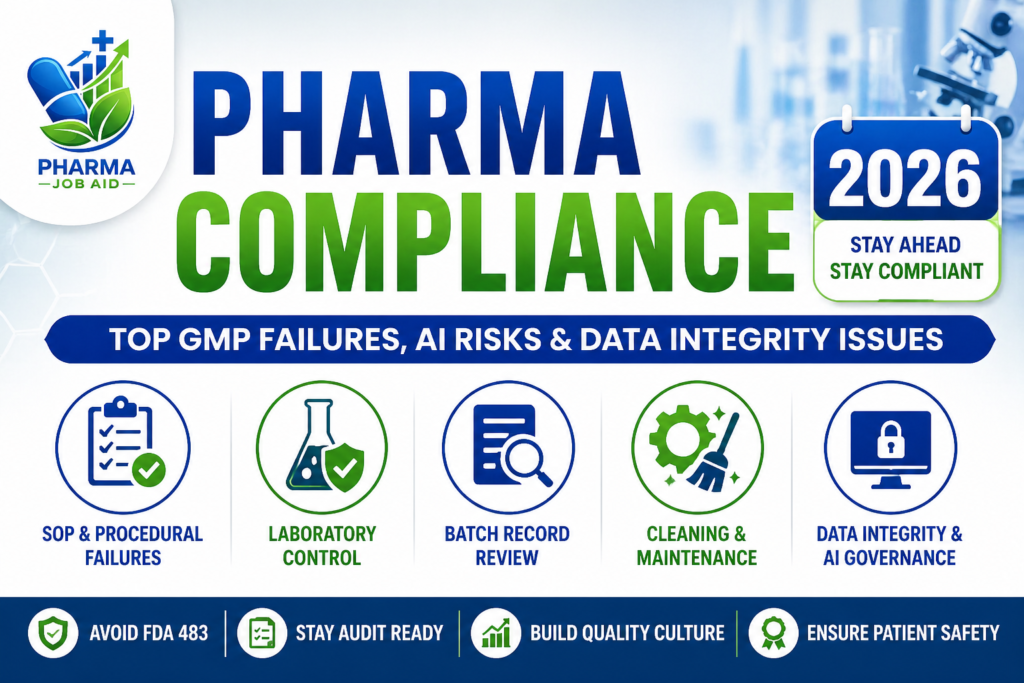
In 2026, pharmaceutical compliance is no longer limited to traditional GMP documentation. Regulators globally are focusing on data integrity, AI governance, digital quality systems, contamination control, laboratory reliability, batch release justification, and supply-chain oversight.
The core message is clear: a pharmaceutical company must prove that every quality decision is scientifically justified, traceable, and independently verified.
1. SOP Deficiency and Failure to Follow Procedures
SOP failure remains one of the most common compliance problems. In 2026, regulators expect SOPs to be more than approved documents. They must be practical, version-controlled, trained, implemented, and followed consistently.
A major 2026 concern is the use of AI-generated GMP documents without scientific review. Companies may use AI to draft SOPs or procedures, but the Quality Unit must verify accuracy, regulatory suitability, and site-specific applicability.
Example
A company generates a cleaning SOP using AI. The SOP includes generic cleaning steps but does not mention actual equipment design, product residue risk, cleaning agent concentration, hold time, swab location, or acceptance criteria.
This becomes a GMP failure because the procedure is not scientifically justified.
Expected CAPA
The company should establish an AI-use procedure, require QA and SME review for all AI-assisted GMP documents, perform risk assessment, and retrain users on document control expectations.
2. Weak Laboratory Controls
Laboratory control failures remain a serious inspection issue. Regulators expect scientifically sound specifications, validated analytical methods, calibrated instruments, controlled reference standards, complete raw data, and proper handling of OOS/OOT results.
In 2026, laboratories are under increased pressure because many systems are now digital. Regulators expect audit trail review, restricted access, proper data backup, and full traceability of every analytical result.
Example
An HPLC result initially fails specification. The analyst repeats the test and reports only the passing result without investigating the original failure.
This is not acceptable. It indicates possible testing into compliance, poor data integrity, and weak laboratory governance.
Expected CAPA
The company should initiate an OOS investigation, review raw data and audit trail, assess method performance, evaluate analyst technique, and define preventive actions to stop selective reporting.
3. Poor Batch Record Review and Incomplete Investigation
Batch record review is not just a documentation activity. It is a critical quality decision step before batch release. Regulators expect the Quality Unit to identify discrepancies, yield variation, missing signatures, incomplete logbooks, unexplained alarms, rejected units, and any abnormal trend before batch disposition.
Example
A batch shows higher-than-expected yield. The production team considers it positive because there is no low yield or rejection. However, high yield may indicate weighing error, incorrect reconciliation, mix-up, unrecorded rework, or calculation error.
Expected CAPA
The company should perform mass balance verification, review dispensing records, check equipment calibration, reconcile issued versus consumed materials, and update the batch review checklist to include both low-yield and high-yield alerts.
4. Cleaning, Maintenance, and Contamination Control Failures
Cleaning and maintenance failures directly affect product safety. Regulators expect companies to prove that equipment is cleaned, maintained, inspected, and released before use.
In 2026, contamination control is viewed as a lifecycle system, not only a cleaning validation report. Companies must monitor cleaning effectiveness, equipment condition, residue risk, preventive maintenance, and operator behavior.
Example
A shared manufacturing line is used for multiple products. Cleaning is recorded in the logbook, but swab results are not reviewed before the next product starts.
This creates cross-contamination risk.
Expected CAPA
The company should introduce cleaning verification hold points, QA release before equipment use, defined dirty/clean hold times, periodic residue trend review, and preventive maintenance linkage with cleaning status.
5. Computerized System and Data Integrity Failure
Computerized systems are now central to GMP operations. Regulators expect validated systems, controlled access, audit trails, backup, disaster recovery, electronic signatures, and periodic review.
In 2026, this area also includes AI tools, electronic batch records, LIMS, cloud QMS, ERP, Excel sheets, and laboratory instruments.
Example
A shared login is used for laboratory software. Multiple analysts can change sample data using the same username.
This destroys data traceability and violates basic data integrity principles.
Expected CAPA
The company should disable shared login, assign individual user access, review audit trails, validate user privileges, train staff on ALCOA+ principles, and perform periodic data integrity audits.
6. Supplier and Material Control Weakness
Supplier control is becoming more important due to global supply-chain disruptions, API shortages, counterfeit material risk, and outsourced manufacturing. Regulators expect companies to qualify suppliers, monitor performance, review quality agreements, and investigate supplier-related deviations.
Example
An API supplier changes the manufacturing site or process, but the finished product manufacturer continues using the material without proper change control.
This may affect impurity profile, residual solvents, particle size, stability, or bioavailability.
Expected CAPA
The company should perform supplier change assessment, update quality agreement, request regulatory documents, evaluate impact on registered dossier, perform confirmatory testing, and notify regulators if required.
7. Inadequate CAPA Effectiveness
In 2026, closing CAPA is not enough. Regulators expect proof that CAPA worked. Many companies fail because they write corrective actions but do not verify long-term effectiveness.
Example
A company identifies repeated documentation errors in batch records. CAPA states “retraining completed.” Three months later, the same error repeats.
This means the CAPA was ineffective.
Expected CAPA
Instead of only retraining, the company should revise the form design, add mandatory review checkpoints, simplify instructions, introduce error-proofing, and verify effectiveness through batch record review trend data.
2026 Compliance Takeaway
The biggest global compliance risks in 2026 are:
| Area | Main Risk |
|---|---|
| SOP | Written but not followed |
| Laboratory | Data not scientifically reliable |
| Batch Record | Discrepancies not investigated |
| Cleaning | Contamination risk not controlled |
| Computerized System | Data integrity failure |
| Supplier | Uncontrolled external risk |
| CAPA | Action closed without effectiveness |
Final Message
In 2026, pharmaceutical compliance means evidence-based quality control. A company must not only perform GMP activities, but also prove that each activity was controlled, reviewed, justified, and traceable.
Modern GMP is no longer paperwork-based. It is risk-based, data-driven, and accountability-focused.