🔬 Overview of Drug Development Lifecycle
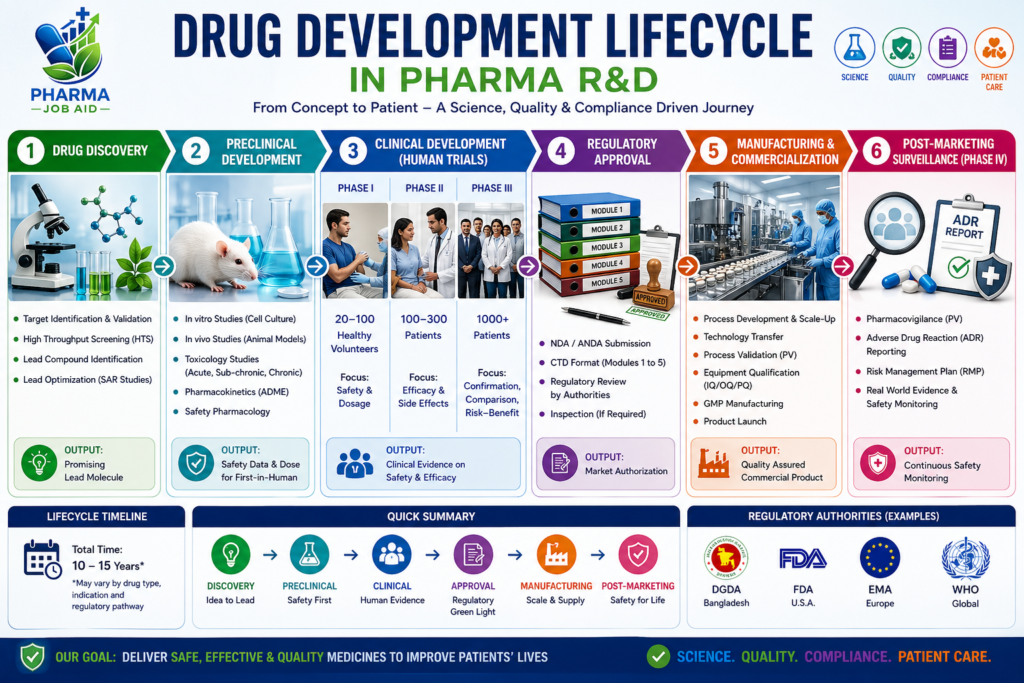
The drug development lifecycle is a highly structured, scientific, and regulatory-driven process that transforms a new chemical entity (NCE) or biological molecule into a safe, effective, and marketable pharmaceutical product. In Bangladesh, this lifecycle aligns with DGDA GMP guidelines, WHO standards, and international regulatory frameworks like U.S. Food and Drug Administration and European Medicines Agency.
This lifecycle typically spans 10–15 years and involves multidisciplinary collaboration across R&D, QA, QC, Regulatory Affairs, Production, and Clinical Teams.
🧪 1. Drug Discovery Phase


7
The lifecycle begins with drug discovery, where researchers identify potential therapeutic targets and compounds.
Key Activities:
- Target Identification & Validation
- Lead Compound Identification (HTS Screening)
- Lead Optimization (Structure-Activity Relationship)
Output:
- A promising candidate molecule with biological activity.
Bangladesh Context:
Local pharma R&D units (e.g., in Beximco, Square) focus more on generic development, but innovation is gradually increasing.
⚗️ 2. Preclinical Development


5
Before human testing, the drug undergoes preclinical evaluation.
Key Studies:
- In vitro testing (cell culture)
- In vivo studies (animal models)
- Toxicology (acute, sub-chronic, chronic)
- Pharmacokinetics (ADME)
Objective:
Ensure safety profile and determine starting dose for humans.
Regulatory Submission:
- Investigational New Drug (IND) application submitted to authorities like U.S. Food and Drug Administration.
👨⚕️ 3. Clinical Development (Human Trials)


6
Clinical trials are conducted in three main phases to evaluate safety and efficacy in humans.
Phase I:
- Small group (20–100 healthy volunteers)
- Focus: Safety & Dosage
Phase II:
- 100–300 patients
- Focus: Efficacy & Side Effects
Phase III:
- 1000+ patients
- Focus: Confirmation, Comparison, Risk-Benefit
Bangladesh Scenario:
Clinical trials are growing under DGDA supervision, especially in collaboration with global CROs.
📑 4. Regulatory Approval


6
After successful clinical trials, a comprehensive dossier is submitted.
Major Submissions:
- NDA (New Drug Application)
- ANDA (for generics)
CTD Format:
- Module 1: Administrative
- Module 2: Summary
- Module 3: Quality (CMC)
- Module 4: Non-clinical
- Module 5: Clinical
Authorities:
- Directorate General of Drug Administration
- European Medicines Agency
- U.S. Food and Drug Administration
🏭 5. Manufacturing & Commercialization


6
Once approved, the drug enters large-scale manufacturing.
Key Elements:
- Process Validation (PV)
- Equipment Qualification (IQ/OQ/PQ)
- GMP Compliance
- Technology Transfer from R&D to Production
Bangladesh GMP Focus:
- Strict adherence to WHO GMP & DGDA inspection requirements
- Documentation: BMR, BPR, SOPs
📊 6. Post-Marketing Surveillance (Phase IV)


6
Even after approval, continuous monitoring ensures long-term safety.
Activities:
- Pharmacovigilance (PV)
- Adverse Drug Reaction (ADR) Reporting
- Risk Management Plan (RMP)
Importance:
Detect rare or long-term side effects not seen in trials.
🔁 Integrated Lifecycle Flow (Quick Summary)
| Stage | Key Output | Regulatory Link |
|---|---|---|
| Discovery | Lead Molecule | Research |
| Preclinical | Safety Data | IND |
| Clinical | Efficacy & Safety | NDA |
| Approval | Market Authorization | DGDA/FDA |
| Manufacturing | Commercial Product | GMP |
| Post-Marketing | Safety Monitoring | PV System |
📌 Final Insight (PharmaJobAid Perspective)
The drug development lifecycle is not just a scientific journey—it is a compliance-driven system where quality, safety, and documentation are critical at every stage. For professionals in Bangladesh’s pharmaceutical industry, understanding this lifecycle is essential for roles in:
- QA / QMS
- Regulatory Affairs
- Production & Validation
- Clinical Research
With the expansion of Bangladesh’s pharma sector and increasing global exports, mastering this lifecycle aligned with DGDA and WHO GMP standards will significantly enhance career opportunities.