
Introduction to HVAC Validation
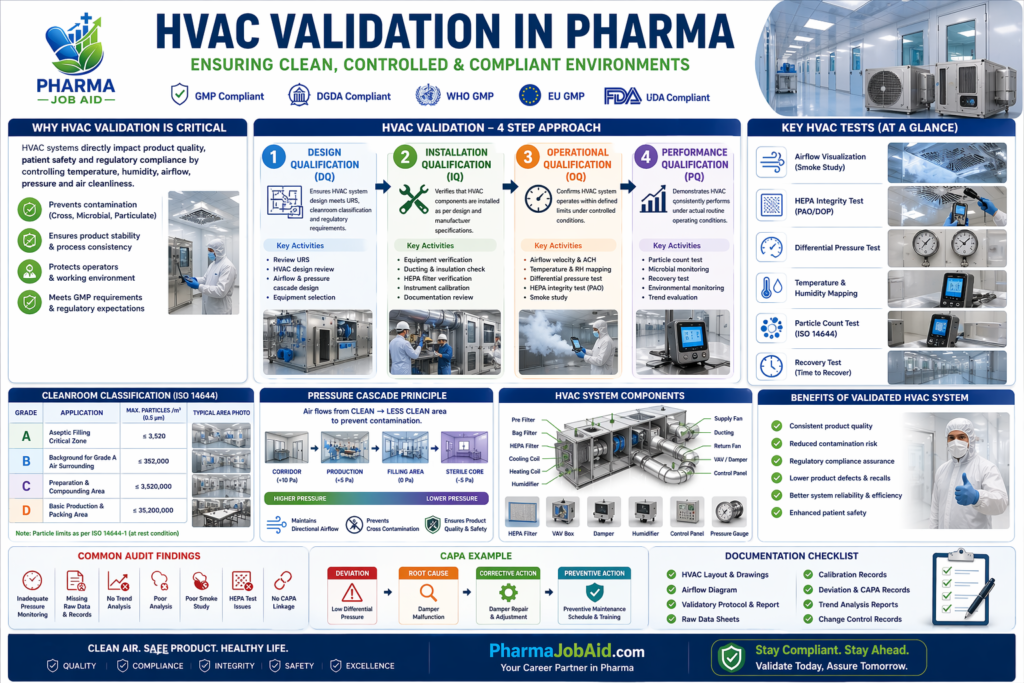
HVAC (Heating, Ventilation, and Air Conditioning) validation in the pharmaceutical industry is a systematic, documented approach to ensure that air handling systems consistently maintain the required environmental conditions for manufacturing. These conditions include temperature, relative humidity, airflow velocity, air cleanliness, and differential pressure. In pharmaceutical facilities, especially those producing sterile and non-sterile dosage forms, HVAC systems are not merely for comfort—they are a critical quality control mechanism. Regulatory bodies like the Directorate General of Drug Administration (DGDA) consider HVAC validation a fundamental requirement during inspections, as it directly affects product quality, patient safety, and compliance with GMP standards.
Importance of HVAC Validation in GMP Compliance
HVAC validation plays a central role in maintaining Good Manufacturing Practices (GMP). It ensures that contamination—whether particulate, microbial, or cross-product—is effectively controlled. In sterile manufacturing, improper airflow or filtration can lead to microbial contamination, while in solid dosage facilities, poor air control can result in cross-contamination between products. HVAC systems also protect operators and maintain consistent processing conditions. Therefore, validation provides documented evidence that the system performs reliably within predefined acceptance criteria, aligning with WHO GMP, EU GMP Annex 1, and US FDA expectations.
Components of a Pharmaceutical HVAC System
A typical pharmaceutical HVAC system consists of several interconnected components working together to control the environment. The Air Handling Unit (AHU) is the core, responsible for air filtration, heating, cooling, and circulation. HEPA filters are installed to remove fine particles and microorganisms, especially in cleanroom environments. Ducting systems distribute conditioned air across different production zones, while return air systems help maintain circulation efficiency. Differential pressure gauges ensure proper pressure cascades between rooms, preventing contamination flow. Additional elements like airlocks, pass boxes, and control systems further enhance environmental control and segregation.
Stages of HVAC Validation (DQ, IQ, OQ, PQ)
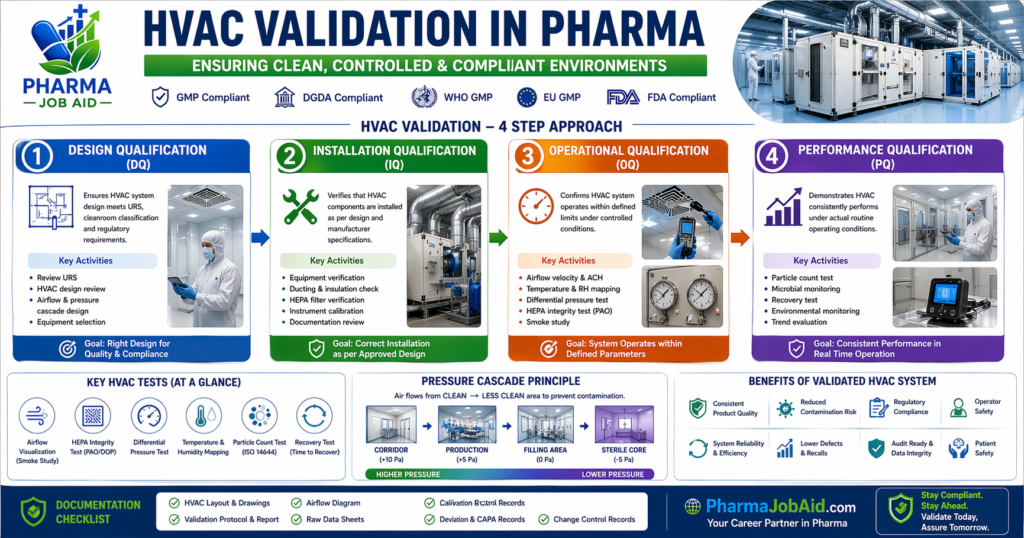
HVAC validation follows a lifecycle approach starting with Design Qualification (DQ), where the system design is verified against user requirements and regulatory expectations. Installation Qualification (IQ) confirms that all components, such as AHUs, filters, and ducting, are installed correctly and according to design specifications. Operational Qualification (OQ) evaluates whether the system operates within defined limits, including airflow rates, temperature, and humidity control. Finally, Performance Qualification (PQ) demonstrates that the HVAC system performs effectively under actual operating conditions, supported by environmental monitoring data such as particle counts and microbial levels.
Critical HVAC Validation Tests
Several critical tests are conducted during HVAC validation to confirm system performance. Airflow velocity and air change per hour (ACH) measurements ensure adequate air circulation in cleanrooms. HEPA filter integrity testing, commonly performed using PAO/DOP methods, verifies that filters are leak-free and functioning efficiently. Differential pressure testing confirms the correct pressure cascade, ensuring airflow moves from cleaner to less clean areas. Temperature and humidity mapping assess environmental stability, which is particularly important for moisture-sensitive products like tablets and capsules. Smoke studies provide visual confirmation of airflow patterns, especially in aseptic areas, while particle count testing ensures compliance with ISO cleanroom standards. Recovery tests evaluate how quickly a cleanroom returns to its specified condition after disturbance.
Cleanroom Classification and HVAC Role
Cleanroom classification is directly linked to HVAC performance. Pharmaceutical cleanrooms are categorized into Grade A, B, C, and D based on cleanliness levels. Grade A areas, used for critical operations like aseptic filling, require the highest level of air cleanliness and laminar airflow. Grade B serves as the background environment for Grade A zones. Grades C and D are used for less critical stages of production. The HVAC system must be designed and validated to consistently maintain these classifications, ensuring that particle counts and microbial levels remain within acceptable limits.
HVAC Validation Protocol and Documentation
A well-structured HVAC validation protocol is essential for regulatory compliance. The protocol should clearly define the objective, scope, system description, test procedures, and acceptance criteria. It must include sampling plans, data recording formats, and deviation handling procedures. All activities should follow Good Documentation Practice (GDocP), ensuring data integrity and traceability. The final validation report should summarize results, highlight any deviations, and confirm whether the system meets predefined criteria. Approval by QA, engineering, and authorized personnel is mandatory to ensure accountability.
Revalidation and Change Control
HVAC systems require periodic revalidation to ensure continued performance. Revalidation is necessary after major system modifications, HEPA filter replacements, significant maintenance activities, or facility layout changes. Even without changes, periodic requalification—typically annually—is recommended. Change control procedures must be strictly followed to assess the impact of any modification on the validated state of the HVAC system, ensuring compliance is maintained at all times.
Common Audit Findings in Pharmaceutical HVAC Systems
Regulatory inspections often reveal recurring deficiencies in HVAC validation. These include inadequate monitoring of differential pressure, incomplete documentation, lack of trend analysis for environmental data, and improper execution of smoke studies. In some cases, HEPA filter integrity testing is either not performed correctly or not documented properly. Another common issue is the absence of effective Corrective and Preventive Actions (CAPA) for environmental deviations. Addressing these gaps is essential for maintaining audit readiness, particularly for DGDA and international regulatory inspections.
HVAC Validation vs Environmental Monitoring
While HVAC validation and environmental monitoring are closely related, they serve different purposes. HVAC validation is a periodic qualification activity that verifies system performance, whereas environmental monitoring is a routine process that continuously assesses cleanroom conditions. Validation focuses on engineering parameters, while monitoring emphasises microbiological and particulate control. Together, they form a comprehensive system to ensure consistent environmental quality in pharmaceutical manufacturing.
Risk-Based HVAC Validation Approach (ICH Q9 Aligned)
Modern pharmaceutical quality systems emphasize a risk-based approach to HVAC validation. Instead of treating all areas equally, validation efforts are prioritized based on product risk, process criticality, and contamination potential. For example, sterile injectable manufacturing areas (Grade A/B) require the highest level of control, whereas secondary packing areas (Grade D) may have less stringent requirements. Risk assessment tools such as FMEA (Failure Mode and Effects Analysis) are commonly used to identify critical parameters like airflow, pressure differentials, and filtration efficiency. By focusing validation activities on high-risk zones, pharmaceutical companies can optimize resources while maintaining compliance with GMP expectations and ensuring patient safety.
Pressure Cascade Concept and Contamination Control
One of the most critical design principles in HVAC systems is the pressure cascade. This ensures that air always flows from cleaner areas to less clean areas, thereby preventing contamination ingress. In sterile facilities, a positive pressure gradient is maintained from the aseptic core outward, whereas in facilities handling potent or hazardous materials (e.g., hormones, cytotoxics), a negative pressure regime is applied to protect operators and prevent product escape. Proper validation of pressure differentials—typically monitored using calibrated magnehelic gauges or digital sensors—is essential. Even minor fluctuations can compromise the cleanroom classification and lead to regulatory observations.
Airflow Patterns and Laminar Flow Systems
Airflow pattern validation is particularly important in aseptic manufacturing. Laminar airflow systems are designed to provide a unidirectional airflow, usually at a velocity of 0.36–0.54 m/s, to sweep away contaminants from critical zones. Smoke studies are conducted to visualize airflow patterns and confirm that there is no turbulence or dead space that could harbor contaminants. These studies are often video-recorded and reviewed during audits. A well-executed smoke study not only demonstrates compliance but also provides strong visual evidence of contamination control effectiveness.
HEPA Filter Lifecycle Management
HEPA filters are the backbone of cleanroom air quality, and their lifecycle management is a crucial aspect of HVAC validation. Filters must be selected based on efficiency ratings (typically 99.97% for 0.3 microns) and installed with proper sealing to prevent bypass leakage. Routine integrity testing using PAO (Poly Alpha Olefin) ensures that filters remain effective over time. Additionally, differential pressure across filters is monitored to determine loading and replacement intervals. Improper handling or delayed replacement of HEPA filters can lead to contamination risks and non-compliance during inspections.
Integration with Environmental Monitoring Systems (EMS)
A robust HVAC validation program is closely integrated with the Environmental Monitoring System (EMS). While validation confirms system capability, EMS provides real-time assurance of ongoing performance. Data from particle counters, microbial sampling, temperature sensors, and humidity probes are continuously collected and trended. Advanced systems use automated alarms to notify deviations in critical parameters, enabling immediate corrective actions. Trend analysis of EMS data is particularly important for identifying gradual system deterioration and supporting continuous improvement initiatives.
Energy Efficiency and Sustainable HVAC Practices
With increasing emphasis on sustainability, pharmaceutical companies are now integrating energy-efficient HVAC designs without compromising GMP compliance. Variable frequency drives (VFDs), energy recovery systems, and optimized air change rates are being implemented to reduce energy consumption. However, any modification aimed at improving efficiency must undergo proper change control and revalidation to ensure that it does not negatively impact cleanroom performance. Balancing energy efficiency with regulatory compliance is becoming a key challenge and opportunity in modern pharmaceutical engineering.
Digitalization and Smart HVAC Systems (Pharma 4.0)
The concept of Pharma 4.0, promoted by organizations like International Society for Pharmaceutical Engineering, is transforming HVAC validation through digitalization. Smart HVAC systems now incorporate IoT sensors, real-time monitoring dashboards, and predictive analytics. These technologies enable proactive maintenance, early detection of system deviations, and enhanced data integrity. डिजिटल validation records and automated reporting systems also improve audit readiness by ensuring traceability and compliance with data integrity principles such as ALCOA+ (Attributable, Legible, Contemporaneous, Original, Accurate).
HVAC Validation in Different Dosage Forms
The requirements of HVAC validation vary depending on the type of pharmaceutical product being manufactured. In solid dosage forms like tablets and capsules, the focus is on dust control, temperature, and humidity regulation to ensure product stability and prevent cross-contamination. In liquid and semi-solid manufacturing, microbial control becomes more critical. Sterile manufacturing demands the highest level of HVAC performance, including strict control of airflow, filtration, and environmental monitoring. Understanding these differences is essential for designing and validating HVAC systems that are fit for purpose.
Regulatory Expectations and Global Harmonization
Global regulatory agencies have aligned their expectations regarding HVAC validation. WHO GMP guidelines provide a broad framework applicable to developing countries, including Bangladesh. EU GMP Annex 1 offers detailed requirements for sterile manufacturing, emphasizing contamination control strategies. The US FDA, under 21 CFR Part 211, requires adequate environmental control systems to ensure product quality. Harmonization of these guidelines allows pharmaceutical companies to adopt a unified validation approach, facilitating international market access and regulatory approvals.
Advanced Documentation and Data Integrity Practices
In the current regulatory landscape, documentation is as important as the validation itself. All HVAC validation activities must be recorded with complete traceability, including raw data, calibration records, and deviation reports. इलेक्ट्रॉनिक data management systems are increasingly being used to maintain data integrity and prevent manipulation. Audit trails, electronic signatures, and secure data storage are essential features of modern validation documentation systems. Regulatory inspectors pay close attention to data integrity, and any gaps can lead to serious compliance issues.
Continuous Improvement and Lifecycle Management
HVAC validation should not be viewed as a one-time activity but as part of a continuous lifecycle management process. Ongoing monitoring, periodic reviews, and trend analysis help identify opportunities for improvement. CAPA systems play a vital role in addressing deviations and preventing recurrence. Management review meetings (MRM), as per GMP requirements, should include HVAC performance as a key agenda item. This ensures that top management remains informed and committed to maintaining a state of control.
Practical Industry Insight
In many Bangladeshi pharmaceutical facilities, HVAC validation is often challenged by issues such as power fluctuations, maintenance delays, and limited automation. However, leading companies are increasingly adopting global best practices, including automated monitoring systems and risk-based validation approaches. Preparing for DGDA inspections requires not only technical compliance but also strong documentation, trained personnel, and a culture of quality. Facilities that invest in robust HVAC validation systems are better positioned to achieve international certifications and expand into export markets.
HVAC Validation Lifecycle
HVAC validation in pharmaceutical facilities follows a structured lifecycle approach, ensuring that the system is designed, installed, tested, and continuously monitored under GMP compliance. This lifecycle is not linear—it is a closed-loop system integrated with change control, CAPA, and environmental monitoring.
Below is a DGDA/GMP-aligned HVAC Validation Flowchart presented in a clear, audit-ready format:
🔷 HVAC Validation Flowchart (GMP Lifecycle)
User Requirement Specification (URS)
                ↓
Design Qualification (DQ)
                ↓
Installation Qualification (IQ)
                ↓
Operational Qualification (OQ)
                ↓
Performance Qualification (PQ)
                ↓
Validation Report Approval (QA + Engineering + QA Head)
                ↓
Routine Environmental Monitoring (EMS)
                ↓
Trend Analysis & Data Review
                ↓
Deviation Identification
                ↓
Root Cause Analysis (Fishbone + 5 Why)
                ↓
CAPA Implementation
                ↓
Change Control (if required)
                ↓
Revalidation / Periodic Review
                ↓
Management Review Meeting (MRM)
                ↓
Continuous Improvement Loop
                ↺ (Back to System Optimization)
Explanation of Each Flow Step
User Requirement Specification (URS)
The HVAC validation process begins with URS, where all environmental and operational requirements are clearly defined. This includes cleanroom classification, temperature limits, humidity ranges, pressure differentials, and airflow requirements. URS serves as the foundation for design and validation activities and must align with GMP guidelines and regulatory expectations, including those of the Directorate General of Drug Administration.
Design Qualification (DQ)
During DQ, the HVAC system design is evaluated against URS to ensure that it is capable of meeting all specified requirements. This includes verifying AHU capacity, HEPA filter selection, ducting design, and pressure cascade logic. Any design gaps identified at this stage must be addressed before installation begins.
Installation Qualification (IQ)
IQ ensures that all HVAC components are installed correctly according to approved design documents. This includes verification of equipment specifications, installation drawings, calibration of instruments, and documentation of system components. Proper IQ documentation is critical for traceability and audit readiness.
Operational Qualification (OQ)
OQ focuses on testing the HVAC system under controlled conditions to confirm that it operates within defined parameters. Key tests include airflow velocity measurement, air changes per hour (ACH), temperature and humidity control, and differential pressure verification. All results must meet predefined acceptance criteria.
Performance Qualification (PQ)
PQ demonstrates that the HVAC system consistently performs under actual operating conditions. This stage involves environmental monitoring, including particle count testing and microbial sampling. PQ provides assurance that the system can maintain cleanroom conditions during routine production.
Validation Report Approval
After successful completion of DQ, IQ, OQ, and PQ, a comprehensive validation report is prepared. This report summarizes all test results, deviations, and conclusions. Approval by QA, Engineering, and authorized personnel confirms that the HVAC system is fit for use.
Routine Environmental Monitoring (EMS)
Once validated, the HVAC system enters the routine monitoring phase. Environmental Monitoring Systems continuously track parameters such as particle counts, microbial levels, temperature, humidity, and pressure differentials. This ensures ongoing compliance with cleanroom standards.
Trend Analysis & Data Review
Collected data is analyzed over time to identify trends or deviations. Trend analysis helps detect gradual system deterioration, such as filter loading or airflow imbalance, before it becomes critical. This proactive approach is essential for maintaining a state of control.
Deviation Management & Root Cause Analysis
Any deviation from specified limits must be documented and investigated. Root cause analysis tools such as Fishbone diagrams and 5-Why analysis are used to identify the underlying cause. Proper documentation of investigations is crucial for regulatory compliance.
CAPA Implementation
Corrective and Preventive Actions (CAPA) are implemented to address identified issues. Corrective actions resolve the immediate problem, while preventive actions ensure that similar issues do not recur. CAPA effectiveness must be verified and documented.
Change Control Integration
Any modification to the HVAC system—such as equipment replacement, layout changes, or parameter adjustments—must go through a formal change control process. The impact of the change on the validated state must be assessed, and revalidation may be required.
Revalidation and Periodic Review
Periodic revalidation ensures that the HVAC system continues to perform as expected over time. Revalidation may also be triggered by major changes, maintenance activities, or audit findings. Annual reviews are commonly practiced in pharmaceutical facilities.
Management Review Meeting (MRM)
HVAC performance, deviations, CAPA status, and trend analysis are reviewed during Management Review Meetings. This ensures that top management remains informed and can make strategic decisions to improve system performance and compliance.
Continuous Improvement Loop
The HVAC validation lifecycle is a continuous process. Lessons learned from deviations, audits, and monitoring activities are used to improve system design, operation, and maintenance. This aligns with GMP principles of continuous improvement and quality excellence.
🔷 Practical Audit Tips
- Always maintain raw data traceability (no missing records)
- Ensure pressure differential logs are continuous and justified
- Keep smoke study videos ready for audit
- Maintain trend analysis reports (monthly/quarterly)
- Link HVAC deviations with CAPA tracker
- Ensure calibration status of all sensors is valid
🔷 Integration with Quality Systems
HVAC validation is not standalone—it is tightly integrated with:
- Deviation Management System
- CAPA System
- Change Control System
- Environmental Monitoring Program
- Validation Master Plan (VMP)
A strong integration ensures full compliance with global GMP standards and enhances audit readiness
Conclusion
HVAC validation is a cornerstone of pharmaceutical quality assurance, ensuring that manufacturing environments remain controlled, compliant, and capable of producing safe and effective products. In the context of Bangladesh’s pharmaceutical industry, adherence to DGDA requirements and international GMP standards is critical for both local and export markets. A robust HVAC validation program, supported by proper documentation, regular monitoring, and proactive CAPA systems, not only ensures regulatory compliance but also strengthens overall product quality and operational reliability.