📌 Introduction
Quality Assurance (QA) plays a critical role in ensuring drug safety, efficacy, and compliance in the pharmaceutical industry. In Bangladesh, QA functions are strictly aligned with DGDA (Directorate General of Drug Administration), WHO GMP, and international regulatory expectations.
Whether you are preparing for:
- QA Officer interview
- QA Executive role
- Fresh graduate pharma job
This guide provides practical, audit-ready answers that reflect real industry expectations.
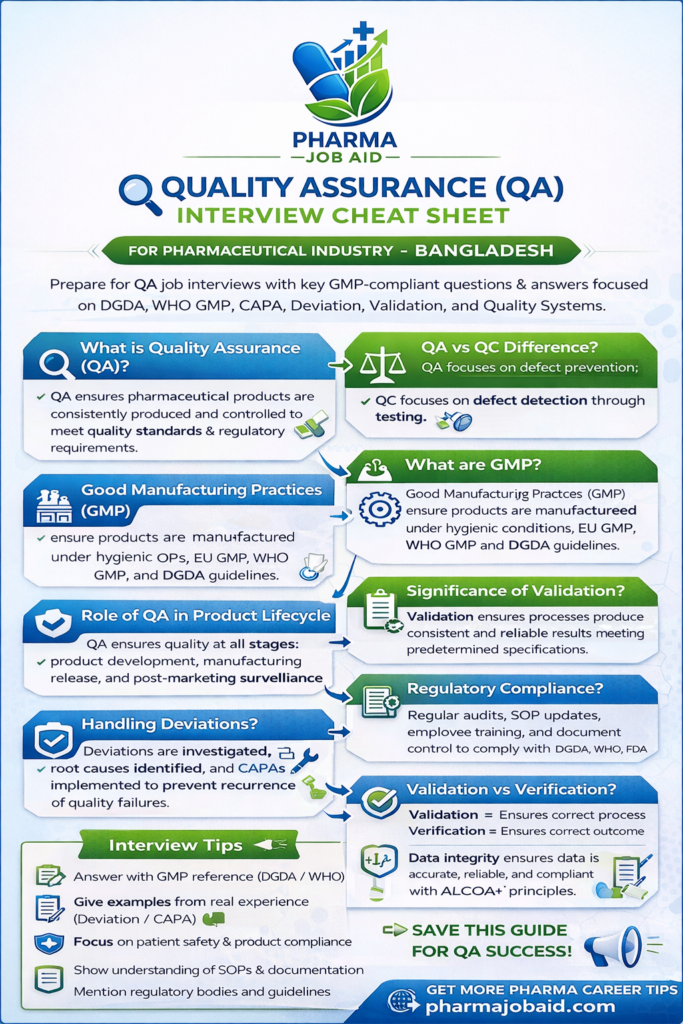
🔍 What is Quality Assurance (QA)?
Quality Assurance (QA) is a systematic, process-driven approach that ensures pharmaceutical products are consistently produced and controlled according to predefined standards.
Key Focus Areas:
- Defect prevention
- Process control
- Documentation compliance
- Regulatory adherence
👉 QA ensures “Right First Time” manufacturing
⚖️ Difference Between QA and QC
| Aspect | QA (Quality Assurance) | QC (Quality Control) |
|---|---|---|
| Focus | Process | Product |
| Objective | Prevent defects | Detect defects |
| Activities | SOP, audits, validation | Testing, analysis |
| Responsibility | System compliance | Lab analysis |
👉 In GMP, QA releases the batch, while QC provides test data.
🏭 What are GMP (Good Manufacturing Practices)?
Good Manufacturing Practices (GMP) are regulatory requirements ensuring that pharmaceutical products are:
- Consistently manufactured
- Controlled according to quality standards
- Safe for patient use
GMP Covers:
- Personnel hygiene
- Equipment qualification
- Documentation (GDP)
- Production control
- Quality systems
👉 Follow WHO GMP:
https://www.who.int/teams/regulation-prequalification/regulation-and-safety/pharmaceuticals/gmp
🔄 Role of QA in Product Lifecycle
QA ensures compliance throughout the entire lifecycle:
📊 Lifecycle Stages:
- Product development
- Technology transfer
- Commercial manufacturing
- Batch release
- Distribution
- Post-market surveillance
👉 QA is involved from concept to patient
🌍 What are ICH Guidelines?
International Council for Harmonisation of Technical Requirements for Pharmaceuticals for Human Use provides global harmonized guidelines:
ICH Categories:
- Q-series: Quality (Q1–Q14)
- S-series: Safety
- E-series: Efficacy
👉 Example: ICH Q10 → Pharmaceutical Quality System
⚠️ Deviation Management in Pharma
Deviation = Any departure from approved procedures or expected results.
🔍 Types:
- Planned deviation
- Unplanned deviation
- Critical / Major / Minor
🧪 Investigation Flow:
- Deviation reporting
- Root Cause Analysis (5-Why / Fishbone)
- Impact assessment
- CAPA implementation
- QA approval & closure
👉 Proper deviation handling is critical for audit readiness
🔧 CAPA (Corrective and Preventive Action)
CAPA is the backbone of the Quality Management System (QMS).
Components:
- Corrective Action: Fix current issue
- Preventive Action: Prevent recurrence
Example:
- Issue: Low fill volume
- Root cause: Operator error
- Corrective: Retrain operator
- Preventive: Add automated check
👉 CAPA must be traceable, measurable, and effective
🧬 Importance of Validation in QA
Validation provides documented evidence that processes consistently produce expected results.
Types of Validation:
- Process validation
- Cleaning validation
- Equipment qualification (IQ/OQ/PQ)
- Analytical method validation
👉 Without validation = No GMP compliance
📊 Regulatory Compliance in Bangladesh
Pharmaceutical companies in Bangladesh must comply with:
- DGDA guidelines
- WHO GMP
- EU GMP (for export companies)
- US FDA (for regulated markets)
How QA Ensures Compliance:
- Internal audits
- SOP management
- Training programs
- Continuous monitoring
👉 Compliance = License to operate
📋 Good Documentation Practices (GDP)
GDP ensures data is:
- Accurate
- Legible
- Contemporaneous
- Original
- Attributable
👉 Known as ALCOA+ principles
🧪 Handling OOS (Out of Specification)
Investigation Phases:
- Phase I: Lab error check
- Phase II: Full investigation
Steps:
- Data review
- Retesting (if justified)
- Root cause identification
- CAPA implementation
👉 OOS must follow strict regulatory procedures
🔁 Change Control System
Change Control ensures any change does not impact product quality.
Changes Include:
- Equipment modification
- Process changes
- Raw material change
- Facility upgrades
👉 No change without QA approval
⚠️ Risk Management in QA
Risk assessment tools:
- FMEA (Failure Mode & Effects Analysis)
- HACCP
- Fault Tree Analysis
👉 Focus: Patient safety first
🔄 Product Recall Management
Steps:
- Identify affected batch
- Notify DGDA
- Recall product from market
- Investigate root cause
- Implement CAPA
👉 Recall must be fast, traceable, and documented
📈 Continuous Improvement in QA
Achieved through:
- Internal audits
- Trend analysis
- CAPA effectiveness review
- Management Review Meeting (MRM)
👉 QA is not static — it evolves continuously
📊 Key Elements of QMS
A robust Quality Management System includes:
- Document control
- CAPA system
- Training management
- Change control
- Deviation management
- Audit system
👉 QMS = Backbone of pharmaceutical compliance
🧾 Batch Release Process (QA Responsibility)
Before release, QA ensures:
- BMR (Batch Manufacturing Record) review
- QC results approval
- Deviation closure
- Compliance with GMP
👉 Final release is done by QA Head / Authorized Person
🧑🔬 Data Integrity in Pharma
Data Integrity ensures:
- Accuracy
- Consistency
- Reliability
Principles:
- ALCOA+ (Attributable, Legible, Contemporaneous, Original, Accurate)
👉 Critical for audits (FDA, EU, WHO)
🧠 Interview Tips for Pharma QA Jobs
✔ Always answer with GMP reference
✔ Use real examples (Deviation, CAPA)
✔ Focus on patient safety
✔ Show understanding of documentation
✔ Mention regulatory bodies
🚀 CTA (For PharmaJobAid)
👉 Explore more pharma career resources:
🌐 https://pharmajobaid.com/
📌 CV Preparation | Interview Guides | Pharma Jobs