
Formulation design is one of the most important activities in pharmaceutical Research & Development (R&D). It is the scientific process of converting an active pharmaceutical ingredient (API) into a safe, stable, effective, patient-friendly, and commercially manufacturable dosage form such as tablet, capsule, syrup, injection, cream, ointment, suspension, inhaler, or modified-release product.
In simple words, formulation design answers one key question:
How can we deliver the drug to the patient in the best possible form, dose, strength, stability, and performance?
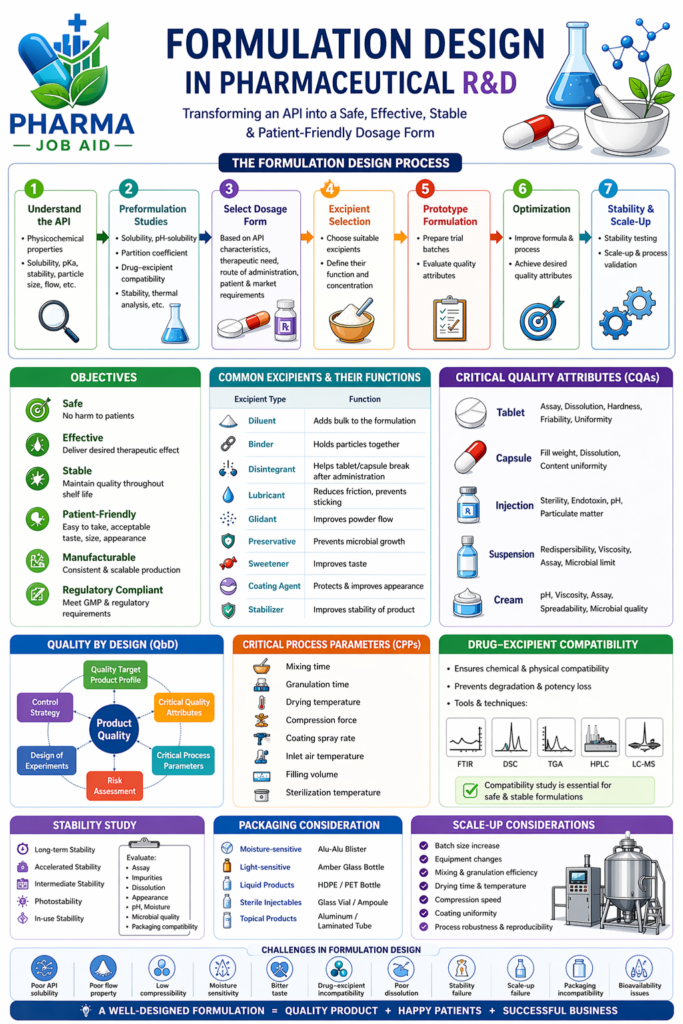
Main Objectives of Formulation Design
The main objective of formulation design is to develop a product that is:
| Objective | Meaning |
|---|---|
| Safe | No harmful interaction between API and excipients |
| Effective | Drug releases properly and produces desired therapeutic effect |
| Stable | Maintains quality during shelf life |
| Patient-friendly | Easy to take, acceptable taste, size, appearance |
| Manufacturable | Can be produced consistently at commercial scale |
| Regulatory compliant | Meets GMP, pharmacopeial, and regulatory requirements |
Key Steps in Formulation Design
1. Understanding the API
Before designing a formulation, the R&D team studies the API carefully. Important API properties include:
- Solubility
- Particle size
- Melting point
- Polymorphism
- Hygroscopicity
- Stability
- pH sensitivity
- Flow property
- Compressibility
- Compatibility with excipients
For example, if an API has poor water solubility, the formulation scientist may use solubilizers, particle size reduction, solid dispersion, surfactants, or lipid-based systems.
2. Preformulation Study
Preformulation is the foundation of formulation development. It helps identify the physical, chemical, and mechanical properties of the API.
Important studies include:
- API identification
- Solubility profile
- pH-solubility study
- pKa determination
- Partition coefficient
- Moisture sensitivity
- Thermal analysis
- Drug-excipient compatibility
- Forced degradation study
- Stability risk assessment
A strong preformulation study reduces future development failure.
3. Selection of Dosage Form
The dosage form is selected based on the nature of the API, therapeutic need, route of administration, patient group, and market requirement.
Examples:
- Tablet: Most common, cost-effective, stable
- Capsule: Suitable for powders, pellets, and sensitive APIs
- Syrup/Suspension: Suitable for pediatric and geriatric patients
- Injection: Used when rapid action or high bioavailability is required
- Cream/Ointment: Used for topical application
- Modified-release tablet: Used for controlled or sustained drug release
4. Excipient Selection
Excipients are inactive ingredients, but they play a major role in product quality and performance.
Common excipients include:
| Excipient Type | Function |
|---|---|
| Diluent | Adds bulk to tablet/capsule |
| Binder | Holds powder particles together |
| Disintegrant | Helps tablet break after swallowing |
| Lubricant | Prevents sticking during compression |
| Glidant | Improves powder flow |
| Preservative | Prevents microbial growth |
| Sweetener | Improves taste |
| Coating agent | Protects tablet and improves appearance |
| Stabilizer | Improves product stability |
Example: In tablet formulation, microcrystalline cellulose may be used as diluent, povidone as binder, croscarmellose sodium as disintegrant, and magnesium stearate as lubricant.
Formulation Development Approach
Prototype Formulation
The R&D team prepares several trial batches using different excipient combinations and process parameters. These are called prototype formulations.
Each trial batch is evaluated for:
- Appearance
- Weight variation
- Hardness
- Friability
- Disintegration
- Dissolution
- Assay
- Content uniformity
- Impurities
- Stability
The best-performing formulation is selected for further optimization.
Optimization
Optimization means improving the formulation to achieve desired quality attributes.
Common optimization areas include:
- API particle size
- Binder concentration
- Disintegrant level
- Lubricant mixing time
- Granulation endpoint
- Compression force
- Coating weight gain
- Dissolution profile
- Stability performance
Critical Quality Attributes
Critical Quality Attributes, or CQAs, are product characteristics that must be controlled to ensure quality, safety, and efficacy.
Examples:
| Dosage Form | CQAs |
|---|---|
| Tablet | Assay, dissolution, hardness, friability, uniformity |
| Capsule | Fill weight, dissolution, content uniformity |
| Injection | Sterility, endotoxin, pH, particulate matter |
| Suspension | Redispersibility, viscosity, assay, microbial limit |
| Cream | pH, viscosity, assay, spreadability, microbial quality |
Critical Process Parameters
Critical Process Parameters, or CPPs, are manufacturing process variables that can affect product quality.
Examples:
- Mixing time
- Granulation time
- Drying temperature
- Compression force
- Coating spray rate
- Inlet air temperature
- Homogenization speed
- Filling volume
- Sterilization temperature
Good formulation design links CQAs with CPPs.
QbD in Formulation Design
Modern formulation development follows the Quality by Design (QbD) approach.
QbD focuses on building quality into the product from the beginning instead of testing quality only at the end.
Key QbD elements include:
- Quality Target Product Profile
- Critical Quality Attributes
- Critical Material Attributes
- Critical Process Parameters
- Risk assessment
- Design of Experiments
- Control strategy
Drug-Excipient Compatibility
Drug-excipient compatibility is very important. Sometimes an excipient may react with the API and cause degradation, discoloration, impurity formation, or reduced potency.
Common compatibility tools include:
- FTIR
- DSC
- TGA
- HPLC
- LC-MS
- Stability study
Example: If an API is moisture-sensitive, hygroscopic excipients should be avoided or controlled carefully.
Stability Study in Formulation Design
Stability study confirms whether the formulation can maintain quality throughout its shelf life.
Stability testing evaluates:
- Assay
- Degradation products
- Dissolution
- Appearance
- Moisture content
- pH
- Microbial quality
- Packaging compatibility
Common stability conditions include:
- Long-term stability
- Accelerated stability
- Intermediate stability
- Photostability
- In-use stability
Packaging Selection
Packaging is also part of formulation design because it protects the product from moisture, light, oxygen, and contamination.
Examples:
| Product Risk | Suitable Packaging |
|---|---|
| Moisture-sensitive tablet | Alu-Alu blister |
| Light-sensitive drug | Amber bottle |
| Liquid product | HDPE/PET bottle |
| Sterile injectable | Glass vial or ampoule |
| Cream/ointment | Aluminum or laminated tube |
Scale-Up Consideration
A formulation that works in the laboratory must also work at pilot and commercial scale.
Scale-up focuses on:
- Batch size increase
- Equipment change
- Mixing efficiency
- Granulation behavior
- Drying time
- Compression speed
- Coating uniformity
- Process reproducibility
A good formulation should be robust enough for routine manufacturing.
Common Challenges in Formulation Design
- Poor API solubility
- Poor flow property
- Low compressibility
- Moisture sensitivity
- Bitter taste
- Drug-excipient incompatibility
- Poor dissolution
- Stability failure
- Scale-up failure
- Packaging incompatibility
- Bioavailability issue
Example: Tablet Formulation Design
For a conventional immediate-release tablet, a typical development strategy may include:
- Study API properties
- Select direct compression or wet granulation method
- Choose diluent, binder, disintegrant, lubricant
- Prepare trial batches
- Test hardness, friability, disintegration, dissolution
- Optimize formula
- Conduct stability study
- Scale up to pilot batch
- Prepare regulatory documentation
- Transfer technology to production
Conclusion
Formulation design in pharmaceutical R&D is a scientific and regulatory-driven process that converts an API into a finished dosage form. A successful formulation must be stable, effective, safe, patient-friendly, and suitable for commercial production. Strong preformulation study, proper excipient selection, QbD approach, stability evaluation, and scale-up planning are essential for successful pharmaceutical product development.