
🔬 Introduction to LC-MS in Pharma Quality Control
Liquid Chromatography–Mass Spectrometry (LC-MS) is a highly advanced analytical technique widely used in pharmaceutical quality control (QC) laboratories. It combines the separation power of liquid chromatography with the detection capability of mass spectrometry, allowing precise identification and quantification of compounds. Regulatory authorities such as the U.S. Food and Drug Administration and European Medicines Agency strongly encourage the use of sensitive techniques like LC-MS for impurity profiling and trace analysis to ensure drug safety and efficacy.
⚙️ Principle of LC-MS
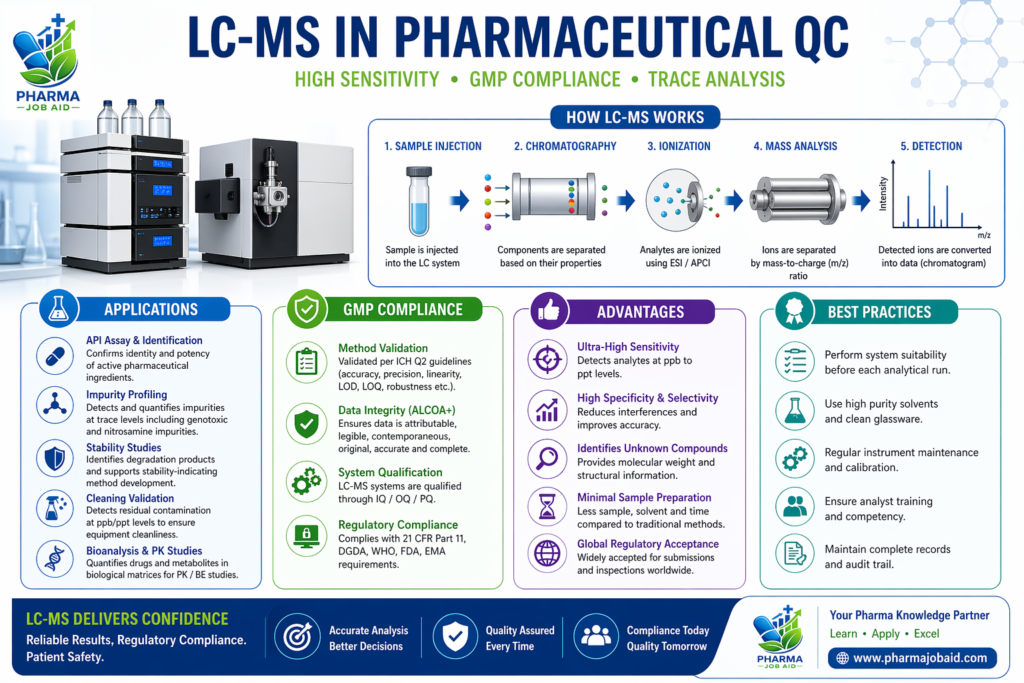
The principle of Liquid Chromatography–Mass Spectrometry (LC-MS) is based on the combined power of chromatographic separation and mass-based detection to analyze complex pharmaceutical samples with high accuracy and sensitivity. In this technique, the liquid chromatography (LC) system first separates the individual components of a mixture as they pass through a column containing a stationary phase, where compounds are resolved based on their polarity, solubility, and interaction with the column material. Each component elutes at a specific retention time and is then introduced into the mass spectrometer. At this interface, the analytes are converted into charged ions using soft ionization techniques such as electrospray ionization (ESI) or atmospheric pressure chemical ionization (APCI), ensuring minimal fragmentation and preserving molecular integrity. These ions are subsequently directed into a mass analyzer, where they are separated according to their mass-to-charge ratio (m/z). Finally, a detector records the ion signals and generates a mass spectrum, which provides both qualitative information (molecular identity and structure) and quantitative data (concentration of the analyte). This integrated process allows LC-MS to deliver highly sensitive, selective, and reliable results, making it an essential tool in pharmaceutical quality control for applications such as impurity profiling, stability testing, and trace-level analysis under regulatory frameworks guided by organizations like the International Council for Harmonisation and the U.S. Food and Drug Administration.
⚙️ ➤ Chromatographic Separation (LC)
In LC-MS, the liquid chromatography (LC) system performs the first and most critical step—separating complex mixtures into individual components. The sample is injected into a flowing mobile phase (solvent system), which carries it through a stationary phase (column, typically C18 in pharma QC).
Separation occurs because each compound interacts differently with the stationary phase based on its polarity, hydrophobicity, and chemical properties. More polar compounds elute faster, while non-polar compounds retain longer in reverse-phase LC.
👉 Why it matters in QC:
- Prevents overlapping peaks (co-elution)
- Ensures accurate identification and quantification
- Improves sensitivity of MS detection
👉 GMP Note: Poor separation is a common audit finding and can lead to unreliable impurity profiling.
⚖️ ➤ Mass Detection (MS)
After chromatographic separation, analytes enter the mass spectrometer, where they are detected based on their mass-to-charge ratio (m/z). The MS consists of three main parts: ion source, mass analyzer, and detector.
Once ionized, ions are sorted in the mass analyzer (e.g., Quadrupole, TOF) according to their m/z values. The detector then converts these ions into electrical signals, producing a mass spectrum (intensity vs m/z).
👉 What information you get:
- Molecular weight of compounds
- Structural fragments (for identification)
- Quantitative concentration (via peak intensity/area)
👉 Why it matters in QC:
- Confirms API identity
- Detects trace impurities (ppb/ppt level)
- Supports stability and degradation studies
⚡ ➤ Ionization Techniques (Interface Step)
Ionization is the bridge between LC and MS, where neutral molecules are converted into charged ions without excessive fragmentation (soft ionization).
🔹 Electrospray Ionization (ESI)
ESI is the most widely used technique in pharmaceutical QC. The liquid effluent from LC is sprayed through a high-voltage needle, forming fine charged droplets. As solvent evaporates, ions are released into the gas phase.
👉 Best for:
- Polar and large molecules (APIs, peptides)
- Bioanalysis and impurity profiling
👉 Advantages:
- High sensitivity
- Produces multiply charged ions (useful for large molecules)
🔹 Atmospheric Pressure Chemical Ionization (APCI)
APCI uses heat and a corona discharge to ionize analytes in the gas phase. The sample is first vaporized, then ionized through chemical reactions.
👉 Best for:
- Less polar and moderately volatile compounds
- Small molecule drugs
👉 Advantages:
- Less affected by matrix effects
🧪 Applications in Pharmaceutical QC
➤ API Identification and Assay
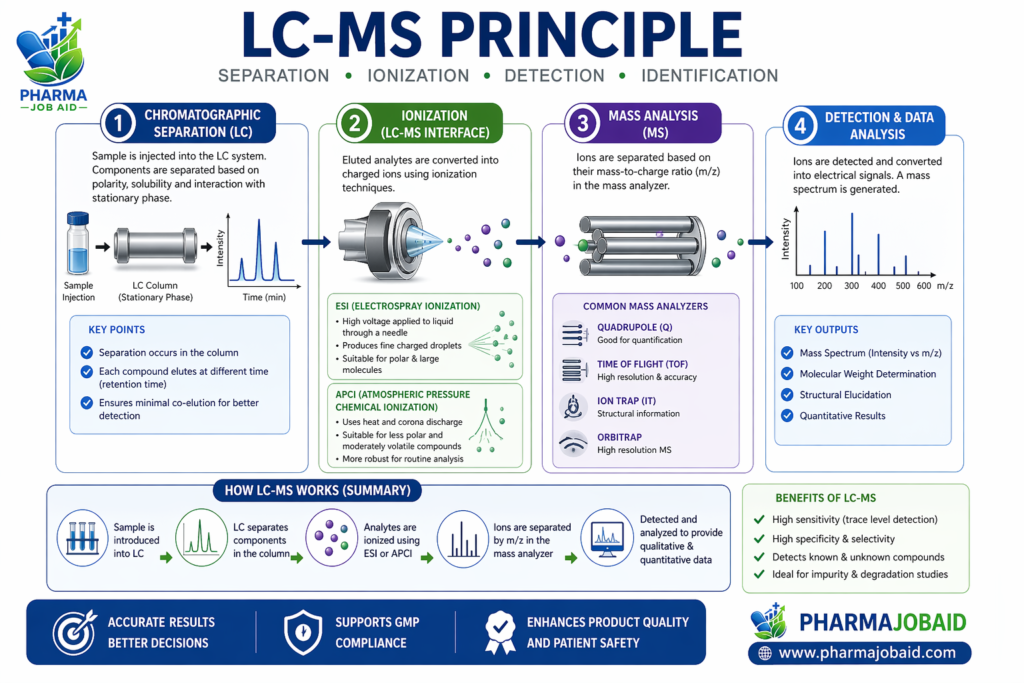
LC-MS ensures accurate identification of active pharmaceutical ingredients (APIs) and confirms molecular structure with high specificity.
➤ Impurity Profiling
It detects impurities at trace levels, including genotoxic and nitrosamine impurities, aligning with guidelines from the International Council for Harmonisation (ICH).
➤ Stability Studies
LC-MS is used to monitor degradation products during stability testing, supporting stability-indicating method development.
➤ Cleaning Validation
It detects residual contaminants at very low concentrations, ensuring effective cleaning and preventing cross-contamination in multi-product facilities.
➤ Bioanalysis & Pharmacokinetics
LC-MS plays a vital role in drug metabolism studies, bioequivalence (BE), and pharmacokinetic (PK) analysis.
🏭 GMP & Regulatory Compliance
➤ Method Validation Requirements
Methods must be validated for accuracy, precision, specificity, linearity, LOD, and LOQ as per GMP and ICH guidelines.
➤ Data Integrity (ALCOA+)
All LC-MS data must comply with ALCOA+ principles—ensuring data is attributable, legible, contemporaneous, original, and accurate.
➤ System Qualification
LC-MS instruments must undergo Installation Qualification (IQ), Operational Qualification (OQ), and Performance Qualification (PQ) before routine use.
➤ Audit Readiness
Electronic systems must comply with 21 CFR Part 11 to ensure secure data handling and traceability during audits.
🚀 Advantages of LC-MS in QC
- Ultra-high sensitivity (ppb to ppt level detection)
- High selectivity and specificity
- Ability to identify unknown compounds
- Minimal sample preparation compared to traditional methods
- Strong regulatory acceptance worldwide
⚠️ Challenges and Limitations
➤ High Cost
LC-MS systems are expensive to procure and maintain, requiring skilled analysts.
➤ Complex Method Development
Optimization of mobile phase, ionization, and MS parameters requires expertise.
➤ Matrix Effects
Sample matrix can interfere with ionization, affecting accuracy if not properly controlled.
🧩 Instrument Components & Workflow
➤ Solvent Delivery & Autosampler
A high-pressure pump delivers mobile phase with precise gradient control, while the autosampler ensures reproducible injection—critical for assay precision and audit consistency.
➤ LC Column (Separation Core)
Columns (e.g., C18 reverse phase) separate analytes based on polarity. Column selection is method-critical and must be justified during validation.
➤ Ion Source
The ion source (ESI/APCI) converts analytes into charged ions. ESI is preferred for polar compounds, widely used in API and impurity analysis.
➤ Mass Analyzer & Detector
Mass analyzers (Quadrupole, TOF, Orbitrap) measure m/z ratios, while detectors convert ions into signals for data processing.
🧪 Method Development Strategy (DGDA/GMP Style)
➤ Step 1: Objective Definition
Define purpose—assay, impurity profiling, cleaning validation, or stability study.
➤ Step 2: Chromatographic Optimization
Select mobile phase (buffer + organic solvent), pH, and gradient program to achieve proper separation.
➤ Step 3: MS Parameter Optimization
Optimize ionization mode, capillary voltage, cone voltage, and collision energy (for LC-MS/MS).
➤ Step 4: System Suitability Criteria
Set parameters like resolution, tailing factor, signal-to-noise ratio, and %RSD before analysis.
📊 Validation Parameters (Audit-Ready Format)
Aligned with International Council for Harmonisation (ICH Q2):
- Specificity: Ability to separate analyte from impurities
- Accuracy: Recovery within 98–102% (typical range)
- Precision: %RSD ≤ 2% for repeatability
- Linearity: r² ≥ 0.999 across concentration range
- LOD/LOQ: Based on signal-to-noise (3:1 and 10:1)
- Robustness: Small variations should not affect results
🧬 LC-MS/MS (Tandem MS) in Advanced QC
➤ Multiple Reaction Monitoring (MRM)
LC-MS/MS uses MRM transitions to selectively detect compounds, minimizing interference.
➤ Nitrosamine Testing
Global recalls have made LC-MS/MS essential for detecting nitrosamines at trace levels (ng/day limits). Regulatory bodies like the U.S. Food and Drug Administration and European Medicines Agency mandate such testing.
🧪 Sample Preparation Techniques (Detailed)
➤ Protein Precipitation (PPT)
Protein precipitation is mainly used in bioanalytical LC-MS methods where biological matrices such as plasma or serum are involved. Organic solvents like acetonitrile or methanol are added to denature and precipitate proteins, which are then removed by centrifugation. This step is critical because proteins can clog the LC column and interfere with ionization in the mass spectrometer. In GMP environments, improper protein removal may lead to variability in results, impacting accuracy and precision.
➤ Liquid–Liquid Extraction (LLE)
LLE separates analytes based on their solubility in two immiscible liquids (typically aqueous and organic phases). It is widely used for isolating APIs and impurities from complex matrices. In pharmaceutical QC, LLE helps concentrate analytes and remove interfering substances, improving sensitivity. However, it requires careful method optimization to ensure consistent recovery, as variations can lead to batch-to-batch inconsistency.
➤ Solid Phase Extraction (SPE)
SPE is a more advanced and selective technique where analytes are retained on a solid sorbent and then eluted using a suitable solvent. It provides cleaner samples compared to LLE and is highly preferred in trace-level impurity analysis and cleaning validation. From a regulatory perspective, SPE improves method robustness and reproducibility, which is critical during audits.
⚠️ Matrix Effect & Ion Suppression (Detailed)
➤ Understanding Matrix Effect
Matrix effect refers to the alteration of analyte response due to co-eluting substances affecting ionization efficiency in the mass spectrometer. This can either suppress or enhance the signal, leading to inaccurate quantification. It is a major concern in LC-MS methods, especially when dealing with complex formulations or biological samples.
➤ Control Strategies
- Internal Standards: Isotopically labeled standards compensate for variability in ionization.
- Chromatographic Separation: Proper separation reduces co-eluting interference.
- Sample Cleanup: Techniques like SPE reduce matrix complexity.
- Validation Studies: Matrix effect must be evaluated and documented as per International Council for Harmonisation guidelines.
📊 System Suitability Parameters (Detailed)
➤ %RSD (Relative Standard Deviation)
Ensures repeatability of injections. A %RSD ≤ 2% confirms system precision and stability.
➤ Signal-to-Noise Ratio
Determines sensitivity. A ratio ≥10 for LOQ ensures reliable quantification at low levels.
➤ Resolution
Indicates separation efficiency between peaks. Poor resolution can lead to overlapping peaks and incorrect results.
➤ Tailing Factor
Measures peak symmetry. Tailing peaks indicate column or method issues, affecting quantification accuracy.
➤ Retention Time Consistency
Ensures system stability. Variations may indicate pump issues or mobile phase inconsistency.
🔍 Troubleshooting in LC-MS (Detailed)
➤ No Signal / Low Response
This may occur due to ion source contamination, incorrect MS tuning, or degraded mobile phase. Regular cleaning and calibration are essential to maintain sensitivity.
➤ Peak Tailing / Broad Peaks
Common causes include column deterioration, incorrect pH, or dead volume in fittings. This affects resolution and method reliability.
➤ High Background Noise
Often caused by contaminated solvents, carryover, or dirty ion source. It reduces signal clarity and impacts detection limits.
🧾 Stability-Indicating Method (Detailed)
LC-MS plays a vital role in identifying degradation products formed under stress conditions such as heat, light, and oxidation. It helps confirm peak purity and ensures that analytical methods can distinguish between API and degradation products. Regulatory authorities like the U.S. Food and Drug Administration and European Medicines Agency require such methods for product approval and lifecycle management.
🏭 Cleaning Validation (Detailed – DGDA Focus)
➤ Importance
In multi-product facilities, cross-contamination is a major risk. LC-MS provides ultra-sensitive detection of residues, ensuring equipment cleanliness.
➤ Acceptance Criteria
Limits are calculated based on toxicological data such as HBEL (Health-Based Exposure Limits) and MACO (Maximum Allowable Carryover).
➤ Practical Implementation
Swab samples from equipment surfaces are analyzed using LC-MS. If residue levels are below acceptable limits, cleaning is considered effective.
🧾 Data Integrity & Compliance (ALCOA+)
➤ Attributable
Each data point must be traceable to the analyst.
➤ Legible & Contemporaneous
Data must be readable and recorded in real-time.
➤ Original & Accurate
No data manipulation; raw data must be preserved.
➤ + Complete, Consistent, Enduring, Available
Ensures full lifecycle compliance during audits.
🏭 LC-MS in Bangladesh Pharma Industry
Pharmaceutical companies in Bangladesh are rapidly upgrading QC labs with LC-MS systems to meet export requirements (EU, US, WHO prequalification). DGDA inspections increasingly focus on:
- Data integrity compliance
- Trace impurity detection capability
- Validated analytical methods
- Electronic audit trails
This makes LC-MS not just an analytical tool, but a regulatory necessity.
⚠️ Common Audit Findings (Realistic QC Gaps)
- Incomplete method validation reports
- Lack of system suitability documentation
- Poor integration settings (manual peak manipulation risk)
- Inadequate training records for analysts
- Missing audit trail review
👉 CAPA should include SOP revision, retraining, and system control enhancement.
📈 Trending Applications (Pharma 4.0 Alignment)
➤ High-Resolution Mass Spectrometry (HRMS)
Used for unknown impurity identification and structural elucidation.
➤ Automation & AI Integration
Automated peak detection, anomaly identification, and predictive maintenance.
➤ Green Analytical Chemistry
Reduced solvent consumption and eco-friendly method development.
🌐 Conclusion
LC-MS has become indispensable in pharmaceutical QC due to its unmatched sensitivity, specificity, and versatility. From impurity detection to stability testing and regulatory compliance, it ensures that pharmaceutical products meet the highest quality standards. As regulatory expectations continue to evolve, LC-MS will remain a key analytical tool for ensuring drug safety and global market acceptance.