
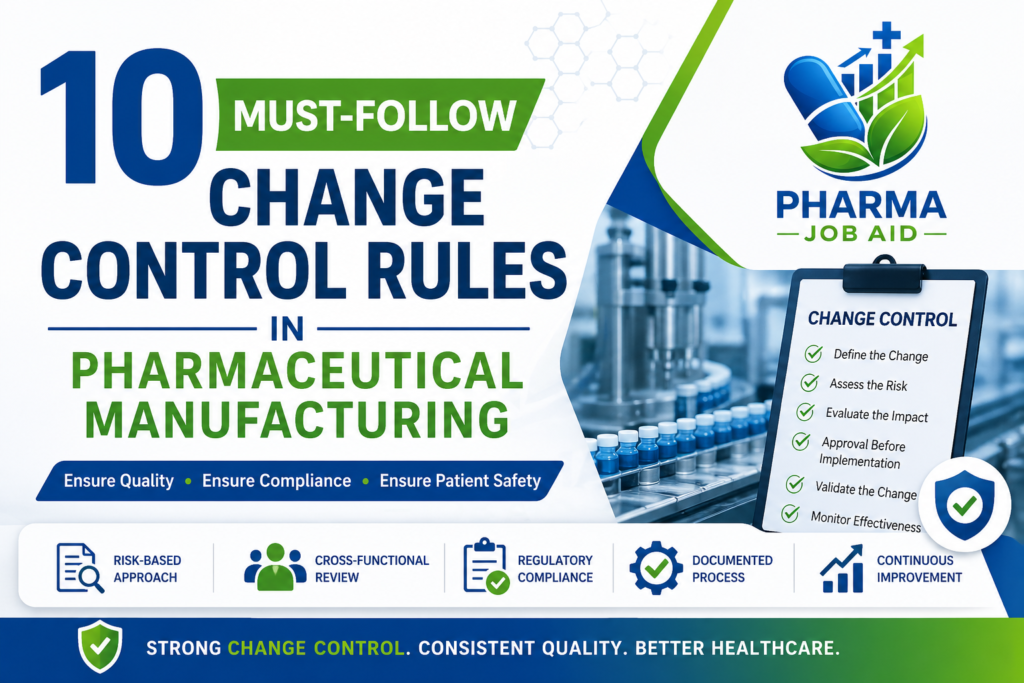
1. No Change Without Formal Approval
In pharmaceutical manufacturing, no change—whether related to process, material, equipment, or documentation—should be implemented without prior approval through a formal Change Control system. Regulatory authorities like Directorate General of Drug Administration and US Food and Drug Administration consider unauthorized changes a critical violation. For example, changing an API supplier without QA approval and regulatory notification can lead to product recall or license risk.
2. Clearly Define and Document the Change
Every change must be clearly described in a precise and structured manner, including what is being changed, why the change is needed, and which products or systems are affected. Vague descriptions such as “process improvement” are unacceptable. For instance, a proper statement would be: “Change of API supplier for Paracetamol BP from Supplier A to Supplier B due to supply chain risk mitigation.”
3. Provide Scientific and Data-Driven Justification
Change justification must be supported by scientific evidence such as trend analysis, stability data, or deviation history. Regulatory frameworks like International Council for Harmonisation emphasize knowledge-based decisions. For example, switching from PVC to PVC/PVDC blister packaging should be justified by moisture sensitivity data and stability failures observed in the previous packaging.
4. Perform Comprehensive Risk Assessment
A formal risk assessment must be conducted to evaluate the impact of the proposed change on product quality, patient safety, and regulatory compliance. Tools like FMEA are commonly used. For example, changing an API supplier may impact impurity profile, dissolution, and stability, making it a high-risk (critical) change requiring extensive evaluation.
5. Classify the Change Correctly
Proper classification of change (Minor, Major, or Critical) is essential for determining the level of control, validation, and regulatory submission required. Misclassification is a common audit finding. For instance, an API supplier change is always considered a critical change, while a minor SOP formatting correction may be classified as minor.
6. Conduct Cross-Functional Review
Change Control must involve multiple departments including QA, Production, QC, Engineering, and Regulatory Affairs. Each function evaluates the change from its perspective. For example, in a packaging material change, QC assesses compatibility, Production evaluates machinability, and QA ensures compliance.
7. Evaluate Regulatory Impact and Filing Requirement
Before implementing any change, its regulatory impact must be assessed. Changes affecting registered product details may require variation submission to Directorate General of Drug Administration or other global authorities. For example, API source changes require updates in CTD Module 3.2.S and prior approval before implementation.
8. Perform Validation and Qualification Activities
Any change impacting process, material, or equipment must be validated to ensure consistent product quality. According to World Health Organization guidelines, validation is mandatory for high-risk changes. For example, introducing a new API supplier requires process validation (typically 3 batches) and comparative dissolution studies.
9. Ensure Proper Documentation, Training, and Controlled Implementation
All related documents such as SOPs, BMR/BPR, specifications, and logbooks must be updated before implementation. Additionally, personnel must be trained on the revised procedures. For example, after changing blister material, packing SOPs and artwork must be updated and operators trained accordingly before execution.
10. Verify Effectiveness Before Closure
A change should only be closed after confirming its effectiveness through monitoring, trend analysis, or stability studies. Regulators expect evidence that the change did not adversely affect product quality. For instance, after implementing a new packaging material, stability results should confirm improved product protection before closing the change control.
🔷 Final Professional Insight
A robust Change Control system ensures compliance with ICH Q10 guideline and builds confidence during audits. In real-world inspections, most observations arise from poor risk assessment, lack of validation, and incomplete documentation.
👉 Strong Change Control = Consistent Quality + Regulatory Compliance + Patient Safety