
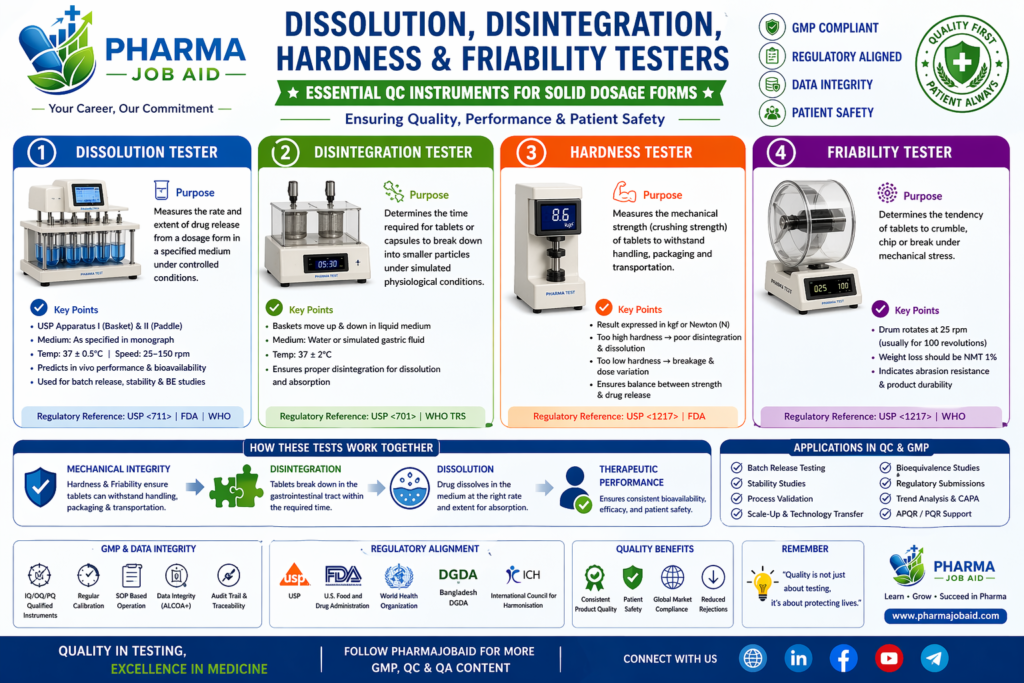
In pharmaceutical quality control (QC), solid oral dosage forms such as tablets and capsules must consistently meet predefined performance and mechanical integrity standards. Four essential instruments—dissolution tester, disintegration tester, hardness tester, and friability tester—play a critical role in ensuring compliance with global regulatory requirements such as US Food and Drug Administration, World Health Organization, and pharmacopeial standards like United States Pharmacopeia and European Pharmacopoeia. These tests collectively confirm that a product will perform as intended in the human body while maintaining physical stability during handling and transportation.
🔬 Dissolution Tester
A dissolution tester evaluates the rate and extent to which the active pharmaceutical ingredient (API) dissolves in a specified medium under controlled conditions. This test is critical for predicting the in vivo performance and bioavailability of oral dosage forms. Typically conducted using apparatus such as USP Apparatus I (basket) or Apparatus II (paddle), the test measures drug release over time at specific intervals. The data generated are used to establish dissolution profiles, which are essential for batch release, stability studies, and bioequivalence assessments. Regulatory bodies like FDA require strict adherence to validated dissolution methods as part of GMP compliance.
👉 Learn more: https://www.usp.org <br>
👉 WHO guideline reference: https://www.who.int/publications/i/item/9789241549950
💊 Disintegration Tester
The disintegration tester determines the time required for tablets or capsules to break down into smaller particles under simulated physiological conditions. This test ensures that the dosage form disintegrates within an acceptable time frame to allow dissolution and absorption. The apparatus consists of baskets with tubes and mesh screens that move up and down in a temperature-controlled liquid medium (usually water or simulated gastric fluid at 37°C). According to USP and WHO guidelines, disintegration is a mandatory test for immediate-release dosage forms and serves as a critical quality attribute (CQA) during product development and routine QC.
👉 Reference: https://www.usp.org/compounding/general-chapter-701
👉 WHO TRS guideline: https://www.who.int/publications/trs
⚙️ Hardness Tester (Tablet Crushing Strength)
The hardness tester measures the mechanical strength of tablets, indicating their ability to withstand handling, packaging, and transportation without breaking. It is typically expressed in kilogram-force (kgf) or Newton (N). Excessive hardness may delay disintegration and dissolution, while insufficient hardness may lead to tablet breakage and dose inconsistency. Modern digital hardness testers provide precise and reproducible measurements, often integrated with data logging systems for GMP documentation. Maintaining optimal hardness is essential for achieving a balance between mechanical integrity and drug release performance, in line with regulatory expectations.
👉 GMP overview: https://www.fda.gov/drugs/pharmaceutical-quality-resources
🔄 Friability Tester
The friability tester assesses the tendency of tablets to crumble or chip under mechanical stress. The test involves rotating a sample of tablets in a drum (usually at 25 rpm for 100 revolutions) and measuring weight loss. A loss of less than 1% is generally considered acceptable as per pharmacopeial standards. This test is particularly important for ensuring product durability during packaging, shipping, and handling. Friability complements hardness testing by providing insight into the tablet’s resistance to abrasion rather than crushing force.
👉 USP reference: https://www.usp.org
👉 WHO stability & QC guidance: https://www.who.int/teams/health-product-policy-and-standards
📊 Integrated Importance in GMP & QC Systems
Together, these four tests form a comprehensive evaluation system for solid dosage forms in pharmaceutical QC laboratories. Dissolution and disintegration ensure therapeutic performance, while hardness and friability guarantee mechanical robustness. In a GMP-compliant environment, all instruments must be qualified (IQ/OQ/PQ), calibrated regularly, and operated according to approved SOPs, aligning with expectations from authorities such as Directorate General of Drug Administration. Data from these tests are also critical inputs for product quality review (PQR/APQR), deviation investigations, and CAPA systems.
🔄 Advanced Considerations & Regulatory Depth in QC Testing
Beyond routine batch release, dissolution, disintegration, hardness, and friability testing play a strategic role in lifecycle management of pharmaceutical products. These tests are not isolated QC checks—they are deeply integrated into formulation development, process validation, scale-up, and post-approval changes. Regulatory authorities such as International Council for Harmonisation emphasize a science- and risk-based approach where these parameters are linked to Critical Quality Attributes (CQAs) and Critical Process Parameters (CPPs). For example, tablet hardness is often directly influenced by compression force during manufacturing, which in turn affects dissolution behavior—highlighting the interconnected nature of these tests.
Dissolution testing, in particular, has evolved from a simple QC tool into a predictive and discriminatory method. Modern pharmaceutical development uses dissolution profiles to establish in vitro–in vivo correlation (IVIVC), enabling manufacturers to predict how a drug behaves in the human body based on laboratory data. This is especially critical for regulatory submissions to agencies like European Medicines Agency, where comparative dissolution profiles are required for generic drug approval and post-approval changes. Advanced techniques such as biorelevant media and automated sampling systems further enhance the reliability and reproducibility of dissolution testing.
🧪 Method Validation & System Suitability
All QC test methods must be validated according to ICH Q2(R2) principles to ensure accuracy, precision, specificity, and robustness. For dissolution and disintegration tests, system suitability criteria—such as apparatus calibration, medium temperature (37 ± 0.5°C), rotation speed, and sampling intervals—must be strictly controlled. Calibration of dissolution apparatus using USP calibrator tablets is a mandatory requirement under United States Pharmacopeia. Similarly, hardness and friability testers must undergo routine calibration using certified reference standards to ensure data integrity.
In GMP environments, all instruments must pass through qualification stages—Installation Qualification (IQ), Operational Qualification (OQ), and Performance Qualification (PQ)—with proper documentation. This aligns with expectations from World Health Organization and local authorities like Directorate General of Drug Administration, where audit observations often highlight gaps in calibration, documentation, or SOP adherence.
📉 Trending, OOS, and CAPA Integration
Data generated from these tests are critical for trend analysis and quality risk management. For instance, a gradual increase in tablet hardness over multiple batches may indicate tooling wear or changes in granulation moisture content. Similarly, deviations in dissolution profiles can signal formulation instability or process inconsistency. Such trends must be captured in Annual Product Quality Review (APQR/PQR) and investigated using structured tools like Fishbone Analysis and 5-Why methodology.
Out-of-Specification (OOS) and Out-of-Trend (OOT) results in dissolution or disintegration testing require immediate investigation following GMP guidelines. Root cause analysis may involve factors such as API particle size variation, excipient functionality, or compression force fluctuations. Corrective and Preventive Actions (CAPA) must be implemented and tracked to ensure recurrence prevention. Regulatory agencies including FDA expect a scientifically justified and well-documented approach to such investigations.
🏭 Application in Process Validation & Scale-Up
During process validation, these four tests serve as key indicators of process consistency and reproducibility. For example, during compression stage validation, hardness and friability data confirm that tablets meet mechanical specifications across different batches and shifts. Dissolution and disintegration results ensure that product performance remains consistent despite scale-up from pilot to commercial production.
In Bangladesh’s pharmaceutical industry, where export compliance is critical, alignment with global standards is essential. Companies must demonstrate that their QC systems—including these testers—are capable of producing reproducible and reliable data under GMP conditions. This is particularly important for regulated markets such as the EU and US, where stringent documentation and validation requirements are enforced.
⚡ Emerging Technologies & Digital QC
The pharmaceutical industry is gradually adopting digital transformation in QC laboratories. Automated dissolution systems with online UV or HPLC integration allow real-time monitoring of drug release. Data integrity is ensured through compliance with 21 CFR Part 11 requirements, particularly under FDA regulations. Similarly, modern hardness and friability testers are equipped with digital interfaces, audit trails, and integration with Laboratory Information Management Systems (LIMS).
Process Analytical Technology (PAT) tools are also being explored to predict tablet properties without destructive testing. Near-Infrared (NIR) spectroscopy, for example, can estimate hardness and content uniformity in real time, reducing dependency on traditional offline QC tests. These advancements align with the vision of Pharma 4.0, promoted by organizations like ISPE.
📌 Conclusion
Dissolution, disintegration, hardness, and friability testers are not merely routine QC instruments—they are foundational pillars of pharmaceutical quality assurance. Their data support critical decisions across the product lifecycle, from development to commercial distribution. In a DGDA and GMP-focused environment like Bangladesh, mastering these tests and their regulatory expectations is essential for ensuring product quality, patient safety, and global market competitiveness.