
📌 Introduction to Stability Studies in Pharma
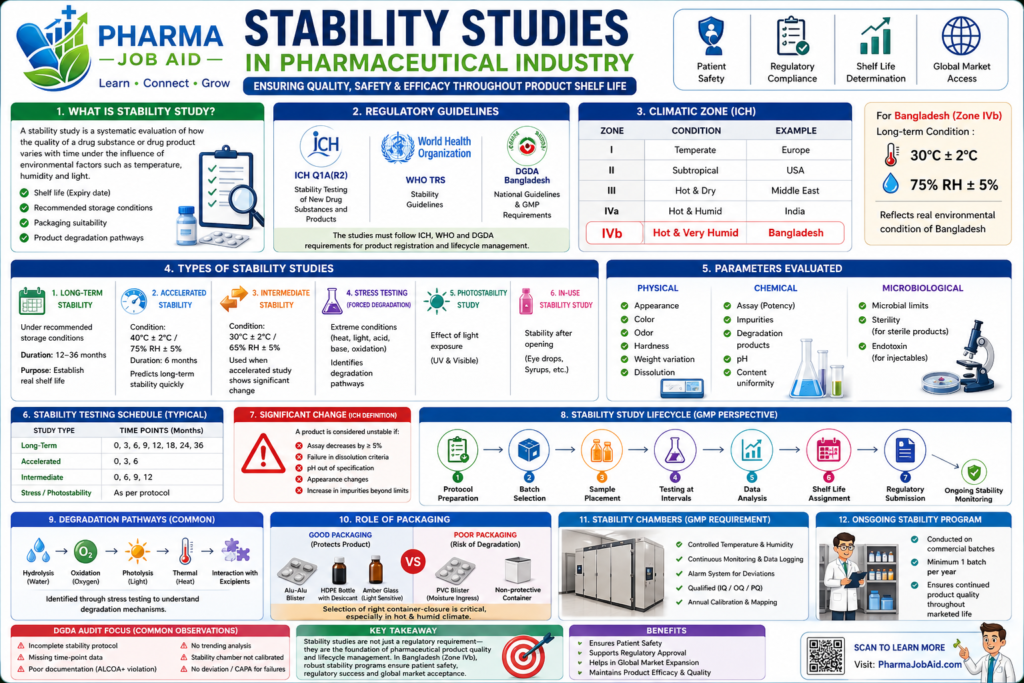
Stability studies in the pharmaceutical industry are a fundamental part of drug development, quality assurance, and regulatory compliance, ensuring that medicines remain safe, effective, and within specification throughout their shelf life. Under Good Manufacturing Practice (GMP) and regulatory expectations set by organizations like the International Council for Harmonisation, World Health Organization, and Directorate General of Drug Administration, stability studies are mandatory for product registration, export approval, and lifecycle management. In Bangladesh, where climatic conditions fall under Zone IVb (hot and very humid), stability testing becomes even more critical due to increased risk of degradation from temperature and humidity stress.
🔬 What is Stability Study? (Concept & Regulatory Meaning)
A stability study is a scientific and systematic evaluation of how the quality of a drug substance or drug product varies with time under the influence of environmental factors such as temperature, humidity, and light. These studies establish the expiry date, recommended storage conditions, and packaging suitability. From an SEO and regulatory perspective, keywords like pharmaceutical stability testing, drug shelf life determination, and ICH stability guidelines are highly relevant, as they align with industry search intent and compliance frameworks.
🌍 Climatic Zone & Bangladesh Regulatory Perspective
Bangladesh falls under Climatic Zone IVb, which represents hot and very humid conditions. This classification directly impacts stability study design. According to ICH guidelines, long-term stability testing for Bangladesh must be conducted at 30°C ± 2°C / 75% RH ± 5%, reflecting real environmental exposure. This condition is significantly harsher than European or temperate zones, making moisture-sensitive products (e.g., tablets, capsules) particularly vulnerable. Therefore, pharmaceutical companies in Bangladesh must carefully select container-closure systems, such as alu-alu blisters or HDPE bottles with desiccants, to ensure product integrity.
🧪 Types of Stability Studies in Pharmaceutical Industry
Stability studies are categorized based on purpose and conditions, each playing a distinct role in regulatory submission and product development. Long-term stability studies are conducted under recommended storage conditions over extended periods (typically 24–36 months) to determine actual shelf life. Accelerated stability studies, performed at elevated conditions like 40°C/75% RH, help predict degradation trends within a shorter timeframe, usually 6 months. If significant changes occur, intermediate studies at 30°C/65% RH are required. Additionally, stress testing or forced degradation studies expose the drug to extreme conditions (acid, base, oxidation, heat, light) to understand degradation pathways. Photostability studies evaluate light sensitivity, while in-use stability studies assess product stability after opening, which is crucial for multi-dose formulations like syrups and eye drops.
📦 Key Parameters Evaluated During Stability Testing
During stability studies, pharmaceutical products are tested against physical, chemical, and microbiological parameters. Physical attributes include appearance, color, hardness, and dissolution behavior. Chemical testing focuses on assay (API potency), impurity profiling, degradation products, and pH changes. Microbiological testing ensures sterility or microbial limits compliance. These parameters are monitored at predefined intervals to detect any significant change, which, according to ICH, includes assay reduction by more than 5%, failure in dissolution, or increase in impurities beyond acceptable limits.
⏳ Stability Study Protocol & Testing Schedule
A well-designed stability protocol is essential for regulatory acceptance. It includes details such as product description, batch information (minimum three batches), packaging configuration, storage conditions, testing intervals, and analytical methods. Typical testing schedules for long-term studies include time points at 0, 3, 6, 9, 12, 18, 24, and 36 months, while accelerated studies are usually conducted at 0, 3, and 6 months. The protocol must align with DGDA expectations and GMP documentation practices, ensuring traceability and data integrity (ALCOA+ principles).
🏭 Stability Chambers & GMP Requirements

6
Stability studies are conducted in qualified stability chambers that maintain controlled environmental conditions. These chambers must be validated through IQ (Installation Qualification), OQ (Operational Qualification), and PQ (Performance Qualification). Modern chambers are equipped with digital monitoring systems, alarms, and data loggers to ensure continuous compliance. Any deviation in temperature or humidity must be investigated and documented through a deviation and CAPA system, as per GMP requirements.
📊 Data Analysis & Shelf Life Determination
The data generated from stability studies are analyzed using statistical tools such as trend analysis and regression analysis. The goal is to determine the point at which the product no longer meets its specifications. Based on this evaluation, a shelf life (expiry date) is assigned. Regulatory authorities require scientific justification for shelf life claims, and any extrapolation beyond real-time data must follow strict ICH guidelines.
🔄 Ongoing Stability Program (Post-Approval Requirement)
After product approval, pharmaceutical companies must continue stability testing under an ongoing stability program. At least one batch per year is placed on stability to confirm that the product remains within specification throughout its marketed life. This requirement ensures continuous quality assurance and is frequently reviewed during DGDA and international audits.
⚠️ Common GMP Observations in Stability Studies
From a DGDA audit perspective, several common deficiencies are observed in stability study management. These include incomplete stability protocols, missing time-point data, lack of trend analysis, improper documentation, and unqualified stability chambers. Failure to implement proper Corrective and Preventive Actions (CAPA) can lead to regulatory findings and impact product approval or export eligibility.
🚀 Importance of Stability Studies in Pharma Industry
Stability studies play a vital role in ensuring patient safety, product efficacy, and regulatory compliance. They support product registration, labeling claims, and global market expansion. In Bangladesh’s challenging climatic conditions, robust stability programs are essential to prevent product degradation and ensure consistent quality. Without proper stability data, a pharmaceutical product cannot be legally marketed or trusted by healthcare professionals.
Why Stability Studies Define Product Success
Stability studies in the pharmaceutical industry go far beyond basic shelf-life determination—they are a scientific backbone for product lifecycle management, regulatory approval, and global market acceptance. In highly regulated environments governed by the International Council for Harmonisation, World Health Organization, and Directorate General of Drug Administration, stability data acts as a legal and scientific document that validates product quality over time.
For Bangladesh, operating under Zone IVb (hot & very humid) conditions, stability studies are even more critical because environmental stress can accelerate degradation pathways such as hydrolysis and oxidation. Therefore, stability programs must be robust, data-driven, and fully compliant with GMP and data integrity principles (ALCOA+).
🔬 Degradation Mechanisms in Pharmaceutical Products
Understanding degradation is essential for designing effective stability studies. Drug products degrade through multiple pathways:
1. Hydrolysis
Water-sensitive drugs (e.g., esters, amides) degrade in the presence of moisture. This is highly relevant in Bangladesh due to high humidity.
2. Oxidation
Exposure to oxygen leads to chemical breakdown, especially in APIs with double bonds or phenolic groups.
3. Photolysis
Light exposure (UV/visible) can degrade photosensitive drugs such as vitamins and certain antibiotics.
4. Thermal Degradation
High temperatures accelerate chemical reactions, reducing drug potency.
5. Interaction with Excipients
Incompatibility between API and excipients can lead to instability over time.
👉 These mechanisms are identified during forced degradation studies, which are mandatory for method development and validation.
🧪 Stability-Indicating Methods (Analytical Perspective)
A critical requirement in stability studies is the use of stability-indicating analytical methods. These methods must:
- Accurately quantify API without interference
- Detect degradation products
- Be validated as per ICH Q2 guidelines
Common techniques include:
- HPLC / UHPLC
- LC-MS/MS
- UV Spectroscopy
- FTIR (for compatibility studies)
These methods ensure that even minor degradation is detected early, supporting robust quality control systems.
📦 Role of Packaging in Stability Studies
Packaging plays a decisive role in maintaining product stability, especially in humid climates like Bangladesh. The choice of packaging must be justified through stability data.
Common Packaging Systems:
- Blister Packs (PVC/Alu, Alu-Alu) → Moisture protection
- HDPE Bottles with Desiccants → Suitable for tablets/capsules
- Glass Vials → For injectables
- Amber Containers → Light-sensitive products
👉 Example: A moisture-sensitive tablet may fail dissolution if packed in PVC blister but remain stable in Alu-Alu packaging.
🌡️ Stability Chamber Mapping & Qualification (Audit Focus)


6
Before use, stability chambers must undergo temperature and humidity mapping to ensure uniform environmental conditions.
Key GMP Requirements:
- Placement of sensors at multiple locations
- Identification of hot & cold spots
- Calibration of probes
- Annual requalification
Failure in mapping is a major GMP observation during DGDA audits.
⏳ Statistical Evaluation & Shelf-Life Extrapolation
Stability data is not just collected—it must be scientifically analyzed.
Statistical Tools Used:
- Regression analysis
- Arrhenius equation (temperature effect prediction)
- Trend analysis
Shelf-Life Assignment:
- Based on real-time data
- Extrapolation allowed only if justified
- Must remain within specification limits
👉 Regulatory authorities often challenge over-extrapolated shelf life, especially without sufficient long-term data.
🔄 Stability Commitment in Regulatory Submission
For product registration, companies must submit:
- Primary stability data (3 batches)
- Accelerated study results
- Ongoing stability commitment
A post-approval commitment is required when full long-term data is not available at the time of submission. This ensures continued monitoring after product launch.
🧾 Stability in Different Dosage Forms
Different dosage forms behave differently under stability conditions:
Tablets & Capsules
- Sensitive to moisture → dissolution failure risk
Syrups & Suspensions
- pH changes, microbial growth
Injectables
- Sterility & particulate matter critical
Creams & Ointments
- Phase separation, viscosity changes
Biologics
- Highly sensitive → require cold chain stability
👉 Each dosage form requires a customized stability protocol.
❄️ Cold Chain & Biopharmaceutical Stability
Biologics and vaccines require strict temperature control (2–8°C or below). Stability studies for these products include:
- Freeze-thaw cycles
- Transport simulation studies
- Real-time cold chain monitoring
Failure in cold chain stability can result in loss of efficacy and product recall.
📉 Out of Trend (OOT) & Out of Specification (OOS) in Stability
Stability studies often trigger investigations:
OOT (Out of Trend)
- Gradual deviation from expected results
- Requires trend analysis
OOS (Out of Specification)
- Result outside specification limit
- Requires full investigation + CAPA
👉 Both are critical from a DGDA audit and GMP compliance perspective.
⚠️ Risk-Based Stability Approach (Modern Trend)
Modern pharmaceutical companies adopt risk-based stability programs:
- Focus on high-risk products
- Reduced testing for stable products
- Use of prior knowledge & historical data
This aligns with Quality by Design (QbD) principles and improves efficiency without compromising quality.
🌍 Stability Studies for Export Market (Global Perspective)
For export, stability requirements vary:
- ASEAN countries → Zone IVb
- EU/USA → Zone I/II conditions
- Africa & Middle East → Similar to IVa/IVb
👉 Companies must generate multi-zone stability data for global registration.
📌 Conclusion
Stability studies in the pharmaceutical industry are not just a regulatory requirement but a scientific foundation for product quality and lifecycle management. By following ICH, WHO, and DGDA guidelines, pharmaceutical companies can ensure that their products remain safe, effective, and compliant throughout their shelf life. In a competitive and highly regulated market, strong stability programs are a key driver of regulatory success, export growth, and patient trust.