
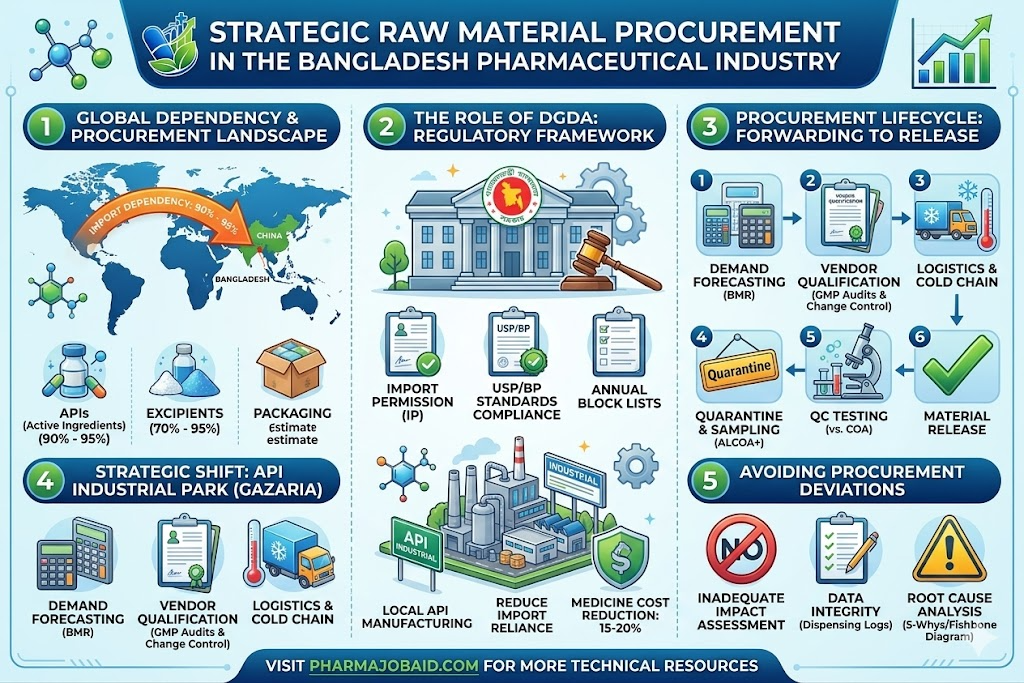
The pharmaceutical sector in Bangladesh represents a rare and significant triumph of domestic industrial policy within the Global South. Over the five decades following national independence, the country has transitioned from a state of near-total reliance on imported finished medicines to a position of formidable self-sufficiency, where local manufacturers now satisfy approximately 98% of the domestic medicinal demand. This trajectory has been facilitated by a robust regulatory framework and a strategic focus on generic drug manufacturing. However, as the industry matures and looks toward the horizon of 2026—the year Bangladesh is slated to graduate from the United Nations’ Least Developed Country (LDC) status—the focus has shifted from the mere assembly of finished dosage forms to the complex, high-stakes domain of raw material procurement and backward integration. The central challenge remains the industry’s profound dependency on imported Active Pharmaceutical Ingredients (APIs), which currently stands at between 85% and 94.6% of the total requirements.
The Macro-Economic Landscape of the Bangladesh Pharmaceutical Market
The domestic pharmaceutical market is currently valued at approximately $6 billion, exhibiting a consistent annual growth rate of 10% to 15%. This sector is not merely a provider of essential healthcare but a cornerstone of the national economy, contributing 1.83% to the GDP and ranking as the second-largest tax-paying industry in the country. The industry’s export reach has also expanded dramatically, with products now reaching over 150 countries, including highly regulated markets such as the United States, the United Kingdom, the European Union, Canada, and Australia. In the fiscal year 2024–25, pharmaceutical exports reached $213 million, a figure that underscores the global recognition of Bangladeshi manufacturing quality.
This growth is driven by several converging factors. An aging population and a rising incidence of chronic conditions such as diabetes, cardiovascular disease, and oncological ailments have created a sustained demand for complex formulations. Furthermore, the industry is moving beyond simple generics into high-value segments, including biosimilars, insulin, hormones, anti-cancer drugs, and specialized delivery systems like Metered Dose Inhalers (MDIs) and Dry Powder Inhalers (DPIs).
Key Market Indicators and Projections
| Indicator | Value/Status (2024-2025) | Growth/Context |
| Market Size | ~$6 Billion | Projected CAGR of 12% |
| Export Value | $213 Million | Up from $100M seven years ago |
| Domestic Market Control | 98% Local | Dominated by top 20 firms (92.2% share) |
| API Import Dependence | 85% – 94.6% | Costs $1.3B – $1.5B annually |
| Manufacturing Base | 295 Allopathic Firms | ~150 companies are actively producing |
| Labor Cost Advantage | Monthly ~$68.99 | 15% lower than regional peers |
The industry’s structural resilience was tested and proven during the Covid-19 pandemic, where the rapid production and export of antiviral drugs like Remdesivir and Favipiravir established Bangladesh as a reliable global supplier during times of crisis. However, the pandemic also highlighted the fragility of the supply chain, as disruptions in the primary source markets for raw materials—China and India—led to immediate upstream cost pressures.
The Global API Supply Chain and the China-India Nexus
Active Pharmaceutical Ingredients (APIs) are the core therapeutic components of any medication, providing the intended pharmacological effect. For Bangladesh, the procurement of these ingredients is almost entirely externalized. China and India are the dominant suppliers, with India alone providing approximately 30% of the raw material requirements. This geographical concentration creates a significant strategic vulnerability.
The global API market is projected to reach $238.38 billion by 2025, growing to $405.09 billion by 2034. As the global demand for treatments for chronic diseases and biotech advancements increases, the competition for high-quality APIs will intensify. Bangladesh currently relies on these neighbors not only for the APIs themselves but also for the crude chemicals and intermediates required by the few local firms that do produce APIs at scale.
Supply Chain Vulnerabilities and Geopolitical Risks
The dependency on India and China is compounded by the structural vulnerabilities of their own supply chains. For instance, India receives roughly 40% of its crude oil through the Strait of Hormuz, and any disruption in that region impacts the production of petroleum-based solvents and intermediates used in API synthesis. When Indian pharmaceutical sectors face export disruptions—estimated to cost between INR 2,500 crore and INR 5,000 crore in certain crisis scenarios—the impact is felt immediately in Bangladesh through rising input costs and delayed shipments.
Furthermore, many firms in the source countries have faced situations where they were unable to take new orders due to their own raw material shortages, leaving Bangladeshi procurement managers with limited options. While most large Bangladeshi firms maintain an inventory buffer of three to six months, the long-term outlook remains sensitive to the macroeconomic stability of the regional giants.
Regulatory Framework and Procurement Protocols in Bangladesh
The procurement and importation of pharmaceutical raw materials are strictly regulated by the Directorate General of Drug Administration (DGDA), which serves as the National Regulatory Authority (NRA) under the Ministry of Health and Family Welfare. The legal basis for these operations has recently been updated with the passage of the Drugs and Cosmetics Act 2023, which consolidated and modernized regulations previously held under the 1940 Drugs Act and the 1982 Drug Control Ordinance.
The Block List Management System
The primary mechanism for controlling raw material imports is the “Block List.” In the Bangladeshi context, a Block List is a standardized format used by manufacturers to obtain prior approval from the DGDA for the import of specific quantities of raw and packaging materials.
The preparation and management of the Block List involve several critical steps:
- Source Validation: Before an API can be included in a Block List, the specific manufacturing plant and the API itself must be pre-validated and included in the DGDA database. This process is usually initiated by a local representative or indenting firm and takes approximately 30 working days to secure a validation certificate, which remains valid for three years.
- Import Restrictions: Only finished formulators holding a valid Drug Manufacturing License are permitted to import APIs. Commercial traders are legally barred from importing these ingredients, ensuring that the chain of custody remains within the control of qualified pharmaceutical entities.
- Industrial IRC: Imports are conducted using the firm’s industrial Import Registration Certificate (IRC), which reflects the manufacturing capacity and needs of the facility.
- Quantity and Forecast Alignment: The Block List must align with the company’s production forecast and the “Recipe Registration” approved by the DGDA.
Import Permissions and Customs Clearance
Following the approval of the Block List, firms must apply for an Import Permission (IP) for individual consignments. This ensures that every shipment arriving at the port is authorized under the broader Block List parameters.
| Documentation for Customs Clearance | Regulatory Significance |
| Bill of Entry (B/E) | Formal declaration of goods via ASYCUDA World system |
| Invoice and Packing List | Detailed weight, quantity, and financial valuation |
| Letter of Credit (L/C) | Financial instrument required for most imports |
| Certificate of Analysis (CoA) | Verification that the batch meets pharmacopoeial standards |
| Country of Origin Certificate | Mandatory for most goods to confirm source |
| Insurance Cover Note | Mandatory risk protection for the shipment |
For imported chemicals, the Customs Authority may require laboratory testing at the port of entry if the shipment lacks certification from an accredited laboratory in the exporting country. Goods must generally be cleared within 21 days at an airport or 30 days at a seaport, failing which they may be subject to auction or disposal.
The API Industrial Park: Gazaria, Munshiganj
The most significant strategic initiative to reduce raw material dependency is the Active Pharmaceutical Ingredients (API) Industrial Park, established by the Bangladesh Small and Cottage Industries Corporation (BSCIC) in Gazaria, Munshiganj. Spanning 200 acres, the park is designed to accommodate 42 plots allocated to 27 leading pharmaceutical companies.
Infrastructure and Planned Facilities
The API Industrial Park aims to provide a centralized, environmentally controlled ecosystem for chemical synthesis. Key features include:
- Central Effluent Treatment Plant (CETP): A critical requirement for the hazardous waste management inherent in API production.
- Waste Dumping Yard: For the safe disposal of solid industrial waste.
- Employment: Projected to create approximately 25,000 jobs upon full operation.
Current Operational Status and Challenges
Despite its strategic importance, the park has been plagued by delays for over 15 years. As of early 2025, the status of key players in the park is as follows:
| Company | Status in API Industrial Park (2024-2025) |
| ACME Laboratories | Production ready; slated to begin operations |
| Healthcare Pharmaceuticals | Infrastructure built; preliminary works initiated |
| Axis Pharmaceuticals | API plant construction completed |
| Ibn Sina Pharmaceuticals | Plant construction in progress |
| Unimed-UniHealth | Plant construction in progress |
| Square, Beximco, ACI | Stalled due to lack of gas and utility connections |
The lack of consistent gas and electricity supply remains the primary bottleneck. API manufacturing requires massive, uninterrupted energy for precise chemical reactions. Furthermore, the complexity of obtaining up to 20 different No Objection Certificates (NOCs) from various government departments—such as the Department of Narcotics Control for solvent use—has deterred many investors. Industry experts estimate that if the park were fully functional, local production could cover up to 50% of the country’s API needs.
Quality Management and Vendor Qualification
In the pharmaceutical domain, raw material procurement is not merely a commercial transaction; it is a quality-critical event. Good Manufacturing Practice (GMP) standards, as set by the DGDA and aligned with WHO guidelines, dictate the protocols for raw material handling.
The 5 Ps of GMP in Bangladesh
The “5 Ps” framework is central to maintaining quality throughout the procurement and production process in Bangladesh :
- People: Personnel involved in procurement and QC must be trained in GMP and GDP (Good Distribution Practice).
- Products: Raw materials must meet predefined pharmacopoeial or internal specifications.
- Processes: Documented methods for sampling, testing, and releasing materials.
- Procedures: Standard Operating Procedures (SOPs) for every task to ensure consistency.
- Premises: Facilities must be designed to prevent cross-contamination and ensure proper storage.
Vendor Qualification and Auditing
Pharmaceutical companies are legally responsible for verifying that their raw material suppliers adhere to GMP standards. This qualification process involves:
- Initial Gap Analysis: Identifying deviations in the vendor’s QMS.
- On-site Audits: Physical inspection of the vendor’s manufacturing site to evaluate facility cleanliness, equipment calibration, and documentation practices.
- Quality Agreements: Formal contracts that define the quality responsibilities of both parties.
- Ongoing Monitoring: Periodic re-audits and performance reviews to ensure continued compliance.
The risk of poor vendor qualification is severe, potentially leading to product contamination, incorrect formulations, regulatory fines, and damaging product recalls.
Data Integrity and the ALCOA+ Principles
Modern pharmaceutical procurement and quality control are increasingly defined by the integrity of the data generated. The ALCOA+ framework is the global standard for ensuring that GxP data is trustworthy.
| ALCOA Principle | Application in Raw Material Testing |
| Attributable | Testing results must be traceable to the specific analyst and instrument. |
| Legible | Records must be readable and permanent, avoiding shared logins. |
| Contemporaneous | Data must be recorded at the time the observation is made. |
| Original | The first capture of data (raw instrument files) must be retained. |
| Accurate | Results must reflect the true observation without rounding errors or falsification. |
| Complete | All data, including failed tests or deviations, must be included. |
| Consistent | Records must follow a logical, timestamped sequence. |
| Enduring | Data must be stored in durable, validated systems for the required retention period. |
| Available | Data must be promptly retrievable for DGDA or international audits. |
The breach of data integrity—such as deleting “bad” test results or overwriting raw data—is a major focus area for regulatory inspectors and can lead to the immediate suspension of manufacturing licenses.
Logistics, Cold Chain, and Supply Chain Resilience
The physical procurement of raw materials faces significant logistical challenges in Bangladesh, ranging from climate sensitivity to port congestion.
Cold Chain Management for APIs
Many APIs and biological raw materials are highly temperature-sensitive, requiring a cold chain that maintains a precise window—sometimes as narrow as a few degrees.
- Stability Risks: Exposure to heat or moisture during the monsoon season can degrade the efficacy of these ingredients.
- Infrastructure: Effective cold chain management relies on advanced equipment, real-time temperature monitoring, and specialized warehouses.
- Transportation: The journey from global ports through the “last mile” to local warehouses involves risks during loading and unloading, necessitating robust SOPs and industry expertise.
Port Operations and Infrastructure Gaps
The primary points of entry for pharmaceutical raw materials are Chittagong Seaport and Dhaka International Airport.
- Airport Bottlenecks: Hazrat Shahjalal International Airport (HSIA) has historically suffered from failures in X-ray cargo screening machines, causing massive backlogs of air freight.
- ICD Limitations: Inland Container Depots (ICDs) often lack the specialized facilities required for handling hazardous or temperature-controlled pharmaceutical cargo.
- Customs Delays: The manual processing of samples valued over $100 and the need for chemical testing for unknown substances can extend lead times significantly.
The implementation of the ASYCUDA World system has improved the efficiency of goods declaration, but the physical infrastructure remains a hurdle to seamless supply chain operations.
Digital Transformation: Towards Pharma 4.0
To mitigate human error and improve regulatory compliance, the Bangladesh pharmaceutical industry is undergoing a significant digital transformation. The move toward “Pharma 4.0” involves the integration of high-level digital tools into the supply chain and production floor.
Electronic Batch Records (EBR)
The transition from paper-based manufacturing records to Electronic Batch Records (EBR) is a key feature of this transformation.
- Accuracy: EBR systems guide operators through manufacturing steps, capturing data in real-time and reducing manual entry errors.
- Traceability: These systems provide full traceability from the raw material component to the finished product, which is essential for rapid batch recalls.
- Review-by-Exception: EBR allows quality teams to focus only on deviations, speeding up the batch release process and reducing time-to-market.
Enterprise Resource Planning (ERP) and eQMS
Leading firms like Beximco and Square have implemented SAP S/4HANA to serve as the “digital core” of their operations.
- SAP S/4HANA: This platform integrates procurement, production, inventory, and finance. For pharma, the SAP Advanced Track and Trace for Pharmaceuticals (ATTP) module is used for serialization and compliance with global anti-counterfeiting laws.
- Parallel Execution: Modern implementation strategies favor running ERP and EBR programs in parallel. This approach ensures that master data from the financial and supply chain layers aligns perfectly with the manufacturing execution layer from the start.
- Sustainability: Digitizing quality workflows (eQMS) has led to measurable environmental gains, with some firms reporting up to a 53% reduction in paper usage in the first phase of implementation.
| System Integration | Role in Procurement and Compliance |
| SAP S/4HANA (ERP) | Manages material requirements planning (MRP) and vendor financials. |
| Electronic Batch Records (EBR) | Captures real-time manufacturing data and material usage. |
| LIMS / eQMS | Manages laboratory testing of raw materials and CAPA workflows. |
| SAP ATTP | Tracks serial numbers and ensures end-to-end traceability. |
The adoption of these technologies is not merely an efficiency play but a strategic move to build “trust with regulators, investors, and the public” as Bangladesh enters more strictly regulated international markets.
Scientific and Technical Evaluation of Raw Materials
The procurement of APIs requires a nuanced understanding of the physical chemistry of the molecules. Two of the most critical factors are polymorphism and particle size distribution.
Polymorphism in APIs
Polymorphism refers to the ability of a substance to exist in multiple crystalline forms while having the same chemical formula.
- Physicochemical Properties: Different polymorphs can have vastly different melting points, solubilities, and dissolution rates.
- Bioavailability: The structural state (amorphous vs. crystalline) directly influences how the drug is absorbed by the body. Selecting the wrong polymorph can render a drug ineffective or unstable over its shelf life.
- Manufacturing Impact: The arrangement of molecules in the crystal lattice also affects the “tabletability” and mechanical properties of the powder during compression.
Particle Size and Milling Effects
Milling is frequently used to reduce the particle size of APIs, which generally improves dissolution kinetics and dosage accuracy.
- Structural Transformations: However, high-energy milling can induce amorphization or unwanted polymorphic transformations. For example, the stable γ form of sorbitol can transform into a metastable α form after three hours of milling.
- Analytical Control: Techniques such as X-ray Diffraction (XRD), Differential Scanning Calorimetry (DSC), and Infrared (IR) Spectroscopy are mandatory for procurement and QC teams to monitor any transformations that occur during processing.
Understanding these properties is crucial for pre-formulation and ensures that the raw materials procured are suitable for the intended therapeutic use.
The Turning Point: LDC Graduation and TRIPS Flexibilities
The most pressing strategic challenge for the Bangladesh pharmaceutical industry is the scheduled graduation from Least Developed Country (LDC) status in November 2026.
The TRIPS Advantage
As an LDC, Bangladesh currently benefits from the WTO TRIPS (Trade-Related Aspects of Intellectual Property Rights) waiver, which allows the country to produce and export patented medicines without paying royalties. This waiver has been extended for pharmaceutical products until 2033, but the graduation from LDC status in 2026 will remove other trade-related flexibilities.
Strategic Implications for Procurement
The post-graduation landscape will demand a shift in procurement strategy:
- Cost Escalation: Currently, local companies can produce patented drugs by sourcing raw materials from non-patent-enforcing jurisdictions. After 2026, the cost of raw materials may rise as firms must navigate a more rigid global IP environment.
- Self-Reliance as Survival: If Bangladesh continues to import 90% of its APIs at international prices while also facing royalty pressures, its competitive edge in the global generic market will erode.
- Policy Support: The government offers a 5% to 6% export subsidy on pharmaceutical products and APIs, but these may be challenged under WTO rules post-graduation, making the inherent efficiency of the supply chain even more critical.
Conclusions and Strategic Outlook
The Bangladesh pharmaceutical industry is a victim of its own success. Having mastered the art of formulation and global distribution, it now faces a “bottleneck” at the very beginning of its value chain: the raw material. The strategic procurement of APIs is no longer just a function of purchasing; it is a complex intersection of geochemistry, global logistics, digital data integrity, and international trade law.
To maintain its growth trajectory and navigate the challenges of LDC graduation, the industry must prioritize:
- Backward Integration: Completing and operationalizing the API Industrial Park is the single most important task for the next 24 months. The provision of utility infrastructure (gas and power) is a non-negotiable requirement for national healthcare security.
- Digital Excellence: The shift to EBR and SAP-driven supply chains is essential for meeting the data integrity standards of the USFDA and EMA, which will be the primary growth markets post-2026.
- Strategic Diversification: Reducing the reliance on the China-India duopoly by exploring new sources for intermediates and high-value APIs will build resilience against regional shocks.
- Regulatory Modernization: Continuous capacity building within the DGDA to handle biosimilars and complex molecules will ensure that the regulatory apparatus does not become a bottleneck for innovation.
In conclusion, while the challenges are significant, the Bangladesh pharmaceutical sector has a proven track record of resilience and policy-driven growth. By securing its raw material base and embracing the digital tools of the fourth industrial revolution, the industry is well-positioned to evolve from a regional success story into a truly self-reliant global pharmaceutical hub.
- tbsnews.netCan Bangladesh’s pharma sector close its API amid supply chain …Opens in a new windowtbsnews.netBangladesh’s pharma industry moves from import dependence to global prominenceOpens in a new windowmbr.idlc.comPharmaceutical Industry in Bangladesh: Upholding Global Standards, Expanding Global Reach – IDLC HomeOpens in a new windowmedium.comBangladesh’s Pharma Industry Has a Problem — And Time is Running Out – MediumOpens in a new windowinvestbangladesh.gov.bdBangladesh Pharmaceutical & API IndustryOpens in a new windowgosgmp.ruAccess to Bangladeshi Pharmaceutical Market for Foreign …Opens in a new windowactizaindustry.comGlobal API Market 2025 Growth drivers strategies for pharma – ACTIZA IndustryOpens in a new windowbapi-bd.comBrief Outline – Bangladesh Association of Pharmaceutical Industries (BAPI)Opens in a new windowscribd.comAPI Industry Feasibility in Bangladesh | PDF | Pharmaceutical Drug – ScribdOpens in a new windowscribd.comOverview of DGDA’s Regulatory Role in Bangladesh | PDF | Food And Drug AdministrationOpens in a new windowscribd.comPharmaceutical Approval Process in Bangladesh | PDF | Generic Drug | Medicine – ScribdOpens in a new windowpharmadra.netTraining–Regulatory affairs – Pharma DRAOpens in a new windowgain.fas.usda.govRegistered No DA -1 – ”May the birth centenary celebrations of the Father of the Nation Bangabandhu Sheikh Mujibur Rahman be successful”Opens in a new windowcbcctg.gov.bdJ.1 Standard Operating Procedures For Import/Export and Customs ClearanceOpens in a new windowbangladeshcustoms.gov.bdCustoms Clearance – Bangladesh Customs, National Board of Revenue (NBR)Opens in a new windowbangladeshtradeportal.gov.bdImport shall be made as per following procedure – Bangladesh Trade PortalOpens in a new windowgrzanglobal.comBangladesh Product Registration | DGDA Medical Device Cosmetic Health FoodOpens in a new windowtrade.govBangladesh – Prohibited & Restricted Imports – International Trade AdministrationOpens in a new windowbangladeshcustoms.gov.bdFees and Charges Links – Bangladesh Customs, National Board of Revenue (NBR)Opens in a new windowtoday.thefinancialexpress.com.bdExpediting completion of API industrial park – The Financial ExpressOpens in a new windowinvestbangladesh.coProduction at API Industrial Park to begin next month – Invest …Opens in a new windowen.prothomalo.comDrug-manufacturing raw material industry fails to take off | Prothom AloOpens in a new windowcertease.comGMP Certification in Bangladesh – CERTEASEOpens in a new windowhmsuniversal.comGood Manufacturing Practices (GMP) Certification for Pharmaceuticals in BangladeshOpens in a new windowpharmaregulatory.inGMP Compliance and Inspection Standards in Bangladesh – pharma gxpOpens in a new windowresearchgate.net(PDF) PHARMACEUTICAL SUPPLY CHAIN MANAGEMENT: AN …Opens in a new windowbasciences.comWhat is Raw Material Testing? Standards for Quality Assurance – BA SciencesOpens in a new windowinglasia.comHow Vendor Qualification in Pharma Ensures Product Safety and ComplianceOpens in a new windowgmp-compliance.orgThe GMP Requirements for Supplier Qualification – ECA AcademyOpens in a new windowtotallab.comALCOA & ALCOA+ Principles Explained | Pharma Data Integrity Guide – TotalLabOpens in a new windowapotechconsulting.comALCOA+ Principles & Data Integrity In Pharma – Apotech ConsultingOpens in a new windowyoutube.comALCOA and ALCOA+ in Pharmaceuticals | Principles of ALCOA | Data Integrity PrinciplesOpens in a new windowodihpn.orgHow our small organisation struggles against logistics challenges in BangladeshOpens in a new windowamchambd.orgLogistics Sector in Bangladesh – Opportunities & ConcernsOpens in a new windowepgna.comPharmaceutical Cold Chain Management: Challenges, Best Practices, and SolutionsOpens in a new windowresearchgate.netDigital Transformation in the Pharmaceutical Industry: Enhancing Quality Management Systems and Regulatory Compliance – ResearchGateOpens in a new windowpmc.ncbi.nlm.nih.govDigitalization enhancement in the pharmaceutical supply network using a supply chain risk management approach – PMCOpens in a new windowmdpi.comThe Effect of Digital Transformation on the Pharmaceutical Sustainable Supply Chain Performance: The Mediating Role of Information Sharing and Traceability Using Structural Equation Modeling – MDPIOpens in a new windowpharmaguideline.comElectronic Batch Record (EBR) Validation Strategy in Pharmaceuticals | PharmaguidelineOpens in a new windowpscsoftware.comThe Role of Electronic Batch Records in Modern Manufacturing | PSC SoftwareOpens in a new windowbatchline.comHow EBR Supports Sustainable Pharma Operations – with BatchLine Lite MESOpens in a new windowinis.iaea.orgDesign and Implementation of Electronic Batch Record Systems for Pharmaceutical Manufacturing Documentation – INIS-IAEAOpens in a new windowtechatalyst.comSolving Complex Pharma Compliance Issues with RISE SAP Implementation – TechatalystOpens in a new windowintuitionlabs.aiSAP in the Pharmaceutical Industry: Enterprise Solutions for Drug Development and Manufacturing | IntuitionLabsOpens in a new windowfactory-talk.comBreaking Quality Silos: From Paper to Connected eQMS – FactorytalkOpens in a new windowvimachem.comAccelerating Value Through Digitization: A CDMO Case Study on Parallel ERP & eBR Implementation – VimachemOpens in a new windowpscsoftware.comWhy Life Sciences Companies Must Embrace Digital Quality Systems | PSC SoftwareOpens in a new windowpmc.ncbi.nlm.nih.govPolymorphic Transformations of Pharmaceutical Materials Induced by Mechanical Milling: A Review – PMCOpens in a new windowhilarispublisher.comImpact of Polymorphism and Particle Size on the Bioavailability of Active Pharmaceutical Ingredients – Hilaris PublisherOpens in a new windowrjptonline.orgPolymorphism: Quality rationalization, mitigation and authentication strategies with respect to regulatory compliances in pharmaceutical industry – Research Journal of Pharmacy and TechnologyOpens in a new windowpmc.ncbi.nlm.nih.govUnderstanding the Multidimensional Effects of Polymorphism, Particle Size and Processing for D-Mannitol Powders – PMCOpens in a new windowstrapi.eacgermany.orgPharmaceutical Manufacturing in Bangladesh – A Success Story. What can we learn? – your Strapi appOpens in a new window