
Explore the most common pharmaceutical deviations in Bangladesh: Learn expert Root Cause Analysis (RCA) techniques and CAPA strategies for DGDA & GMP compliance
The pharmaceutical landscape in Bangladesh has evolved from a local manufacturing hub to a sophisticated global exporter. As firms under the banner of the Directorate General of Drug Administration (DGDA) strive for international accolades such as WHO-GMP, USFDA, and UK MHRA approvals, the management of Pharmaceutical Deviations has become the cornerstone of Quality Assurance. At PharmaJobAid.com, we recognize that understanding deviations is not just about compliance—it’s about operational excellence.
1. Defining the Deviation Landscape
In the context of Good Manufacturing Practices (GMP), a deviation is defined as any unplanned or unapproved departure from an established standard or approved instruction. Whether it is a batch record instruction, a Standard Operating Procedure (SOP), or a validated process parameter, any “drift” from the norm must be documented.
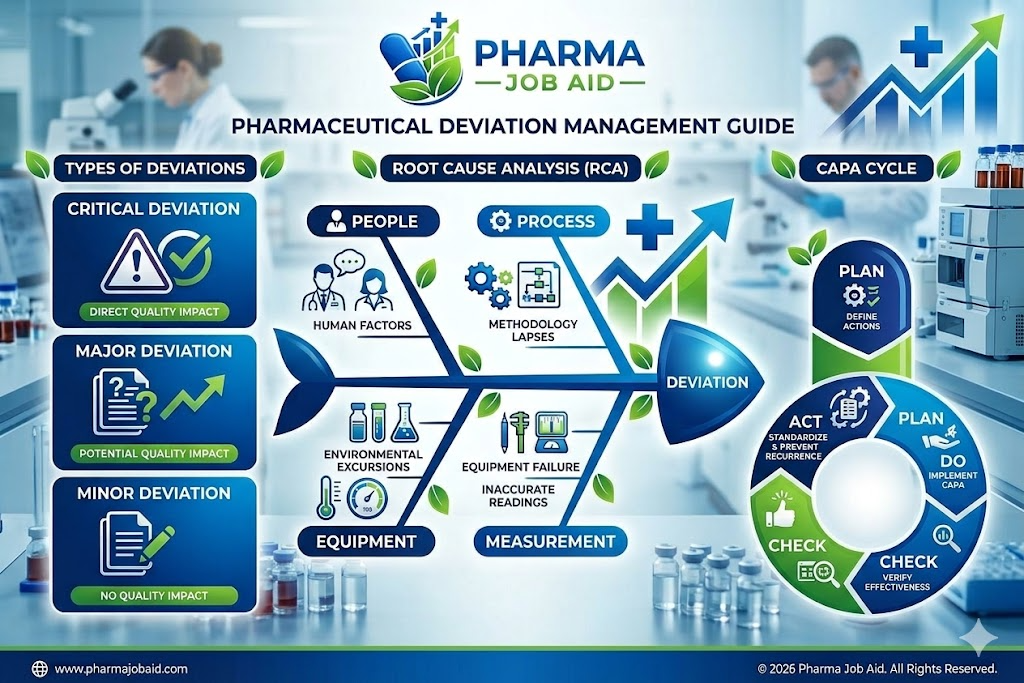
Types of Deviations:
- Critical Deviations: Those that have a direct impact on the identity, strength, quality, purity, or safety of the product. Examples include cross-contamination or total failure of a sterilization cycle.
- Major Deviations: Departures that could potentially affect product quality but are not immediately life-threatening. Examples include an Out-of-Specification (OOS) result in stability testing.
- Minor Deviations: Minor procedural lapses that do not affect the product’s final quality, such as a typographical error in a non-critical logbook.
2. Common Deviations in the Bangladesh Pharma Industry
Despite the rapid growth of the sector, certain recurring patterns emerge during audits. Understanding these common pitfalls is essential for any professional visiting PharmaJobAid.com for career growth.
A. Failure in Root Cause Analysis (RCA)
The most frequent citation by regulatory bodies is the “Failure to conduct a thorough investigation”. Many firms in Bangladesh still rely on “Human Error” as a catch-all root cause. Regulators increasingly view “Human Error” not as a cause, but as a symptom of poor system design, inadequate training, or ambiguous SOPs.
Key Statistic: Industry data suggests that nearly 60% of deviations are initially attributed to human error, but deeper analysis reveals that 80% of those cases involve flawed processes.
B. Data Integrity Lapses (ALCOA+ Compliance)
Data integrity remains a significant challenge. Deviations often involve back-dating entries, shared passwords for lab equipment, or the deletion of “trial runs” in HPLC systems. In a globalized market, “Trust but Verify” has been replaced by “Verify through Audit Trails”.
C. Environmental Monitoring (EM) Excursions
Given Bangladesh’s tropical climate, deviations related to Relative Humidity (RH) and Temperature are extremely common. A deviation occurs when the HVAC system fails to maintain the Grade A or B environment, potentially compromising sterile manufacturing.
3. The Science of Root Cause Analysis (RCA)
To effectively manage a deviation, one must look beyond the surface. Modern pharma professionals must be proficient in the following tools:
The 5-Whys Technique
This is a simple yet powerful iterative interrogative technique used to explore the cause-and-effect relationships underlying a particular problem. By repeating the question “Why?” five times, you can usually peel away the layers of symptoms which can lead to the root cause.
Fishbone (Ishikawa) Diagram
This tool categorizes potential causes of problems into several main categories:
| Category | Common Issues in Bangladesh Pharma |
| Manpower | Lack of training, fatigue, high turnover. |
| Machine | Lack of preventive maintenance, calibration failure. |
| Methods | Ambiguous SOPs, outdated validation protocols. |
| Materials | Variability in API from different vendors. |
| Measurement | Inaccurate scales, sensor drift. |
4. Effective CAPA Management
The Corrective and Preventive Action (CAPA) system is the engine that drives continuous improvement. A deviation without an effective CAPA is merely a paperwork exercise.
Corrective Action vs. Preventive Action:
- Corrective Action: Action taken to eliminate the cause of a detected non-conformity (Fixing the past).
- Preventive Action: Action taken to eliminate the cause of a potential non-conformity (Securing the future).
Example: If a tablet press breaks down, replacing the part is a Correction. Analyzing the wear pattern and updating the maintenance schedule is a Corrective Action. Implementing the same schedule for all similar machines in the facility is a Preventive Action.
5. Global Regulatory Standards and Bangladesh
The DGDA has been working tirelessly to align with PICS/S (Pharmaceutical Inspection Co-operation Scheme). This means that local manufacturers are now expected to follow the same rigor as those in Europe or the US.
The Impact of ICH Q10: The International Council for Harmonisation (ICH) Q10 guideline describes a model for a pharmaceutical quality system. It emphasizes that Senior Management is responsible for ensuring an effective deviation management system is in place. If you are an aspirant on PharmaJobAid.com, understanding ICH Q10 is non-negotiable for leadership roles.
6. Digital Transformation in Deviation Handling
The era of paper-bound logbooks is fading. Modern Bangladeshi plants are adopting Quality Management Software (eQMS). Digital systems offer:
- Real-time tracking of deviation aging.
- Automated alerts for CAPA deadlines.
- Seamless integration with Batch Electronic Records.
7. Career Insights: Becoming a Deviation Specialist
At PharmaJobAid.com, we see a growing demand for “Quality Compliance Officers” and “Investigation Specialists”. To excel in this field, you need a mix of technical knowledge (Chemistry/Pharmacy) and analytical skills.
Professional Tip: When writing a deviation report, always use the Passive Voice for objectivity and ensure that the narrative is chronological. Avoid subjective terms like “I think” or “Perhaps”. Use data-driven statements.
8. Conclusion
Pharmaceutical deviations are inevitable in complex manufacturing environments. However, they are not failures; they are data points. By embracing a robust RCA and CAPA framework, the Bangladesh pharmaceutical industry can continue its journey toward becoming a global powerhouse. For more templates, job circulars, and technical guides, stay connected with PharmaJobAid.com—your partner in pharmaceutical excellence.