
In the pharmaceutical industry, Quality Control (QC) laboratories play a critical role in ensuring that raw materials, in-process samples, and finished products comply with predefined specifications and regulatory requirements set by organisations like the World Health Organisation, International Council for Harmonisation, and the Directorate General of Drug Administration. QC instruments are essential tools that help maintain product quality, safety, and efficacy. Each instrument serves a specific analytical or physical testing purpose.Major QC Instruments in Pharmaceutical Industry and Their Purpose
Quality Control (QC) laboratories are the backbone of pharmaceutical quality systems, ensuring that all materials and finished products meet regulatory standards defined by the World Health Organization, International Council for Harmonisation, and Directorate General of Drug Administration.
With the advancement of pharmaceutical science, QC laboratories are no longer limited to conventional instruments like HPLC or UV spectrophotometers. Modern laboratories now integrate high-resolution, automated, and hybrid analytical technologies to ensure higher sensitivity, accuracy, and compliance.
Role of QC Instruments in Pharmaceutical GMP System
Before diving into instruments, it is important to understand their regulatory significance.
QC instruments are used to:
- Verify raw material identity (RM testing)
- Perform in-process quality checks (IPQC)
- Ensure finished product compliance
- Support stability studies (ICH Q1A)
- Detect impurities (ICH Q3A/Q3B/Q3C/Q3D)
- Maintain data integrity (ALCOA+)
👉 In DGDA audits, improper calibration, lack of qualification (IQ/OQ/PQ), or data integrity issues in QC instruments are considered major observations.
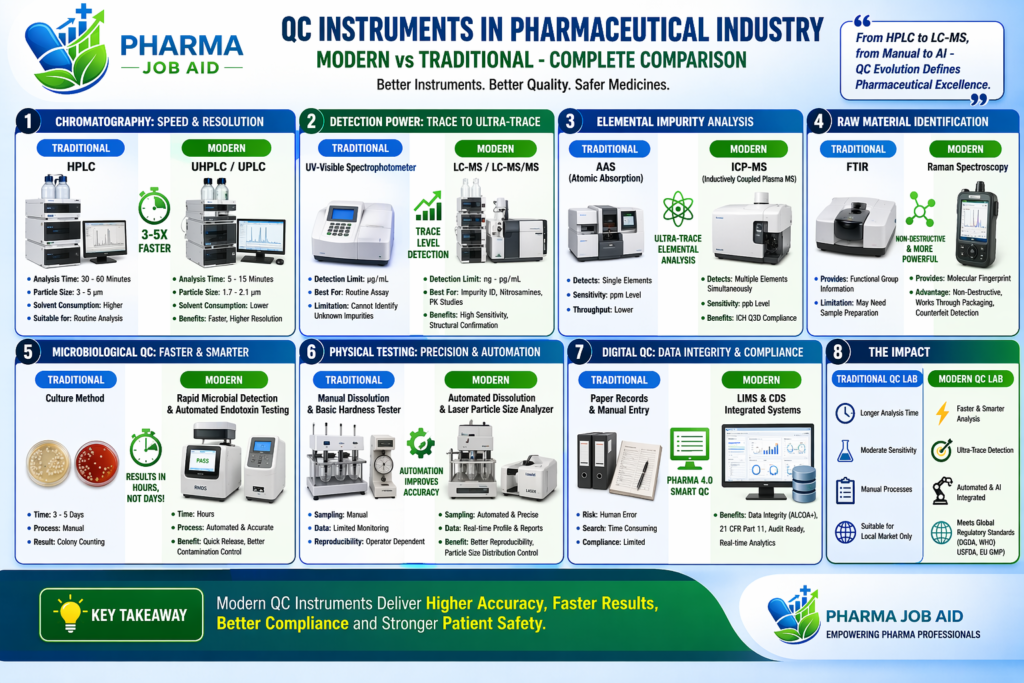
1. Conventional Core QC Instruments (Foundation Level)
These remain the backbone of any pharmaceutical QC lab:
- HPLC (High Performance Liquid Chromatography):
Used for assay, impurity profiling, and stability studies. It is considered the gold standard due to its precision and flexibility. - GC (Gas Chromatography):
Used for residual solvent analysis and volatile compounds. - UV-Visible Spectrophotometer:
Used for routine quantitative analysis. - FTIR (Fourier Transform Infrared Spectroscopy):
Used for identification of raw materials and functional groups. - Dissolution, Disintegration, Hardness & Friability Testers:
Essential for solid dosage form evaluation.
2. Advanced Chromatography Systems (Modern QC Upgrade)
Recent advancements in chromatography have significantly enhanced analytical capability.
Ultra High Performance Liquid Chromatography (UHPLC/UPLC):
This system uses smaller particle sizes and higher pressure, resulting in faster analysis and better resolution compared to traditional HPLC.
Rapid Resolution LC (RRLC) & Ultra-Fast LC (UFLC):
Designed for high-speed analysis without compromising accuracy.
Nano Liquid Chromatography (Nano-LC):
A cutting-edge technique used for trace-level analysis, especially in biologics and proteomics.
Supercritical Fluid Chromatography (SFC):
An eco-friendly technique gaining popularity for reducing solvent usage and improving separation efficiency.
👉 Purpose: Faster analysis, reduced solvent consumption, higher sensitivity, and compliance with green analytical chemistry.
3. Hybrid and High-Resolution Analytical Instruments (Latest Trend)
Modern pharmaceutical QC labs are rapidly adopting hybrid systems.
LC-MS (Liquid Chromatography–Mass Spectrometry):
One of the most powerful instruments used for impurity identification, trace analysis, and pharmacokinetic studies.
- Detects compounds at very low concentration levels
- Used for unknown impurity identification
Recent developments include high-resolution systems like Orbitrap and Q-TOF, offering superior sensitivity and accuracy.
LC-MS/MS (Triple Quadrupole):
Used for highly sensitive quantitative analysis in QC and bioanalysis.
GC-MS (Gas Chromatography–Mass Spectrometry):
Used for detailed analysis of volatile impurities and residual solvents.
👉 Purpose: Ultra-trace detection, structural identification, and regulatory compliance for complex molecules.
4. Automated and Digital QC Systems (Pharma 4.0 Integration)
Modern QC laboratories are shifting toward automation and digitalization.
Chromatography Data System (CDS):
Software platforms used for data acquisition, processing, and regulatory compliance (21 CFR Part 11).
Laboratory Information Management System (LIMS):
Manages sample tracking, data integrity, and reporting.
Automated Sample Preparation Systems:
Reduce human error and improve reproducibility.
Recent systems (2024–2025) integrate automation, remote monitoring, and AI-supported analysis for improved efficiency.
👉 Purpose: Data integrity, compliance, audit readiness, and reduced manual error.
5. Advanced Spectroscopy and Elemental Analysis
ICP-MS (Inductively Coupled Plasma Mass Spectrometry):
Used for ultra-trace elemental impurity analysis (ICH Q3D compliance).
NMR (Nuclear Magnetic Resonance Spectroscopy):
Used for structural elucidation and impurity identification.
Raman Spectroscopy:
Non-destructive technique used for raw material identification and counterfeit detection.
👉 Purpose: High specificity identification and elemental analysis at ppm/ppb levels.
6. Modern Microbiological QC Instruments
Microbiological QC is also evolving with rapid detection systems.
Rapid Microbial Detection Systems (RMDS):
Reduce testing time compared to traditional culture methods.
Automated Endotoxin Testing (LAL systems):
Used for pyrogen testing.
Air Samplers & Particle Counters:
Used in cleanroom monitoring.
👉 Purpose: Faster microbial analysis and improved contamination control.
7. Emerging Trends in QC Instrumentation (Future-Ready Labs)
The pharmaceutical industry is moving toward smarter QC systems:
- Miniaturized LC systems: Compact, high-efficiency instruments with reduced sample and solvent usage
- AI-integrated analytical platforms: For predictive analysis and trend monitoring
- Green analytical instruments: Reducing environmental impact
- Multi-attribute method (MAM) using LC-MS: For biologics quality control