CAPA (Corrective and Preventive Action) is not just a documentation exercise—it is a regulatory expectation under Pharmaceutical Quality System (PQS) as per World Health Organization, US Food and Drug Administration, and International Council for Harmonisation.
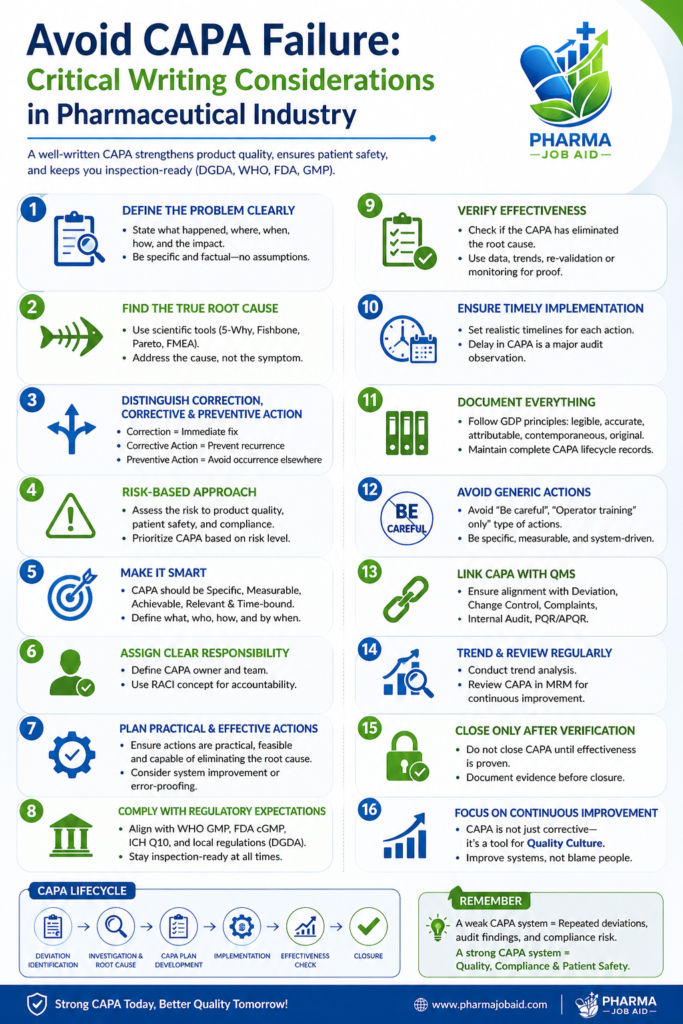
🧩 1. Define the Problem Precisely (No Ambiguity)
A CAPA starts with clear problem definition.
✔ Professional Expectation:
- What happened?
- Where?
- When?
- Batch/Equipment involved?
🔬 Real-Time Example:
Deviation:
Two batches show slightly higher yield than specification (e.g., 102.5% vs 98–102%)
Good Description:
“Finished product yield exceeded upper limit in Batch No. TAB/2026/045 & 046 during compression stage.”
❌ Bad: “Yield high”
🔍 2. Scientific Root Cause Analysis (Mandatory Depth)
Regulators reject superficial root causes.
✔ Tools:
- Fishbone (4M: Man, Machine, Method, Material)
- 5-Why (minimum 4 WHY – audit expectation)
🔬 Real-Time Root Cause (Example):
Problem: High Yield
5-Why Analysis:
- Why high yield? → Excess tablet weight
- Why excess weight? → Compression machine overfill
- Why overfill? → Feeder speed mismatch
- Why mismatch? → No calibration verification before batch
- Why not verified? → SOP gap (no mandatory pre-check)
✔ Final Root Cause:
“Inadequate SOP control for pre-operation feeder speed verification leading to overfill during compression.”
⚠️ 3. Distinguish Correction vs CAPA (Critical Audit Point)
| Type | Meaning | Example |
|---|---|---|
| Correction | Immediate fix | Segregate affected batch |
| Corrective Action | Prevent recurrence | SOP revision + feeder calibration check |
| Preventive Action | Prevent similar issue | Apply to all compression lines |
👉 Regulatory observation: Mixing these = weak CAPA
🧠 4. CAPA Must Be System-Based (Not Blame-Based)
❌ “Operator error”
❌ “Carelessness”
✔ Instead:
- SOP deficiency
- Training gap
- Equipment control failure
🔬 Real Case Insight:
Even if operator made mistake →
Root cause = system allowed the mistake
📊 5. Risk-Based CAPA (Mandatory for GMP)
Evaluate impact on:
- Product quality
- Patient safety
- Regulatory compliance
🔬 Example Risk Evaluation:
- Yield slightly high → Low to Medium Risk
- No content uniformity impact → Acceptable with justification
👉 But CAPA still required (system failure)
⏱️ 6. Time-Bound & Trackable CAPA
✔ GMP Expectation:
- Investigation: ≤30 days
- CAPA completion: defined timeline
🔬 Example:
| Action | Owner | Timeline |
|---|---|---|
| SOP revision | QA | 7 days |
| Training | Production | 10 days |
| Calibration checklist update | Engineering | 5 days |
👉 Overdue CAPA = Major audit finding
🎯 7. SMART CAPA (Professional Standard)
❌ “Provide training”
✔ “Conduct SOP-CP-012 training for 18 operators with ≥80% assessment score by 15 May 2026”
🧾 8. Documentation Integrity (GDP Compliance)
Follow:
- No overwriting
- Signed & dated
- Traceable
Required Records:
- Deviation report
- Investigation report
- CAPA form
- Effectiveness check
👉 Key audit focus by Directorate General of Drug Administration
🔄 9. Effectiveness Check (Most Critical Step)
✔ How to verify:
- Next 3 batches monitoring
- Trend analysis
- No recurrence
🔬 Example:
After CAPA: