
Executive Summary
In the global pharmaceutical landscape of 2026, the Corrective and Preventive Action (CAPA) system is no longer viewed as a mere documentation exercise. It is the engine of continuous improvement. This guide explores why the WHO often cites “Ineffective CAPA” as a major deficiency and provides a granular, step-by-step roadmap to building a system that not only passes inspections but also eliminates the operational waste caused by repeat deviations.
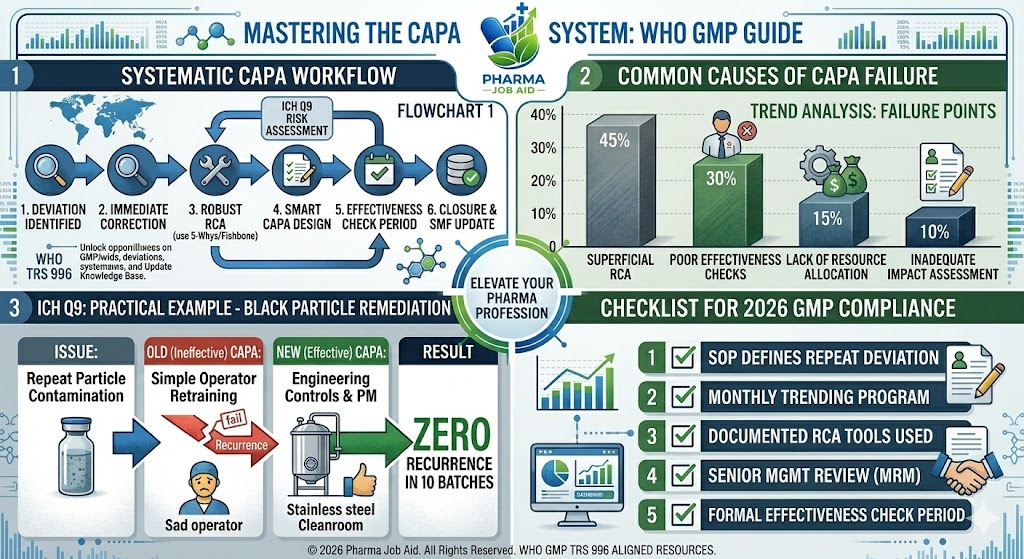
Chapter 1: The Regulatory Anatomy of a CAPA Failure
When a WHO inspector issues an observation stating “CAPA system was ineffective,” they are rarely looking at a single event. They are looking at the trend.
1.1 The “Human Error” Trap
The most common reason for this observation is the “Human Error” fallacy. If a facility attributes $60\%+$ of its deviations to human error and its CAPA to “retraining,” the system is fundamentally broken. Regulatory bodies now expect firms to look at Human Factors Engineering. Was the SOP too complex? Was the lighting poor? Was the interface of the machine counter-intuitive?
1.2 Defining the “Repeat Deviation”
A repeat deviation is a non-conformity that occurs after a CAPA has been implemented for a previous, identical event. This is the ultimate “red flag.” It proves that the initial investigation failed to identify the Root Cause.
Chapter 2: The Advanced Investigation Toolkit (Beyond the Basics)
To remediate an ineffective system, the investigation team must move beyond simple logic and use structured tools.
2.1 The 5-Whys Method (Case Study)
- Problem: Batch 001 failed the assay test.
- Why? The mixing time was insufficient.
- Why? The operator stopped the mixer early.
- Why? The timer on the machine was malfunctioning.
- Why? The timer had not been calibrated in 18 months.
- Why? (Root Cause): The Preventive Maintenance (PM) schedule for that specific equipment type was missing from the Master Calibration List.
2.2 The Ishikawa (Fishbone) Diagram
This tool allows for a 360-degree view of a problem, categorizing causes into:
- Methods: Poor SOPs or validated ranges.
- Materials: Variabilities in API or excipient grades.
- Machines: Mechanical wear, calibration, or software bugs.
- Manpower: Training, fatigue, or staffing levels.
- Measurement: Lab errors or instrument sensitivity.
- Mother Nature: Environmental factors like humidity or temperature.
Chapter 3: Designing “Smart” CAPAs
An effective CAPA must be SMART: Specific, Measurable, Achievable, Relevant, and Time-bound.
3.1 Corrective vs. Preventive
- Correction: Fixing the immediate batch (e.g., re-filtering).
- Corrective Action (CA): Fixing the process to prevent that specific error from happening again.
- Preventive Action (PA): Looking at similar processes in the plant and fixing them before they fail.
Example: If a pump leaks in Area A, the CA is replacing the seal in Area A. The PA is auditing all similar pumps in Area B, C, and D and replacing those seals proactively.
Chapter 4: The Effectiveness Check (The Missing Link)
This is where 90% of pharmaceutical plants fail. You cannot close a CAPA the day you finish the work.
4.1 The Monitoring Phase
An Effectiveness Check (EC) should be a separate, documented phase.
- Quantitative EC: “Review the next 10 batches. If the rejection rate remains below $0.5\%$, the CAPA is effective.”
- Qualitative EC: “Perform a surprise audit of the operator’s technique one month after training.”
Chapter 5: Global Compliance Strategy for 2026
With the Directorate General of Drug Administration (DGDA) in Bangladesh aligning closely with PIC/S and WHO, firms must adopt a “Risk-Based” approach (ICH Q9).
5.1 The Role of Senior Management
WHO inspectors now interview Senior Management. They want to know:
- Is the Quality Unit independent?
- Are enough resources (money/people) allocated to fix the root causes?
- Are CAPA trends discussed in the Management Review Meeting (MRM)?
Chapter 6: Step-by-Step Remediation Plan
If your site has just received an observation, follow this 4-step recovery plan:
- Stop and Analyze: Perform a 2-year retrospective trend analysis.
- Cluster the Failures: Are deviations happening in one department? On one shift? On one machine?
- Re-Open Failed CAPAs: Be brave enough to admit the previous fix didn’t work and re-investigate.
- Update the PQS: Revise your Deviation and CAPA SOPs to include mandatory RCA tools and Effectiveness Checks.
Conclusion: Building a Culture of Quality
An effective CAPA system is a sign of a healthy “Quality Culture.” It rewards honesty, encourages deep thinking, and views every failure as an opportunity to make the plant better. For the Bangladeshi pharmaceutical professional, being an expert in CAPA management is the fastest way to become an indispensable leader in the industry.
Internal Checklist for PharmaJobAid.com Users:
- [ ] Is your RCA documented in a formal report?
- [ ] Does every Major/Critical deviation have a cross-functional team?
- [ ] Are your CAPA due dates being met, or are they constantly extended?
- [ ] Do you have a “Repeat Deviation” metric on your Quality Dashboard?