
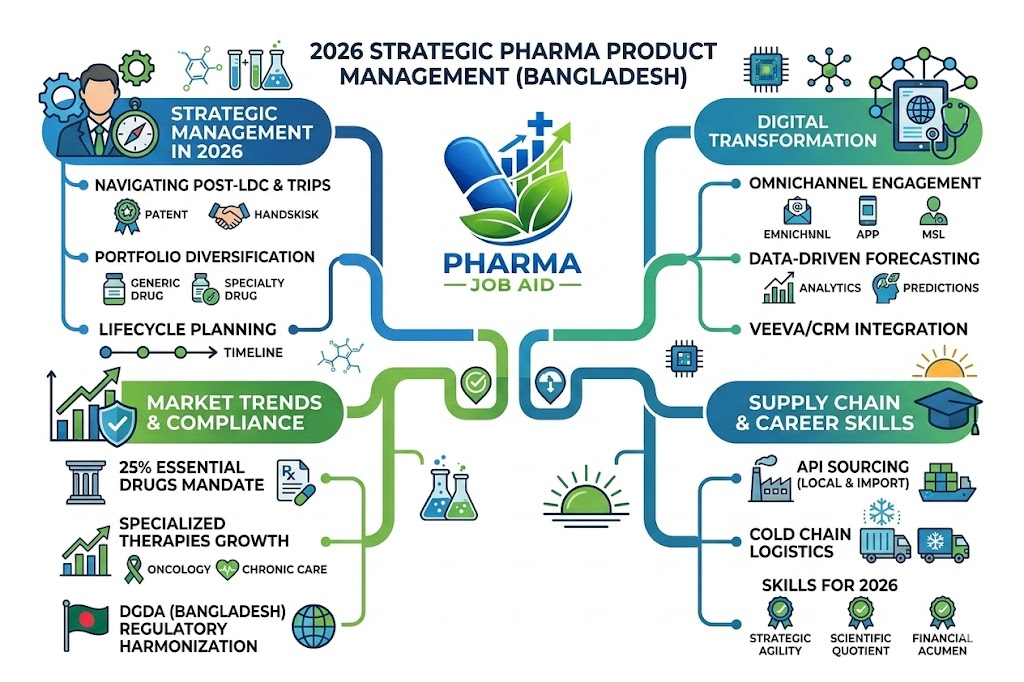
The year 2026 marks the most significant transition in the history of the Bangladesh pharmaceutical industry. With the impending graduation from Least Developed Country (LDC) status and the subsequent expiration of the TRIPS waiver, the role of a Product Manager (PM) has evolved from a marketing support function into a high-stakes executive leadership role.
Chapter 1: The Regulatory Revolution (DGDA & TRIPS 2026)
The “25% Essential Medicines” Mandate
In 2026, the Directorate General of Drug Administration (DGDA) has formalized a policy requiring all Category A pharmaceutical companies to ensure that at least 25% of their total production volume consists of items from the National Essential Medicines List (NEML).
- The PM’s Role: PMs must now manage “Hybrid Portfolios.” You can no longer focus solely on high-margin dermatologicals or specialized oncology drugs. Success is now measured by how efficiently you can market low-margin essential generics to maintain your company’s license to launch high-margin innovative molecules.
Navigating the TRIPS Cliff
By late 2026, the era of “unauthorized reverse engineering” is closing.
- Patent Intelligence: PMs are now working alongside legal teams to conduct “Freedom to Operate” (FTO) searches before every launch.
- Voluntary Licensing (VL): We are seeing a surge in partnerships with global giants (MNCs) where Bangladeshi PMs manage the local distribution of licensed patented molecules, shifting the focus from “copying” to “collaboration.”
Chapter 2: The Shift to Specialized Therapeutic Areas
The generic market for basic NSAIDs and first-generation antibiotics is officially “red ocean” (oversaturated) in 2026. Forward-thinking PMs are pivoting to:
1. Biosimilars and Biologics
With companies like Incepta, Square, and Renata leading the way, the focus is on insulin glargine, monoclonal antibodies (mAbs), and erythropoietin.
- The PM Challenge: Marketing a biosimilar is not like marketing a generic. It requires Scientific Communication and “Evidence-Based Marketing.” PMs are now hiring PhDs as Medical Science Liaisons (MSLs) to support their brand strategies.
2. The Chronic Care Explosion
Bangladesh’s demographic transition has made NCDs (Non-Communicable Diseases) the primary revenue driver.
- Cardiovascular & Metabolic (CVM): PMs are focusing on Triple Fixed-Dose Combinations (FDCs) for hypertension and SGLT2 inhibitors for diabetes.
- Neuro-Psychiatry: Mental health awareness has peaked in 2026, leading to high demand for modern antidepressants and anti-anxiety medications with fewer side effects.
Chapter 3: Digital Transformation & Omnichannel Marketing
The “Medical Representative” (MR) model is no longer enough. In 2026, the most successful PMs utilize an Omnichannel Approach.
The Digital Physician Journey
Doctors in 2026 are “digital natives.” They prefer receiving scientific updates via professional platforms rather than waiting in clinic hallways.
- Veeva/CRM Integration: PMs use AI-driven CRM tools to track exactly when a doctor opens an email or attends a webinar, allowing for “Trigger-Based Marketing.”
- Patient Support Programs (PSPs): To differentiate brands, PMs are launching mobile apps that help patients track their dosage, provide diet plans for diabetics, and offer refill reminders.
Data-Driven Forecasting
In 2026, the “gut feeling” for sales forecasting is dead. PMs use:
- Secondary Sales Data: Real-time data from chemists and distributors.
- Prescription Audits: Using digital prescription tools to see real-time shifts in doctor preferences.
Chapter 4: Supply Chain & API Strategy (2026 Perspective)
Product Management is now deeply integrated with the supply chain. The global supply chain shocks of previous years have taught Bangladeshi PMs that availability is the best marketing.
The API Park & Local Sourcing
With the API Industrial Park in Munshiganj fully operational in 2026, PMs are incentivized to use locally produced Active Pharmaceutical Ingredients.
- NOC Challenges: The DGDA is making it harder to get No Objection Certificates for importing APIs that are already produced locally. PMs must adapt their “Cost of Goods Sold” (COGS) models to reflect local sourcing prices.
Cold Chain Excellence
As the portfolio shifts toward biologics and vaccines, PMs are managing the “Last Mile” of the cold chain. Marketing a vaccine in 2026 means ensuring the doctor that the product was maintained at 2−8°C from the factory floor to the clinic fridge.
Chapter 5: Branding in a Post-Generic World
In 2026, a “Brand” is more than just a name; it is a promise of quality.
Quality-Centric Branding
With the increasing rigor of DGDA inspections and WHO Prequalification, PMs are using Quality as a Competitive Advantage. * Bioequivalence (BE) Studies: Having a BE-tested brand is a massive USP (Unique Selling Point) in 2026. PMs are highlighting these studies in their “Visual Aids” to gain the trust of top-tier consultants.
Value-Added Medicines (VAMs)
If you can’t launch a new molecule, you improve the old one. PMs are focusing on:
- MDIs (Metered Dose Inhalers): Improved actuators for asthma patients.
- Pediatric Formulations: Great-tasting syrups and “dispersible tablets.”
- Sustained Release (SR) Technology: Reducing the pill burden for elderly patients.
The Road Ahead: 2027 and Beyond
As we move toward the end of 2026, the Product Manager in Bangladesh is no longer just a “brochure maker.” They are a Business Unit Head. They must understand IP law, biotech manufacturing, digital algorithms, and complex regulatory frameworks.
Key Skills for the 2026 PM:
- Strategic Agility: Ability to pivot when TRIPS regulations change.
- Scientific Literacy: Understanding the mechanism of action of complex biologics.
- Financial Acumen: Managing P&L (Profit and Loss) in an environment of fluctuating currency and raw material costs.