
In the highly regulated pharmaceutical industry, Quality Control (QC) plays a critical role in ensuring that every product released to the market is safe, effective, and compliant with regulatory standards. From raw material testing to finished product evaluation, QC acts as the final checkpoint before medicines reach patients. In countries like Bangladesh, where compliance with DGDA, WHO GMP, USP, and BP guidelines is mandatory, a strong QC system is not just a requirement—it is a responsibility.
Pharmaceutical QC is a science-driven discipline that combines analytical chemistry, instrumentation, microbiology, and regulatory knowledge to evaluate product quality. Modern QC laboratories rely on a wide range of techniques such as chromatography (HPLC, GC, TLC), dissolution testing, pH measurement, titration, and moisture analysis, along with critical physical tests like hardness, friability, and disintegration. Each of these tests is designed to verify a specific quality attribute, ensuring that the product meets predefined specifications.
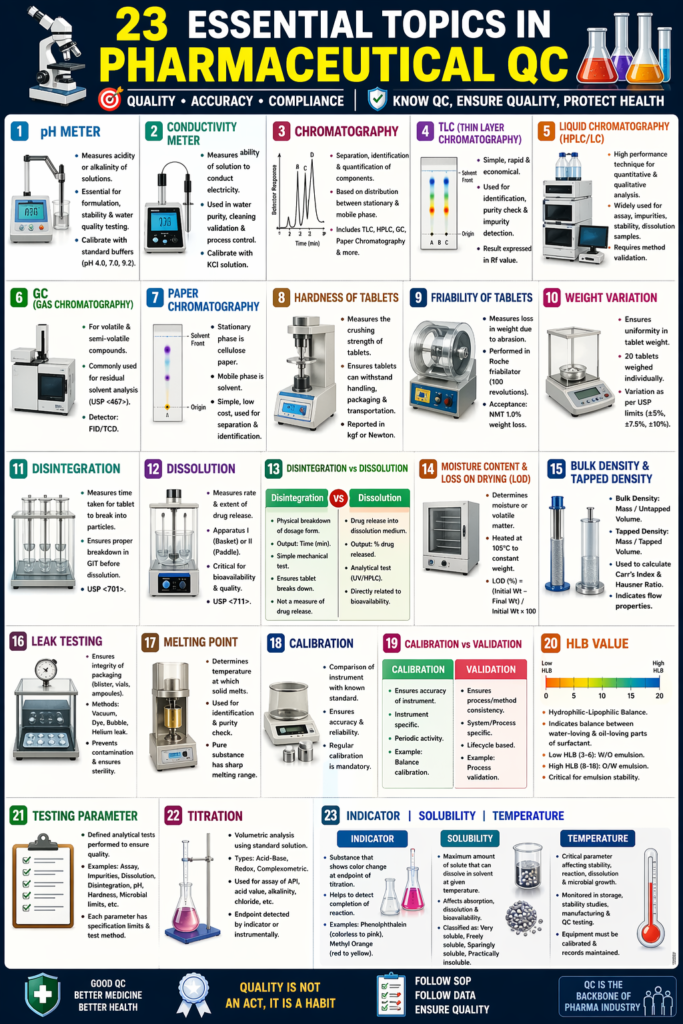
🔹 1. pH Meter in Pharmaceutical QC
A pH meter is an essential analytical instrument used to measure the hydrogen ion concentration of a solution, expressed as pH. In pharmaceutical quality control, pH plays a critical role in ensuring drug stability, solubility, compatibility, and bioavailability. Many formulations such as injectables, ophthalmic solutions, syrups, and suspensions require strict pH control because even slight variation can lead to degradation, precipitation, or reduced therapeutic effect.
The working principle of a pH meter is based on a glass electrode and reference electrode system, which detects the potential difference generated due to hydrogen ion activity. Calibration is performed using standard buffer solutions (pH 4.0, 7.0, and 10.0) before analysis, as per GMP requirements.
In QC laboratories, pH testing is part of in-process control, finished product testing, and stability studies. According to pharmacopeial standards (USP/BP), pH must fall within a specified range. Improper pH can lead to patient irritation (e.g., eye drops), instability of API, and microbial growth risk, making this test highly critical.
🔹 2. Conductivity Meter


5
A conductivity meter measures the ability of a solution to conduct electricity, which directly relates to the presence of ions. In pharmaceutical QC, it is primarily used for water system monitoring, including Purified Water (PW), Water for Injection (WFI), and RO water systems.
Conductivity is a key parameter defined in pharmacopeia (USP <645>) to ensure water purity. High conductivity indicates contamination with ionic substances such as salts, acids, or alkalis. Since water is widely used in manufacturing and cleaning processes, any contamination may directly affect product safety and GMP compliance.
The instrument works by passing an electrical current through the solution and measuring resistance. Regular calibration using standard conductivity solutions is mandatory. Conductivity monitoring is also part of online continuous monitoring systems in modern pharmaceutical plants.
🧪 3. Chromatography (General Principle in Pharmaceutical QC)


6
Chromatography is one of the most critical analytical techniques used in pharmaceutical quality control for the separation, identification, and quantification of components in a mixture. It operates based on the differential distribution of analytes between a stationary phase (solid or liquid supported on solid) and a mobile phase (liquid or gas). The fundamental principle relies on differences in polarity, molecular size, charge, and affinity, which cause compounds to migrate at different rates, resulting in separation.
In pharmaceutical QC, chromatography is extensively applied for assay determination, impurity profiling, degradation product analysis, residual solvent testing, cleaning validation, and stability studies. It forms the backbone of regulatory submissions and must comply with ICH Q2 (R1) Analytical Method Validation guidelines, covering parameters such as specificity, linearity, accuracy, precision, robustness, and detection limits.
From a DGDA/GMP perspective, chromatographic systems must be qualified (IQ/OQ/PQ), calibrated, and system suitability tests (SST) must pass before analysis. Any failure in chromatographic parameters such as tailing factor, resolution, theoretical plates, or retention time variation may lead to batch rejection or investigation (OOS/OOT). Therefore, chromatography is not just an analytical tool but a regulatory-critical system.
🔬 4. Thin Layer Chromatography (TLC)


8
Thin Layer Chromatography (TLC) is a simple, rapid, and economical analytical technique used primarily for qualitative analysis and identification of pharmaceutical compounds. It utilizes a thin layer of adsorbent material (usually silica gel or alumina) coated on a glass, plastic, or aluminum plate as the stationary phase. The mobile phase (solvent system) moves upward by capillary action, carrying the sample components at different rates.
In pharmaceutical QC, TLC is widely used for identity testing, impurity detection, limit tests, herbal drug standardization, and raw material verification. After development, spots are visualized using UV light (254 nm/366 nm) or chemical reagents, and the Retention Factor (Rf value) is calculated:
Rf = Distance traveled by solute / Distance traveled by solvent front
Rf values are compared with reference standards for identification. Although TLC is less sensitive and less precise than HPLC, it remains important due to its simplicity, low cost, and minimal instrument requirement, especially in developing countries and routine screening labs.
From a GMP perspective, solvent systems, plate quality, and environmental conditions (humidity, temperature) must be controlled to ensure reproducibility.
💧 5. Liquid Chromatography (HPLC/LC)


5
High Performance Liquid Chromatography (HPLC) is the most widely used analytical technique in pharmaceutical QC laboratories due to its high sensitivity, accuracy, and reproducibility. It is used for quantitative and qualitative analysis of drug substances and finished products, including assay, related substances, dissolution samples, preservatives, and stability-indicating methods.
The HPLC system consists of solvent reservoirs, high-pressure pump, injector (manual or autosampler), analytical column, detector (UV/PDA/FLD), and data acquisition system. Separation occurs within the column based on interactions between analytes and stationary phase (often C18 reversed phase), while the mobile phase composition (buffer + organic solvent) controls elution behavior.
HPLC methods must be fully validated and are subject to strict regulatory scrutiny (USP, BP, ICH). System suitability tests such as resolution (>2), tailing factor (<2), and theoretical plates must be met before sample analysis.
In pharmaceutical QC, HPLC is considered a “gold standard technique”, and failure in HPLC results often triggers deviation, OOS investigation, and CAPA.
🔥 6. Gas Chromatography (GC)

9
Gas Chromatography (GC) is used for the analysis of volatile and semi-volatile compounds. In pharmaceutical QC, its most important application is residual solvent testing as per USP <467>, ensuring that toxic solvents used in manufacturing are within permissible limits.
The technique involves vaporizing the sample and transporting it through a column using an inert carrier gas such as helium or nitrogen. Separation occurs based on volatility and interaction with the stationary phase. Detection is typically performed using Flame Ionization Detector (FID) or Thermal Conductivity Detector (TCD).
Headspace GC is commonly used to analyze residual solvents without direct injection of the sample matrix. GC methods must be validated and are critical for ensuring patient safety, as residual solvents can be toxic.
📄 7. Paper Chromatography
Paper chromatography is a classical analytical method where cellulose paper acts as the stationary phase, and solvent acts as the mobile phase. Separation occurs due to partition between water trapped in paper fibers and the moving solvent.
Although largely replaced by modern techniques like TLC and HPLC, it is still used for basic separation, educational purposes, and certain qualitative analyses. In pharmaceutical QC, its use is limited but historically important.
💊 8. Hardness of Tablets (Crushing Strength Test)

7
Tablet hardness refers to the mechanical strength required to break a tablet under pressure. It is a critical parameter that ensures tablets can withstand handling, coating, packaging, and transportation without breaking.
The test is performed using a hardness tester, which applies force until the tablet fractures. Results are expressed in kilogram-force (kgf) or Newton (N).
Hardness directly affects:
- Dissolution rate (too hard = slow release)
- Friability (too soft = high breakage)
- Disintegration time
From a GMP perspective, hardness is monitored as an in-process control (IPC) during compression. Any deviation may indicate issues in granulation, binder concentration, or compression force.
🔄 9. Friability of Tablets

6
Friability measures the tendency of tablets to chip, crumble, or break during handling and transportation. It is performed using a friabilator (Roche friability tester), where tablets are rotated in a drum for a specified number of revolutions (usually 100 rotations at 25 rpm).
After testing, tablets are dedusted and weighed. The percentage weight loss is calculated:
Friability (%) = [(Initial weight – Final weight) / Initial weight] × 100
Acceptance criteria: Not more than 1.0% weight loss (as per pharmacopeial standards).
Friability is closely related to hardness but evaluates surface durability rather than crushing strength. High friability indicates poor formulation or compression issues and may lead to customer complaints, product rejection, and regulatory observations.
In GMP terms, friability is a critical quality attribute (CQA) and part of routine QC and validation batches.
💊 10. Weight Variation of Tablets (Uniformity of Weight Test)
The weight variation test is a fundamental quality control parameter used to ensure uniformity in tablet dosage units, particularly for formulations where the active pharmaceutical ingredient (API) constitutes a significant portion of the tablet weight. The principle of this test is based on the assumption that if the tablet weight is uniform, the API content will also be uniform, provided proper mixing and granulation have been achieved.
In practice, a specified number of tablets (usually 20 tablets as per pharmacopeia) are individually weighed using a calibrated analytical balance, and the average weight is calculated. Each individual tablet weight is then compared against the average weight to determine compliance with pharmacopeial limits (USP/BP/Ph. Eur.). The permissible deviation depends on the average weight category (e.g., ±5%, ±7.5%, or ±10%).
From a pharmaceutical manufacturing perspective, weight variation is directly influenced by powder flow properties, die fill uniformity, granule size distribution, compression machine settings, and operator control. Any significant variation may indicate segregation, poor flowability, improper granulation, or machine malfunction.
Under DGDA/GMP inspection, weight variation is considered an in-process control (IPC) parameter and must be monitored at defined intervals during compression. Non-compliance may lead to batch rejection, investigation (deviation/OOS), and CAPA implementation. It is especially critical for low-dose drugs, where content uniformity testing may be required in addition.
⏱️ 11. Disintegration Test


5
The disintegration test determines the time required for a tablet or capsule to break down into smaller particles under specified conditions. It is a critical quality control test that ensures the dosage form will disintegrate properly in the gastrointestinal tract, which is a prerequisite for drug dissolution and absorption.
The test is performed using a disintegration apparatus (basket-rack assembly) containing multiple tubes fitted with screens. The tablets or capsules are placed in the tubes, and the assembly is immersed in a specified medium (usually water or simulated gastric fluid) maintained at 37 ± 2°C. The apparatus moves up and down at a controlled rate, simulating physiological conditions.
Acceptance criteria vary depending on dosage form type:
- Uncoated tablets: typically ≤ 15 minutes
- Film-coated tablets: ≤ 30 minutes
- Enteric-coated tablets: resistant in acid, disintegrate in buffer
Disintegration is influenced by factors such as binder concentration, compression force, type of disintegrant, and formulation design. Failure in disintegration may lead to delayed drug release, reduced bioavailability, and therapeutic failure.
From a GMP standpoint, disintegration testing is a compendial requirement (USP <701>) and must be performed with validated equipment, calibrated temperature control, and documented results.
🌊 12. Dissolution Test
Dissolution testing is one of the most critical quality control tests in pharmaceutical analysis, used to measure the rate and extent of drug release from a dosage form into a dissolution medium. It is directly linked to bioavailability and therapeutic efficacy, making it a key regulatory requirement.
The test is performed using standardized apparatus such as:
- USP Apparatus I (Basket)
- USP Apparatus II (Paddle)
The dosage form is placed in a dissolution medium (e.g., buffer or simulated gastric fluid) maintained at 37 ± 0.5°C, and samples are withdrawn at predetermined intervals. The amount of drug released is quantified using analytical techniques like UV spectrophotometry or HPLC.
Dissolution profiles are compared against pharmacopeial specifications or reference products. The results are expressed as percentage drug release over time.
Factors affecting dissolution include:
- Particle size of API
- Tablet hardness and porosity
- Formulation excipients
- Manufacturing process
Regulatory guidelines (USP <711>, ICH) require dissolution methods to be validated and discriminatory. Dissolution failure often leads to OOS investigations, batch rejection, or regulatory action, as it directly impacts patient safety.
🔍 Difference Between Disintegration & Dissolution
| Parameter | Disintegration | Dissolution |
|---|---|---|
| Definition | Breakdown of dosage form | Drug release into solution |
| Output | Time (minutes) | % drug released |
| Purpose | Physical test | Functional/bioavailability test |
| Regulatory Importance | Preliminary | Critical (CQA) |
| Technique | Mechanical | Analytical (UV/HPLC) |
👉 Key Insight: Disintegration does not guarantee dissolution, but dissolution always requires prior disintegration.
💧 13. Moisture Content & Loss on Drying (LOD)

6
Moisture content determination is essential in pharmaceutical QC because excess moisture can lead to chemical degradation, microbial growth, reduced stability, and altered physical properties of the product.
Loss on Drying (LOD) is the most commonly used method, where a sample is heated at a specified temperature (e.g., 105°C) until a constant weight is achieved. The weight loss represents the amount of moisture and volatile components.
LOD (%) = [(Initial weight – Final weight) / Initial weight] × 100
Alternatively, Karl Fischer titration is used for precise water determination, especially for low moisture content samples.
Moisture affects:
- Powder flow properties
- Compressibility
- Shelf life
- API stability
From a GMP perspective, moisture limits must be defined in specifications, and LOD testing must be performed using calibrated ovens or moisture analyzers with proper documentation.
⚖️ 14. Bulk Density & Tapped Density

6
Bulk density and tapped density are critical parameters used to evaluate the flow properties and packing behavior of powders and granules, which directly impact tablet compression and capsule filling.
- Bulk Density: Mass of powder divided by its untapped volume
- Tapped Density: Mass divided by volume after mechanical tapping
These values are used to calculate:
- Carr’s Index = [(Tapped – Bulk) / Tapped] × 100
- Hausner Ratio = Tapped / Bulk
These indices indicate flowability:
- Good flow: Carr’s Index < 15%, Hausner Ratio < 1.25
- Poor flow: Higher values
Poor flow can cause:
- Weight variation
- Content uniformity issues
- Compression defects
In GMP environments, these tests are part of pre-formulation and in-process controls, ensuring consistent manufacturing performance.
🧪 15. Leak Testing (Container Closure Integrity Test)

7
Leak testing is performed to ensure the integrity of packaging systems, such as blister packs, ampoules, vials, and strip packs, to prevent contamination, moisture ingress, and loss of sterility.
Common methods include:
- Vacuum Leak Test: Samples are placed in a vacuum chamber with dye solution; leakage is indicated by dye penetration
- Dye Penetration Test
- Bubble Emission Test
- Helium Leak Detection (advanced method)
Leak testing is especially critical for:
- Sterile products (injectables)
- Moisture-sensitive drugs
- Blister-packed tablets
Failure in leak testing may result in:
- Product contamination
- Stability failure
- Regulatory non-compliance
Under GMP and DGDA requirements, leak testing must be part of packaging validation and routine QC checks, with documented evidence of container closure integrity.
🔥 16. Melting Point (MP) Determination in Pharmaceutical QC


6
Melting point determination is a fundamental analytical test used in pharmaceutical quality control for identification and purity assessment of solid drug substances (APIs) and intermediates. The melting point is defined as the temperature at which a solid substance transitions into a liquid under controlled conditions.
In QC laboratories, the test is typically performed using a digital melting point apparatus, where a finely powdered sample is filled into a capillary tube and gradually heated. The temperature at which the substance begins to melt and completely liquefies is recorded as the melting range.
A pure compound exhibits a sharp and narrow melting point range, whereas the presence of impurities causes depression and broadening of the melting range. This makes melting point a simple but powerful tool for purity verification and raw material identification.
From a GMP perspective:
- The instrument must be calibrated using certified reference standards
- Heating rate must be controlled (e.g., 1–2°C/min near melting)
- Results must be documented and compared with pharmacopeial limits
Melting point testing is especially important in incoming raw material testing, API verification, and research & development labs.
⚙️ 17. Calibration (Instrument Calibration in Pharma QC)


5
Calibration is the process of comparing an instrument’s measurement with a known standard reference to ensure its accuracy and reliability. In pharmaceutical QC, calibration is essential to ensure that all analytical results are accurate, reproducible, and compliant with regulatory standards.
For example:
- Analytical balance → calibrated using standard weights
- pH meter → calibrated with buffer solutions
- HPLC → system suitability + calibration standards
Calibration ensures that instruments operate within acceptable tolerance limits, and any deviation is corrected through adjustment or maintenance.
From a DGDA/GMP compliance perspective:
- Calibration must be performed at defined intervals (daily, weekly, monthly, yearly)
- Calibration records must be traceable to national/international standards
- Instruments must have calibration status labels
- Out-of-calibration instruments must not be used
Failure in calibration control can lead to data integrity issues, batch rejection, and regulatory observations.
🔍 Difference Between Calibration and Validation
| Parameter | Calibration | Validation |
|---|---|---|
| Definition | Ensures instrument accuracy | Ensures process/system consistency |
| Scope | Specific instrument | Entire system/process/method |
| Frequency | Routine (periodic) | Lifecycle-based |
| Example | Balance calibration | Process validation |
| Regulatory Focus | Accuracy | Reproducibility & reliability |
👉 Key GMP Insight:
Calibration is a part of validation, but validation is broader and ensures overall system performance.
🧪 18. HLB Value (Hydrophilic-Lipophilic Balance)

6
HLB (Hydrophilic-Lipophilic Balance) is a numerical scale (0–20) used to describe the balance between the water-loving (hydrophilic) and oil-loving (lipophilic) portions of a surfactant molecule. It is primarily used in pharmaceutical formulation, especially in emulsions, creams, ointments, and suspensions.
- Low HLB (3–6) → Lipophilic → Suitable for Water-in-Oil (W/O) emulsions
- High HLB (8–18) → Hydrophilic → Suitable for Oil-in-Water (O/W) emulsions
In QC and formulation development, selecting the correct HLB value is critical for:
- Emulsion stability
- Drug distribution
- Shelf life
Incorrect HLB selection may result in phase separation, instability, or poor product performance.
📊 19. Testing Parameters (Specification & Analytical Criteria)


7
Testing parameters in pharmaceutical QC refer to the defined criteria and analytical conditions used to evaluate the quality of a product. These include:
- Assay (API content)
- Impurities / Related substances
- Dissolution / Disintegration
- pH, moisture, hardness
- Microbiological limits
Each parameter has:
- Specification limits (acceptance criteria)
- Test method (SOP/pharmacopeia)
- Sampling plan
These parameters are defined in:
- Pharmacopeia (USP, BP, IP)
- Product specification file
- Regulatory dossiers
From a GMP perspective, testing parameters must be:
- Scientifically justified
- Validated
- Approved and controlled
Failure to meet specifications results in OOS investigation, CAPA, and possible batch rejection.
⚗️ 20. Titration (Volumetric Analysis)

7
Titration is a classical analytical method used to determine the concentration of an analyte using a standard solution (titrant). It is widely used in pharmaceutical QC for assay of APIs, raw materials, and excipients.
Types of titration include:
- Acid-base titration
- Redox titration
- Complexometric titration
The endpoint is detected using an indicator or instrumental method, and the concentration is calculated based on volume consumed.
Despite advanced techniques like HPLC, titration remains important due to:
- Simplicity
- Cost-effectiveness
- Accuracy for certain compounds
🎨 21. Indicator


6
An indicator is a chemical substance used in titration that shows a visible color change at or near the endpoint of the reaction. It helps determine when the reaction is complete.
Examples:
- Phenolphthalein → Colorless to pink (basic endpoint)
- Methyl orange → Red to yellow (acidic endpoint)
The selection of indicator depends on:
- Type of titration
- pH range of endpoint
In QC labs, correct indicator selection is critical for accurate titration results.
💧 22. Solubility

6
Solubility is defined as the maximum amount of solute that can dissolve in a given solvent at a specified temperature. It is a key physicochemical property that affects:
- Drug absorption (bioavailability)
- Formulation design
- Dissolution rate
Pharmacopeia classifies solubility as:
- Very soluble
- Freely soluble
- Sparingly soluble
- Practically insoluble
Poor solubility drugs often require formulation enhancement techniques (e.g., micronization, solid dispersion).
🌡️ 23. Temperature (Critical Parameter in QC & Manufacturing)

6
Temperature is a critical parameter affecting almost every aspect of pharmaceutical quality, including:
- Chemical stability (degradation rate)
- Dissolution rate
- Reaction kinetics
- Storage conditions
In QC laboratories and manufacturing:
- Controlled at 25°C / 30°C / 40°C (stability studies)
- Monitored using calibrated sensors and data loggers
Temperature deviations can lead to:
- Product degradation
- Out-of-specification results
- Regulatory non-compliance
From a GMP perspective:
- Temperature must be continuously monitored and recorded
- Equipment must be calibrated and mapped (e.g., stability chambers)
- Deviations must be investigated