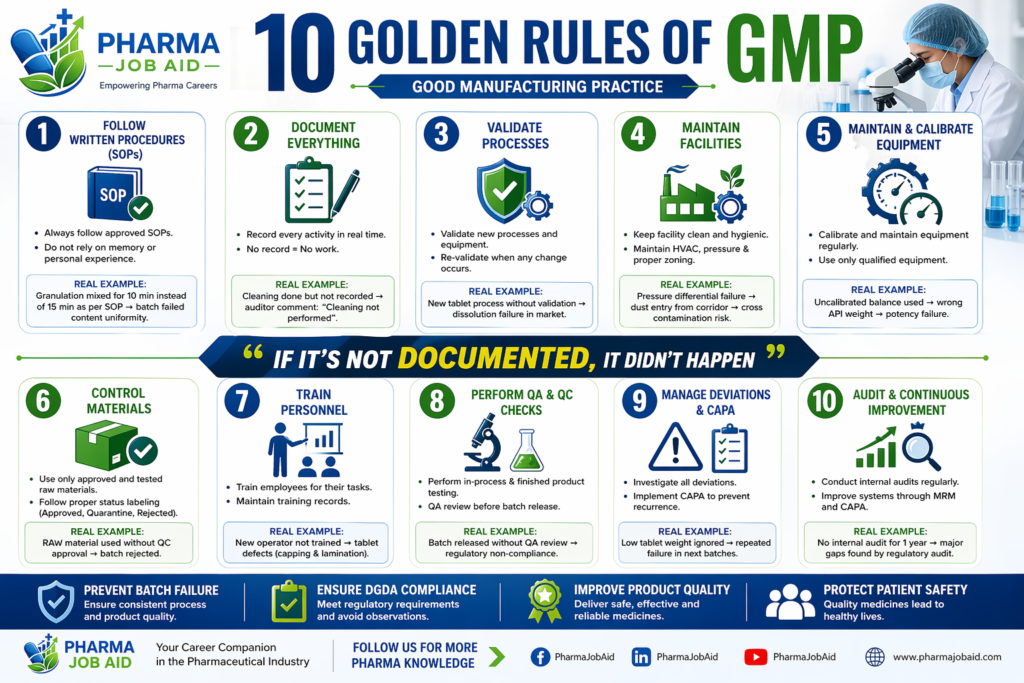
🔑 1. Follow Written Procedures (SOPs)
📖 Explanation
Every activity must be performed according to an approved SOP. SOPs ensure consistency, reproducibility, and compliance.
🧪 Real Example
Case: Granulation process in solid dosage section
- SOP requires: Mixing time = 15 minutes
- Operator runs mixer for 10 minutes (based on experience)
👉 Audit Finding: Process deviation
👉 Impact: Batch inconsistency (content uniformity risk)
👉 CAPA: Retraining + strict SOP adherence
✍️ 2. Document Everything
📖 Explanation
Documentation is the legal evidence that work has been done correctly.
🧪 Real Example
Case: Equipment cleaning completed
- No entry in cleaning logbook
👉 Auditor Comment: “Cleaning not performed”
👉 Impact: Cross-contamination risk → Major observation
👉 CAPA: Real-time recording enforcement
🧠 3. Validate Processes
📖 Explanation
Validation proves that processes consistently produce quality products.
🧪 Real Example
Case: New tablet formulation introduced
- No process validation conducted
👉 Impact: No assurance of uniformity, dissolution failure risk
👉 Audit: Critical deficiency
👉 CAPA: Perform Process Validation (3 consecutive batches)
🏗️ 4. Design & Maintain Facilities
📖 Explanation
Facility design must prevent contamination and mix-ups (HVAC, zoning, cleanliness).
🧪 Real Example
Case: Pressure differential failure between granulation & corridor
👉 Impact: Dust migration → cross contamination
👉 Audit Finding: Major
👉 CAPA: HVAC calibration + alarm system installation
⚙️ 5. Maintain Equipment
📖 Explanation
Equipment must be calibrated, maintained, and fit for use.
🧪 Real Example
Case: Weighing balance used without calibration
👉 Impact: Incorrect API weighing → potency failure
👉 Audit: Critical observation
👉 CAPA: Calibration schedule + QA verification
🧪 6. Control Raw Materials & Products
📖 Explanation
Materials must be properly identified, tested, and released before use.
🧪 Real Example
Case: Raw material used without QC approval
👉 Impact: Unknown quality → batch rejection
👉 Audit: Major GMP violation
👉 CAPA: Strict status labeling (Approved/Quarantine/Rejected)
👨🏫 7. Train Personnel
📖 Explanation
Employees must be trained and competent for their assigned tasks.
🧪 Real Example
Case: New operator performing compression without training
👉 Impact: Tablet defects (capping, lamination)
👉 Audit: Training gap
👉 CAPA: Training matrix + qualification record
🔍 8. Perform Quality Control & QA Review
📖 Explanation
QC tests product quality, and QA ensures compliance before release.
🧪 Real Example
Case: Batch released without QA review
👉 Impact: Regulatory non-compliance
👉 Audit: Critical finding
👉 CAPA: Mandatory QA release authorization
⚠️ 9. Manage Deviations & CAPA
📖 Explanation
All deviations must be investigated with root cause and CAPA.
🧪 Real Example
Case: Low tablet weight observed
- No deviation raised
👉 Impact: Repeat failure in next batches
👉 Audit: Weak QMS
👉 CAPA: Implement deviation system + RCA (5 Why)
🔄 10. Conduct Audits & Continuous Improvement
📖 Explanation
Regular audits ensure compliance and improvement of systems.
🧪 Real Example
Case: No internal audit for 1 year
👉 Impact: Undetected GMP gaps
👉 Audit: System failure
👉 CAPA: Annual audit plan + MRM monitoring
📊 GMP Golden Summary (Audit Language)
| Rule | Risk if Ignored | GMP Impact |
|---|---|---|
| SOP not followed | Process variability | Batch failure |
| No documentation | No evidence | Regulatory rejection |
| No validation | Uncontrolled process | Critical risk |
| Poor facility | Contamination | Product recall |
| No calibration | Wrong data | OOS |
| No material control | Unknown quality | Batch rejection |
| No training | Human error | Deviations |
| No QA review | Non-compliance | Market risk |
| No CAPA | Repeat issues | Weak QMS |
| No audit | Hidden gaps | System failure |
🏆 Final GMP Mindset
👉 GMP is not just rules — it is a discipline of consistency, traceability, and control
Right Process + Right Documentation + Right Control = GMP Compliance