
Pediatric asthma remains one of the most common chronic respiratory diseases affecting millions of children worldwide. While many children achieve symptom control with inhaled corticosteroids and bronchodilators, a subset suffers from severe uncontrolled asthma despite maximum conventional therapy. In recent years, biologic therapies have revolutionized asthma management by targeting specific inflammatory pathways involved in the disease process.
This article explores the role of biologic therapies in pediatric asthma, their mechanisms of action, benefits, limitations, and future prospects in modern respiratory medicine.
For more pharmaceutical and healthcare career-related content, visit PharmaJobAid
Understanding Pediatric Asthma
Asthma is a chronic inflammatory disease of the airways characterized by:
- Airway inflammation
- Bronchial hyperresponsiveness
- Reversible airflow obstruction
- Excess mucus production
Children with asthma commonly experience:
- Wheezing
- Persistent cough
- Chest tightness
- Difficulty breathing
- Nocturnal respiratory symptoms
Asthma severity can range from mild intermittent disease to severe persistent asthma that significantly impacts quality of life.
Why Severe Pediatric Asthma Is Challenging
Severe asthma in children often leads to:
- Frequent hospitalizations
- Emergency room visits
- School absenteeism
- Reduced physical activity
- Psychological stress
- Increased healthcare costs
Traditional therapies may fail to adequately control symptoms in some patients because asthma is not a single disease but rather a collection of different inflammatory phenotypes and endotypes.
This is where biologic therapies have emerged as game-changing treatment options.
What Are Biologic Therapies?
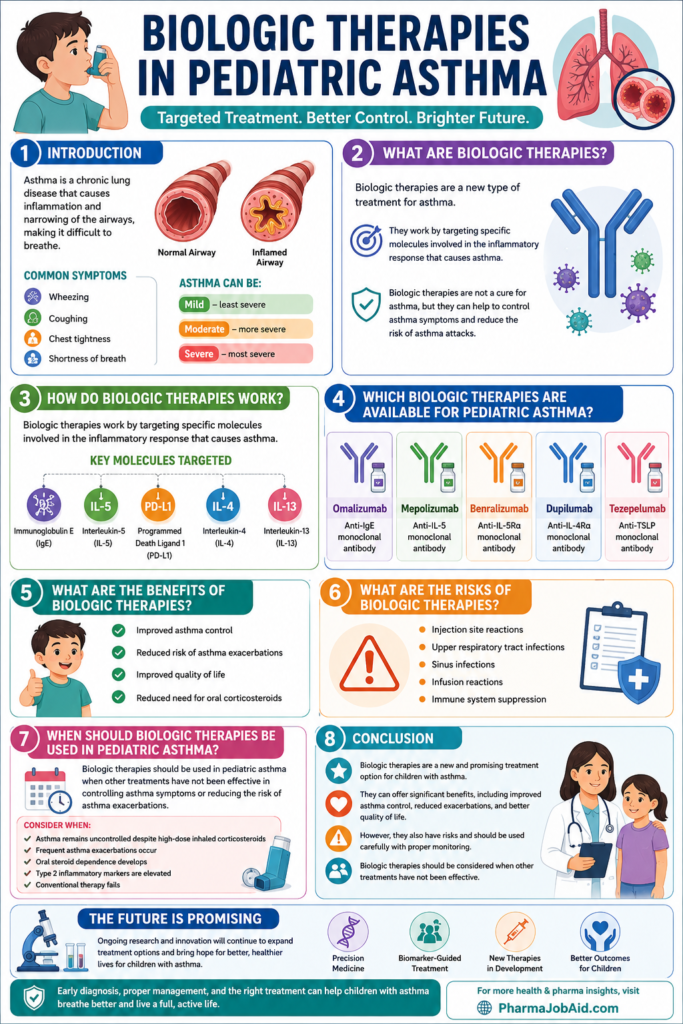
Biologic therapies are advanced targeted medications developed from living organisms or biological processes. Unlike conventional asthma medications that broadly suppress inflammation, biologics specifically target molecules responsible for the inflammatory cascade in asthma.
These therapies are usually administered via:
- Subcutaneous injection
- Intravenous infusion
Biologics are designed for patients with:
- Severe uncontrolled asthma
- Type 2 inflammatory asthma
- Eosinophilic asthma
- Allergic asthma
They are not considered a cure but can dramatically improve disease control.
Mechanism of Action of Biologic Therapies
Asthma inflammation involves several immune mediators including cytokines, eosinophils, and immunoglobulins.
Biologic agents target specific pathways such as:
Immunoglobulin E (IgE)
IgE plays a central role in allergic asthma. Elevated IgE levels trigger allergic reactions and airway inflammation.
Targeted Drug:
- Omalizumab
Interleukin-5 (IL-5)
IL-5 promotes eosinophil growth, activation, and survival.
Targeted Drugs:
- Mepolizumab
- Benralizumab
Interleukin-4 (IL-4) and Interleukin-13 (IL-13)
These cytokines contribute to mucus secretion, airway hyperresponsiveness, and eosinophilic inflammation.
Targeted Drug:
- Dupilumab
Thymic Stromal Lymphopoietin (TSLP)
TSLP is an upstream epithelial cytokine involved in initiating multiple inflammatory pathways.
Targeted Drug:
- Tezepelumab
Available Biologic Therapies for Pediatric Asthma
Several biologic agents are now approved or under investigation for pediatric asthma management.
1. Omalizumab
Omalizumab
Omalizumab is an anti-IgE monoclonal antibody approved for children with moderate-to-severe allergic asthma.
Mechanism
It binds to free IgE antibodies, preventing them from triggering allergic reactions.
Benefits
- Reduced asthma exacerbations
- Better lung function
- Lower corticosteroid requirements
- Improved quality of life
Common Side Effects
- Injection site reactions
- Headache
- Viral infections
2. Mepolizumab
Mepolizumab
Mepolizumab targets IL-5 and is effective in eosinophilic asthma.
Clinical Benefits
- Reduced eosinophil count
- Fewer severe asthma attacks
- Reduced oral steroid dependence
3. Benralizumab
Benralizumab
Benralizumab binds to IL-5 receptors and promotes eosinophil depletion.
Advantages
- Rapid eosinophil reduction
- Less frequent dosing schedule
- Improved symptom control
4. Dupilumab
Dupilumab
Dupilumab inhibits IL-4 and IL-13 signaling pathways.
Major Benefits
- Improved lung function
- Better asthma symptom control
- Reduced exacerbation rates
- Helpful in atopic dermatitis-associated asthma
5. Tezepelumab
Tezepelumab
Tezepelumab is one of the newest biologic therapies for severe asthma.
Why It Is Important
Unlike many biologics that focus only on eosinophilic inflammation, tezepelumab works earlier in the inflammatory cascade and may benefit broader asthma phenotypes.
Benefits of Biologic Therapies in Pediatric Asthma
Biologic therapies provide several significant clinical advantages.
1. Improved Asthma Control
Children experience:
- Fewer daily symptoms
- Better nighttime control
- Improved exercise tolerance
2. Reduced Asthma Exacerbations
One of the greatest advantages is the reduction in:
- Emergency visits
- Hospital admissions
- ICU admissions
3. Reduced Corticosteroid Exposure
Long-term oral corticosteroid use can cause:
- Growth suppression
- Osteoporosis
- Obesity
- Hypertension
- Diabetes risk
Biologics help minimize steroid dependence.
4. Better Quality of Life
Children often experience:
- Improved school attendance
- Better participation in sports
- Reduced psychological stress
- Improved sleep quality
Risks and Limitations of Biologic Therapies
Despite their effectiveness, biologics also have potential risks and challenges.
Common Side Effects
- Injection site reactions
- Fever
- Headache
- Fatigue
- Upper respiratory tract infections
Serious Concerns
Although rare, biologics may occasionally cause:
- Hypersensitivity reactions
- Anaphylaxis
- Immune modulation concerns
Careful monitoring is essential during therapy.
Economic Challenges
Biologic therapies are expensive and may not be easily accessible in many developing countries.
In countries like Bangladesh, accessibility remains limited due to:
- High treatment cost
- Limited insurance coverage
- Availability constraints
When Should Biologics Be Used in Pediatric Asthma?
Biologic therapies are generally recommended when:
- Asthma remains uncontrolled despite high-dose inhaled corticosteroids
- Frequent exacerbations occur
- Oral steroid dependence develops
- Type 2 inflammatory markers are elevated
- Conventional therapy fails
Selection depends on:
- Eosinophil count
- IgE levels
- Allergy profile
- Clinical phenotype
- Age of the child
Personalized Medicine and the Future of Asthma Treatment
Biologic therapies represent a major advancement in precision medicine.
Future directions include:
- Biomarker-guided treatment
- Combination biologic strategies
- More pediatric clinical trials
- Oral biologic formulations
- Gene-targeted asthma therapies
Researchers are actively exploring novel pathways to further improve severe asthma outcomes.
Role of Pharmaceutical Industry in Biologic Development
The pharmaceutical industry has played a crucial role in advancing biologic therapies through:
- Monoclonal antibody development
- Clinical trials
- Biomarker research
- Precision medicine innovation
Major pharmaceutical companies continue investing heavily in respiratory biologics due to the growing global burden of asthma.
For pharmaceutical industry updates, QA/QC insights, GMP articles, and career resources, explore PharmaJobAid Career Resources
Pediatric Asthma Management Beyond Biologics
Although biologics are promising, comprehensive asthma care still requires:
- Trigger avoidance
- Proper inhaler technique
- Environmental control
- Vaccination
- Patient education
- Regular follow-up
Biologics should always be integrated into a holistic asthma management strategy.
Conclusion
Biologic therapies have transformed the management of severe pediatric asthma by offering targeted, personalized treatment approaches. Agents such as omalizumab, mepolizumab, benralizumab, dupilumab, and tezepelumab provide significant benefits in asthma control, exacerbation reduction, and quality of life improvement.
However, patient selection, monitoring, safety evaluation, and economic accessibility remain critical considerations. As research continues to evolve, biologic therapies are expected to become increasingly central in pediatric respiratory medicine.
Healthcare professionals, pharmacists, regulatory experts, and pharmaceutical researchers must stay informed about these rapidly advancing therapies to optimize pediatric asthma care.