
The clinical research world has talked for more than a decade about involving patients. Health authorities, patient groups, sponsors, schools, and life science firms all say they prioritize this—but their efforts stay scattered.
These groups know how important patient involvement is and want to do it well. Still, many programs pop up, targeting small parts of the process while skipping the overall view. Essentially, we focus on individual trees but overlook the whole forest.
Proper patient involvement needs to start early in clinical development. It should shape trial designs and stretch past the study’s end date. The tricky part is putting this into practice. Bureaucratic processes are slow, trials are pricey, and people with chronic illnesses keep adjusting their routines for studies, which isn’t ideal.
However, there are two fresh regulatory moves that could change things. First, ICH E6(R3) updated the Good Clinical Practice rules to require a genuine, planned engagement with all key parties, including patients. Second, ICH E19 lays out ways to gather safety info effectively, cutting down on unnecessary workload across clinical research.
Together, these steps offer a chance to truly integrate what patients need and improve the system as a whole.
They won’t fix things by force alone, but together, they eliminate some major excuses for staying the same and create a chance to work with regulators now. This is before local and regional health authorities lay out their own rules.
There’s a ton of patient advisory boards and advocacy groups involved these days, and talk of putting patients first is everywhere. Yet, the underlying incentives haven’t changed much. These determine when and if patient feedback actually counts in the process.
The incentive problem
Speed-based milestones focus on first site initiation and enrolling the first patient, yet offer no incentives for creating protocols that are actually representative or practical. They don’t encourage developing patient eligibility criteria that make sense or designing trials that work with how health care really operates. To truly improve trial success, input from patients, investigators, and site staff should be valued early on. That kind of engagement is necessary for an effective quality-by-design approach.
Choosing sites makes the problem worse. Community practices with diverse patient groups often get left out due to a lack of required performance history. This creates a cycle where there aren’t enough inclusive research sites, compounded by high investigator turnover and limited established research locations.
E6(R3): Making engagement accountable
When health authorities implement E6(R3), sponsors must have a way to show they talked to key stakeholders, like healthcare providers and patients, and actually used their input.
For folks with chronic conditions, joining a trial could mean missing work or family stuff. That’s more than just annoying; it can make them opt out altogether. The fix isn’t obvious without first understanding what patients face. We’ve gotta hear from them before deciding anything else.
E19: A more deliberate approach to data collection
E19 urges sponsors to collect data more carefully and discipline, contrary to what’s been done in clinical research for decades. This guideline offers a plan for figuring out when it’s okay to collect selective safety data based on how developed the asset is and the current regulations.
For a long time, the main worry has been about regulatory risk. Companies have hesitated to collect less data when they aren’t sure if regulators will approve it. But E19 helps by making it clearer what actual regulatory risks are versus what’s just perceived.
In July 2025, the FDA’s Centre for Drug Evaluation and Research (CDER) put out a white paper through its Centre for Clinical Trial Innovation (C3TI). They also started a project called the Selective Safety Data Collection (SSDC) Demonstration Project. It invites sponsors to participate in late-stage trials, where safety data collection can be appropriately scaled down.
Those who join get to talk directly with CDER experts about their study designs and get a tailored inspection approach. In return, they share what they learn. As these discussions progress and health authorities start chatting more with sponsors about real risks, there’s growing room for smartly simplified data collection practices.
Pragmatic trials: Moving past all or none
Decentralised and pragmatic trial methods have been hot topics for a while now. People aren’t getting caught up in the excitement anymore; instead, they’re really figuring out which parts actually work. One big mistake at the start was thinking it had to be totally decentralised or completely traditional, with no room in the middle.
Recent findings suggest adding practical elements to trials can offer real advantages without needing an entire makeover of the system. Take the RECOVERY trial as an example. They made participation super easy by allowing a wide range of criteria for who could join, using a short consent form, and looking at regular NHS records. In just a few months, they found out that dexamethasone cuts down deaths from COVID-19. Plus, they kept finding answers about other treatments, too.
Then there’s Pragmatica-Lung, doing something similar but for cancer research. They made their participant requirements much simpler than usual, focusing mostly on overall survival rates, basic safety info, and details about the treatment. This project and RECOVERY both show us how collaborations between groups in new ways can speed up getting answers to vital questions and make the results more widely applicable.
What a successful 2026 looks like
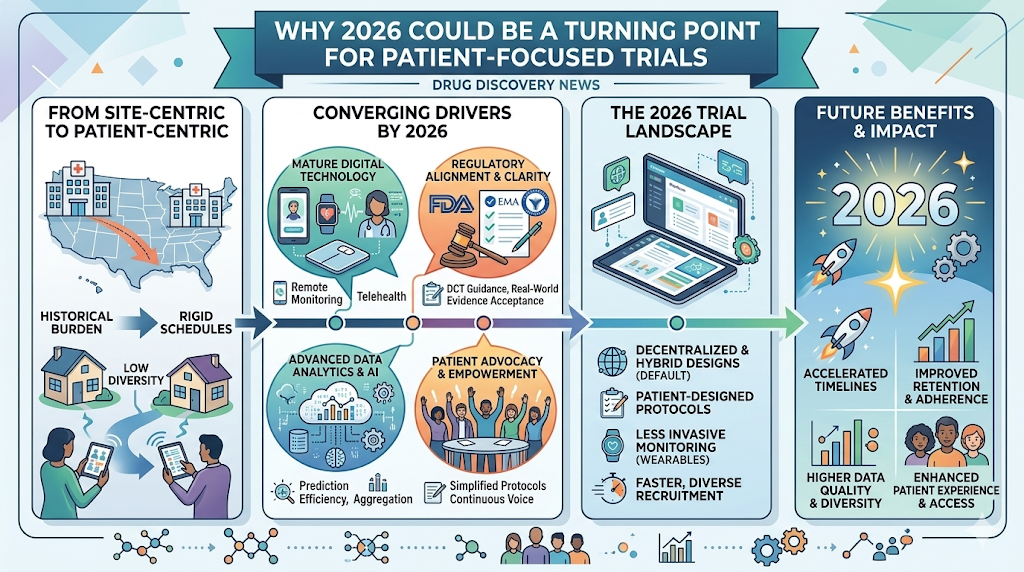
In 2026, success in progress will show up in how protocols follow Quality by Design approaches under E6(R3), backed by documented patient input. Plus, there’ll be studies launched with clear goals for collecting safety data as outlined in E19. We’ll also see a boost in demo projects pushed by CT3I, and ongoing work on extra virtual control arms that cut down on pointless placebo randomization.
This matters because hanging onto old methods means dealing with super slow trial cycles, ever-rising costs, and excluding key groups of people from participation. So, the main question here is whether the big players in clinical research will actually step up and implement these proven strategies. Patients are showing up and getting involved; now it’s the industry’s turn to match their commitment. The challenge for 2026 is seeing if those shaping the future of clinical research have the guts to change for the better.