
For over six decades, metformin has been the bedrock of type 2 diabetes treatment, prescribed to hundreds of millions of people worldwide. Doctors knew it worked, and patients relied on it, but science had a confession to make: we didn’t fully understand how it worked.
Until now.
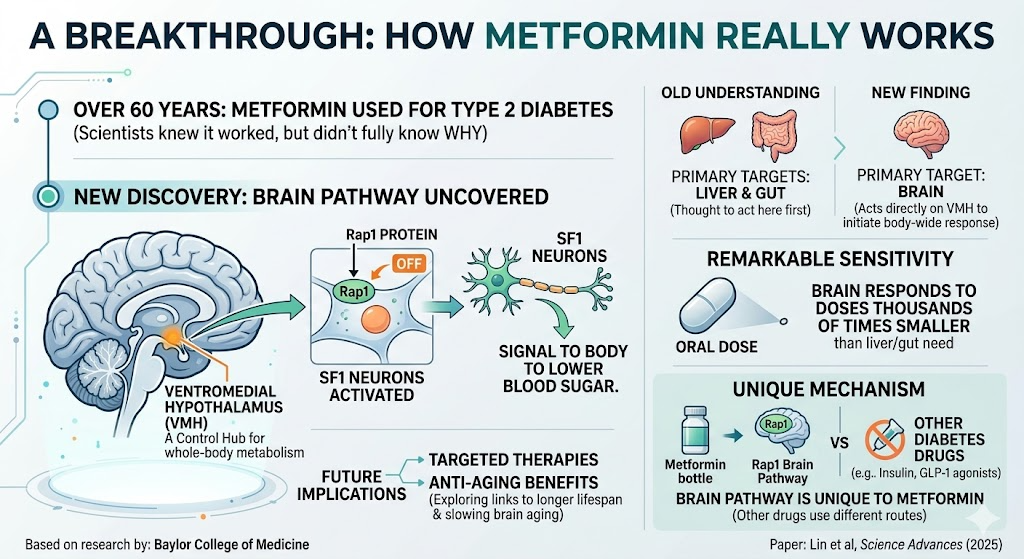
A groundbreaking study by researchers at the Baylor College of Medicine, published in Science Advances, has uncovered a massive piece of the puzzle. It turns out metformin isn’t just working in the gut or the liver, as previously thought. It has been quietly pulling the strings from deep inside the brain.
The Discovery: Slicing Through the Rap1 Pathway
Historically, medical consensus dictated that metformin primarily targeted the liver to reduce glucose production and the intestines to alter sugar absorption. However, the Baylor team looked higher up—specifically at the ventromedial hypothalamus (VMH), a critical brain region that acts as the control hub for whole-body metabolism.
Inside the VMH sits a small protein called Rap1. The researchers discovered a fascinating chain reaction:
- The Arrival: Metformin reaches the VMH in the brain.
- The Switch: Metformin effectively turns off the Rap1 protein.
- The Signal: Deactivating Rap1 triggers a specific cluster of cells known as SF1 neurons.
- The Result: These neurons fire off signals to the rest of the body, commanding it to lower blood sugar levels.
To prove this wasn’t a fluke, the researchers bred mice that lacked the Rap1 protein in this specific brain region and put them on a high-fat diet. When given metformin, the drug completely failed to lower their blood sugar. Interestingly, other diabetes medications like insulin and GLP-1 receptor agonists (such as Ozempic or Wegovy) still worked perfectly. This proved that this specific brain pathway is entirely unique to metformin.
A Microscopic Dose with a Massive Impact
Perhaps the most startling revelation of the study was just how sensitive the brain is to the medication.
While the liver and intestines require high concentrations of metformin to react, the brain’s VMH region responded to doses thousands of times smaller than a standard oral dose. This hypersensitivity reframes our entire understanding of the drug’s potency and delivery. Metformin was never just a localized metabolic drug; it was a neurological one all along.
Beyond Diabetes: Longevity and Aging
This newfound pathway opens up thrilling new avenues for medical research. Metformin has long been a darling of the longevity community, with numerous observational studies suggesting it can slow brain aging, protect against cognitive decline, and potentially extend lifespan.
Now that scientists know metformin directly alters pathways in the hypothalamus—a region intimately tied to aging and vitality—they can actively investigate whether the Rap1 pathway is the secret engine behind these anti-aging benefits.
The Bigger Picture: What Else Are We Missing?
The fact that a drug used by millions for 60 years held such a profound secret begs a fascinating question: What other common medicines have unknown mechanisms?
The reality is that “mechanism of action” (how a drug works at a molecular level) is often discovered after a drug is already proven safe and effective. For example:
- Acetaminophen (Tylenol): Used for over a century, we still don’t fully understand exactly how it blocks pain in the central nervous system.
- Aspirin: Used for millennia (originally from willow bark), its precise cellular mechanisms weren’t decoded until the 1970s.
While human studies are still required to definitively confirm the Rap1 mechanism in people, this study marks a paradigm shift. By looking at old drugs through a new lens, science isn’t just solving decades-old mysteries—it’s opening the door to far more targeted, lower-dose, and effective therapies for the future.