
Validation & Qualification in Pharmaceutical Industry: Complete GMP Guide
Validation and qualification are two of the most important quality assurance pillars in pharmaceutical manufacturing. In Bangladesh, where the pharmaceutical sector continues to grow in both local supply and export ambition, these systems are no longer optional paperwork exercises. They are fundamental to product quality, patient safety, regulatory compliance, and market credibility.
Bangladesh’s legal and policy framework ties pharmaceutical GMP to WHO standards. The Drugs and Cosmetics Act, 2023 defines GMP in reference to WHO guidelines, while the National Drug Policy, 2016, emphasises strict compliance with recommended GMP standards. That means validation and qualification are central to how a compliant pharmaceutical plant should operate in Bangladesh.
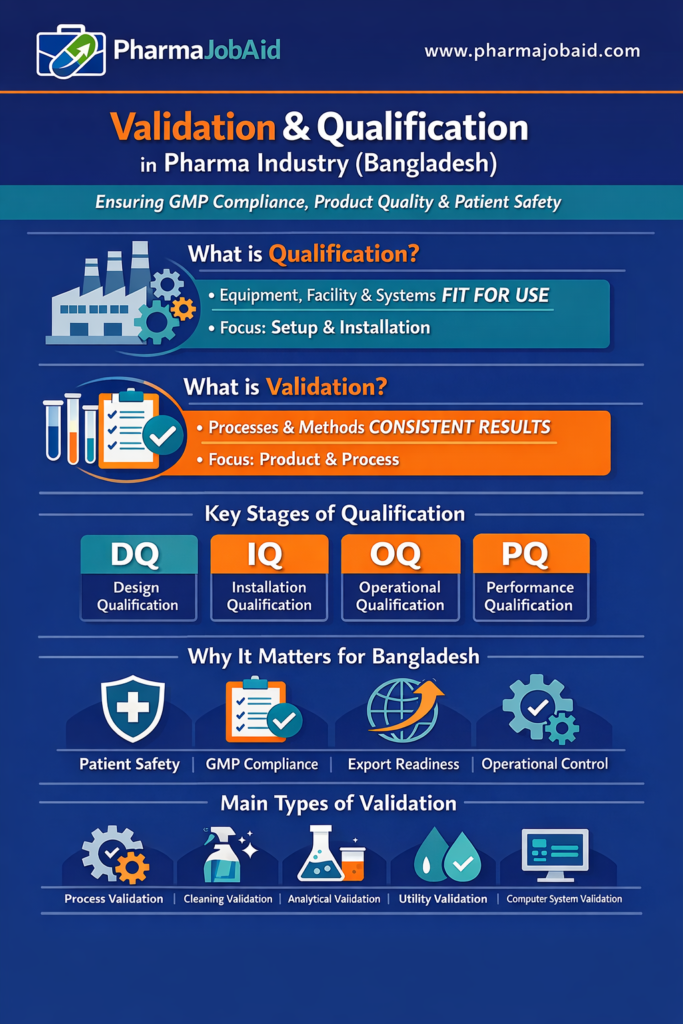
For local manufacturers, this matters at every stage of production: facility design, water systems, HVAC, equipment installation, analytical methods, cleaning procedures, sterile and non-sterile processing, computerised systems, and ongoing revalidation. Globally, WHO GMP guidance treats validation as an essential element of the pharmaceutical quality system, and international references such as EU GMP Annex 15 and PIC/S guidance provide the framework widely used by manufacturers and inspectors to structure these activities.
What is qualification in pharmaceuticals?
Qualification is the documented process of proving that premises, systems, utilities, and equipment are properly designed, installed, operate correctly, and perform consistently for their intended use. WHO guidance describes qualification as part of validation, especially for facilities, utilities, and equipment.
In simple terms, qualification answers this question:
“Is this facility, utility, or equipment fit for pharmaceutical use?”
In a Bangladeshi pharmaceutical factory, qualification commonly applies to:
- purified water systems
- HVAC systems
- compressed air systems
- cleanrooms
- manufacturing vessels
- granulators, blenders, tablet presses, coating machines
- blister and bottle packing machines
- laboratory instruments
- warehouse temperature monitoring systems
- computerised control systems
What is validation in pharmaceuticals?
Validation is the documented evidence that a process, method, cleaning procedure, system, or control strategy consistently produces results meeting predetermined specifications and quality attributes. WHO states that validation is an essential GMP activity and part of the pharmaceutical quality system.
In practical terms, validation answers this question:
“Can this process consistently deliver a quality product?”
Validation in Bangladesh pharma usually covers:
- process validation
- cleaning validation
- analytical method validation
- computerized system validation
- aseptic process simulation or media fill
- hold time studies
- transport validation
- utility system validation
- revalidation after significant change
Difference between qualification and validation
Although the terms are often used together, they are not the same.
Qualification mainly focuses on the readiness of the facility, utility, system, or equipment.
Validation mainly focuses on the consistency of the process or method.
A simple way to remember it:
- Qualification = “the machine or system is ready”
- Validation = “the process using that machine works consistently”
WHO guidance explicitly links the two, and PIC/S explains that qualification and validation should establish documented evidence that premises, utilities, equipment, and processes are designed, installed, operated, and performing as intended.
Why validation and qualification matter in Bangladesh
Bangladesh has built a strong pharmaceutical manufacturing base, and compliance expectations are rising. The National Drug Policy 2016 stresses strict observance of WHO-recommended GMP, and the 2023 law anchors GMP in WHO standards.
This makes validation and qualification important for several reasons.
1. Patient safety
Medicines must be safe, effective, and consistent. A poorly qualified water system or unvalidated process can lead to contamination, mix-ups, potency failure, or stability issues.
2. GMP compliance
Validation is not a cosmetic exercise for audits. WHO GMP treats it as a required GMP element.
3. Inspection readiness
Regulators and clients expect documentary evidence, not verbal assurance. During inspections, companies must show protocols, results, deviations, CAPA, approvals, and traceable data.
4. Export competitiveness
Many Bangladeshi manufacturers aim to serve regulated or semi-regulated markets. In practice, companies often align not only with WHO GMP but also with internationally recognized approaches such as EU Annex 15 and PIC/S recommendations to strengthen inspection readiness and customer confidence. This is a reasonable industry inference from the role these guidance documents play globally.
5. Operational control
Strong validation reduces batch failure, deviation frequency, rework, and investigation burden.
Core stages of equipment qualification
The standard lifecycle is often described as DQ, IQ, OQ, and PQ. PIC/S and WHO guidance support this structured approach.
1. Design Qualification (DQ)
DQ verifies that the proposed design of facilities, utilities, or equipment is suitable for GMP use.
Examples:
- Is the purified water loop made of appropriate material?
- Does the HVAC design support required pressure differentials?
- Is the tablet compression machine capacity suitable for the intended batch size?
- Are user requirement specifications addressed?
DQ is especially important in new projects, expansion areas, and technology transfer.
2. Installation Qualification (IQ)
IQ documents that the equipment or system has been installed correctly according to approved drawings, manuals, engineering specifications, and GMP requirements.
Typical IQ checks include:
- equipment identification
- model and serial number verification
- material of construction
- piping and instrumentation checks
- calibration status
- utility connections
- safety features
- documentation availability
- spare parts and manuals
Example: A purified water generation unit in a Bangladesh plant should have its piping, instruments, tank, loop slope, material certificates, and calibration status verified before release for operation.
3. Operational Qualification (OQ)
OQ demonstrates that the equipment or system operates as intended across the specified operating ranges.
Typical OQ checks include:
- alarm challenge tests
- interlock verification
- operating parameter checks
- temperature mapping
- speed range verification
- pressure hold tests
- emergency stop checks
- control panel functionality
Example: For an HVAC system, OQ may include airflow, HEPA integrity, differential pressure, temperature, humidity, recovery time, and alarm checks.
4. Performance Qualification (PQ)
PQ proves that the equipment or system performs effectively and reproducibly in routine production conditions.
Examples:
- three successful commercial-scale process runs
- stable purified water quality over a defined monitoring period
- consistent compression machine output under production load
- warehouse mapping under routine operating conditions
PQ is the closest stage to normal plant reality.
Main types of pharmaceutical validation
Process validation
Process validation demonstrates that the manufacturing process consistently produces product meeting predetermined quality standards. WHO includes process validation as a major validation area.
For solid dosage plants in Bangladesh, process validation commonly covers:
- sifting and dispensing
- granulation
- drying
- blending
- compression
- coating
- packing
Critical parameters may include mixing time, binder addition rate, drying temperature, compression force, coating pan speed, and sealing temperature.
Common process validation approaches
- prospective validation
- concurrent validation
- continued or ongoing process verification
- revalidation after major change
WHO guidance also recognizes lifecycle thinking rather than treating validation as a one-time event.
Cleaning validation
Cleaning validation proves that cleaning procedures remove product residues, detergents, and microbial contamination to acceptable levels. PIC/S includes cleaning validation among its core qualification and validation recommendations.
In Bangladesh, cleaning validation is especially critical in:
- multiproduct oral solid facilities
- beta-lactam or sensitizing product control
- shared packaging lines
- shared laboratory equipment
A robust cleaning validation program normally includes:
- worst-case product selection
- solubility review
- toxicity or potency assessment
- equipment train definition
- sampling method selection
- swab and rinse recovery studies
- acceptance criteria
- validated analytical method
- campaign and dirty-hold/clean-hold considerations
Analytical method validation
Analytical methods used in QC must be suitable for their intended purpose. WHO’s validation guidance includes analytical procedure validation among key appendices.
Typical parameters include:
- accuracy
- precision
- specificity
- linearity
- range
- detection limit
- quantitation limit
- robustness
In Bangladeshi QC labs, this applies to assay, dissolution, impurity, microbial, cleaning residue, and stability-indicating methods.
Utility system validation
Utilities directly affect product quality. Typical validated or qualified utilities include:
- purified water
- water for injection where applicable
- clean steam
- HVAC
- compressed air
- nitrogen
- temperature-controlled rooms
WHO guidance includes qualification of systems and equipment as part of GMP validation expectations.
Computerized system validation
Modern factories rely on PLCs, BMS, EMS, LIMS, HPLC software, and electronic documentation systems. WHO validation guidance includes computerized systems, and data integrity expectations make this increasingly important.
Typical CSV scope includes:
- user requirement specification
- risk assessment
- functional specification
- access control
- audit trail review
- backup and restore verification
- electronic record integrity
- change control
- disaster recovery considerations
Validation Master Plan in pharma
Every well-managed pharma site should maintain a Validation Master Plan (VMP). WHO says the key elements of a company’s qualification and validation programme should be clearly defined and documented in a validation master plan, and PIC/S also treats the VMP as a foundational document.
A practical VMP for a Bangladeshi pharmaceutical factory should include:
- validation policy
- site scope
- facility and utility overview
- equipment categorization
- process list
- validation matrix
- roles and responsibilities
- document formats
- acceptance philosophy
- requalification and revalidation triggers
- deviation handling
- change control linkage
- annual review mechanism
Documentation required for qualification and validation
Inspection success depends heavily on documentation. A typical document set includes:
- validation master plan
- user requirement specification
- risk assessment
- qualification protocol
- validation protocol
- test scripts and raw data sheets
- deviations and impact assessment
- summary report
- traceability matrix
- CAPA records
- change control records
- SOPs
- approved drawings and manuals
- calibration certificates
Remember: in pharma, an activity not documented is usually treated as not done.
Requalification and revalidation
Qualification and validation do not end after the first approval. They must be maintained through lifecycle control.
Typical triggers include:
- equipment relocation
- major maintenance
- product changeover to worst-case product
- formula or batch size change
- repeated deviations
- out-of-trend data
- utility modification
- software upgrade
- regulatory observation
- long shutdown or inactivity
WHO and PIC/S both support lifecycle-based review and requalification/revalidation when needed.
Common mistakes seen in Bangladeshi pharma plants
Many companies understand the theory but struggle in execution. Common weaknesses include:
- copying protocols without site-specific risk assessment
- weak user requirement specifications
- incomplete IQ documentation
- OQ tests that do not challenge alarms or worst-case settings
- PQ performed with inadequate sampling
- cleaning validation with unrealistic acceptance criteria
- poor linkage between validation and change control
- revalidation ignored after equipment modification
- raw data not attached to reports
- QA approval delayed or superficial
These are not uniquely Bangladeshi problems, but they are common in fast-growing plants where documentation maturity lags behind production expansion.
Role of QA in validation and qualification
Quality Assurance is the central coordinating function. QA should:
- approve master plans, protocols, and reports
- ensure risk-based but GMP-compliant execution
- review deviations and CAPA
- verify document control
- confirm training
- link validation with change control, deviation, and annual product review
- ensure periodic review and state of control
Validation should never be left only to engineering, production, or QC. It is cross-functional, but QA must govern the quality system.
Career importance for pharmacists in Bangladesh
For fresh graduates and early-career professionals, validation and qualification are high-value skill areas. Experience in IQ, OQ, PQ, process validation, cleaning validation, protocol writing, and report review can open opportunities in:
- QA validation
- engineering
- production
- technology transfer
- regulatory compliance
- audits and inspections
- export-oriented operations
Anyone aiming for a pharma career in Bangladesh should understand:
- GMP basics
- documentation practice
- validation lifecycle
- risk assessment
- deviation and CAPA
- data integrity
- SOP writing and execution
Final thoughts
Validation and qualification are the backbone of a reliable pharmaceutical manufacturing system. In Bangladesh, their importance is reinforced by national law and policy through adoption of WHO-aligned GMP expectations.
A company may have modern buildings and expensive machines, but without proper qualification and validation, it cannot truly demonstrate control. On the other hand, a plant that builds strong validation systems gains more than compliance. It gains consistency, inspection confidence, reduced failure risk, stronger export readiness, and better patient protection.
For Bangladesh’s pharmaceutical industry, validation and qualification are not just technical requirements. They are strategic tools for global competitiveness and sustainable quality culture.
SEO title
Validation & Qualification in Pharmaceutical Industry in Bangladesh | Complete GMP Guide
Meta description
Learn validation and qualification in the pharmaceutical industry in Bangladesh, including DQ, IQ, OQ, PQ, process validation, cleaning validation, VMP, GMP compliance, and QA roles.