
A Complete Guide for Pharmaceutical Professionals in Bangladesh
Introduction: Why Companies Fail FDA Inspections
In today’s highly regulated pharmaceutical environment, passing an inspection by the U.S. Food and Drug Administration is not just about having data—it’s about presenting that data with clarity, control, and confidence.
Across global pharmaceutical industries, including Bangladesh, many companies invest heavily in:
- Deviation investigations
- CAPA (Corrective and Preventive Actions) systems
- Quality Management Systems (QMS)
- Documentation and data integrity tools
Yet, despite all these efforts, inspections still result in observations, warning letters, or worse—import alerts.
Why?
Because companies often fail at one critical aspect:
👉 They cannot tell a clear, consistent, and controlled story.
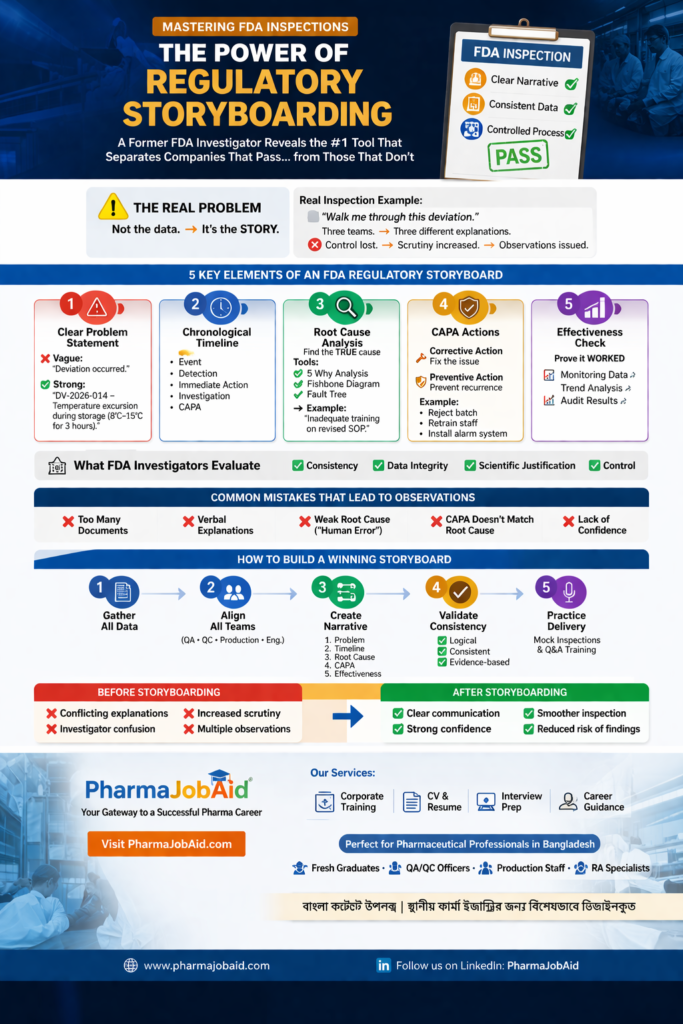
The Real Problem: Lack of Narrative Control
Imagine this scenario:
An FDA investigator asks a simple question:
“Can you walk me through this deviation?”
What follows is chaos:
- The Quality team gives one explanation
- The Production team gives another
- The Subject Matter Expert adds a third perspective
Each version contains partial truth—but collectively, they create confusion.
What does the investigator see?
- Lack of alignment
- Poor data control
- Weak investigation process
- Potential compliance risks
At this point, the issue is no longer just the deviation.
👉 The issue becomes CONTROL.
And once control is questioned:
- Scrutiny increases
- Confidence drops
- Observations begin forming
What Is a Regulatory Storyboard?
A Regulatory Storyboard is a structured, inspection-ready narrative that clearly explains:
- What happened
- Why it happened
- What was done
- What will prevent recurrence
It transforms scattered data into a logical, evidence-backed story.
Why Regulatory Storyboarding Matters in Bangladesh
The pharmaceutical industry in Bangladesh is rapidly expanding, with exports reaching the US, EU, and other regulated markets.
To compete globally, companies must align with:
- World Health Organization GMP guidelines
- European Medicines Agency expectations
- FDA regulatory standards
However, many local companies still struggle with:
- Poor inspection communication
- Inconsistent documentation
- Weak data storytelling
👉 This is where PharmaJobAid plays a crucial role—bridging the gap between technical knowledge and real-world regulatory readiness.
The 5 Key Elements of an Effective FDA Regulatory Storyboard
1. Clear Problem Statement
Every storyboard starts with a precise and consistent definition of the issue.
❌ Weak Example:
“Deviation occurred during manufacturing.”
✅ Strong Example:
“Deviation No. DV-2026-014 identified temperature excursion (8°C–15°C) during storage of finished product batch F-1025 for 3 hours on March 10, 2026.”
Key Tips:
- Be specific
- Use data
- Avoid vague language
2. Chronological Timeline
A strong storyboard follows a clear, step-by-step timeline.
Include:
- Event occurrence
- Detection
- Immediate action
- Investigation phases
- CAPA implementation
👉 Investigators want to see sequence and control.
3. Root Cause Analysis (RCA)
This is where many companies fail.
A proper RCA should:
- Identify the true root cause
- Use tools like:
- 5 Why Analysis
- Fishbone Diagram
- Fault Tree Analysis
Example:
Instead of saying:
“Human error”
Explain:
“Inadequate training on revised SOP QMS-014 led to incorrect temperature monitoring.”
4. CAPA (Corrective and Preventive Actions)
A good storyboard clearly differentiates:
Corrective Action:
Fixes the issue
Preventive Action:
Prevents recurrence
Example:
Corrective:
- Rejected affected batch
- Recalibrated temperature sensors
Preventive:
- Revised SOP
- Conducted retraining
- Installed automated alarm system
5. Effectiveness Check
This is often overlooked—but critical.
👉 FDA expects proof that your CAPA actually works.
Include:
- Monitoring data
- Trend analysis
- Audit results
How FDA Investigators Evaluate Your Story
Investigators from the U.S. Food and Drug Administration are trained to assess:
1. Consistency
Do all departments tell the same story?
2. Data Integrity
Is the data reliable, complete, and traceable?
3. Scientific Justification
Are conclusions backed by evidence?
4. Control
Does the company demonstrate control over processes?
Common Mistakes to Avoid
❌ 1. Overloading with Documents
Providing hundreds of pages without structure:
👉 Confuses investigators
❌ 2. Verbal Storytelling
Relying on memory instead of documented narratives:
👉 Creates inconsistencies
❌ 3. Weak Root Cause
Blaming “human error” without deeper analysis:
👉 Signals poor investigation quality
❌ 4. No Link Between CAPA and Root Cause
If CAPA doesn’t address the root cause:
👉 It’s ineffective
❌ 5. Lack of Confidence
Hesitation or contradiction:
👉 Red flag for investigators
How to Build a Winning Regulatory Storyboard
Step 1: Gather All Data
- Deviation reports
- Batch records
- Audit findings
- Training records
Step 2: Align Cross-Functional Teams
Ensure:
- QA
- QC
- Production
- Engineering
👉 All share the same understanding
Step 3: Create a Structured Narrative
Use a consistent format:
- Problem
- Timeline
- Root Cause
- CAPA
- Effectiveness
Step 4: Validate the Story
Ask:
- Does it make sense?
- Is it consistent?
- Is it evidence-based?
Step 5: Practice Delivery
Conduct mock inspections:
- Simulate FDA questions
- Train team responses
Real-World Impact: Before vs After Storyboarding
Before Storyboarding
- Conflicting explanations
- Investigator confusion
- Increased scrutiny
- Multiple observations
After Storyboarding
- Clear communication
- Strong confidence
- Faster inspection flow
- Reduced risk of findings
Why This Skill Is Critical for Pharma Careers
For professionals in Bangladesh, mastering regulatory storytelling can:
- Boost career growth
- Improve inspection readiness
- Increase job opportunities in multinational companies
How PharmaJobAid Helps You Succeed
At PharmaJobAid, we focus on practical, industry-relevant skills that go beyond textbooks.
Our Key Services
✅ Corporate Training
- FDA inspection readiness
- GMP compliance
- Regulatory documentation
✅ CV & Resume Preparation
- Industry-specific CV formatting
- Job-ready profiles
✅ Interview Preparation
- Real pharma interview questions
- Confidence-building sessions
✅ Career Guidance
- Fresh graduates to experienced professionals
Special Focus: Bangladesh Pharmaceutical Professionals
We understand the local challenges:
- Transition from academic knowledge to industry
- Lack of hands-on regulatory exposure
- Limited inspection training
👉 That’s why our content and training are designed specifically for:
- Fresh graduates
- QA/QC professionals
- Production officers
- Regulatory affairs specialists
Bangla Insight (বাংলা সংযোজন)
FDA Inspection এ সফল হতে কী প্রয়োজন?
অনেক কোম্পানি ডাটা থাকার পরেও ফেল করে কারণ তারা:
👉 একটি পরিষ্কার এবং সঠিক গল্প বলতে পারে না
Regulatory Storyboard কী?
এটি একটি structured explanation যেখানে থাকে:
- কী ঘটেছে
- কেন ঘটেছে
- কীভাবে সমাধান করা হয়েছে
- ভবিষ্যতে কীভাবে প্রতিরোধ করা হবে
কেন এটি গুরুত্বপূর্ণ?
👉 Inspector আপনার ডাটা নয়, আপনার control এবং consistency দেখেন
Final Thoughts: Control the Story, Control the Outcome
In regulatory inspections, perception matters as much as reality.
You may have:
- Strong systems
- Complete data
- Good intentions
But without a clear, structured narrative:
👉 You lose control of the inspection.
Take the Next Step with PharmaJobAid
Whether you are a fresh graduate or an experienced professional, mastering regulatory storytelling can transform your career.
👉 Learn how to:
- Handle FDA inspections confidently
- Build strong investigation reports
- Present data like a regulatory expert
Join PharmaJobAid Today
Your Gateway to a Successful Pharmaceutical Career