
Pharmaceutical Industry Trends (March 2026)
GLP-1 Breakthroughs, Oncology Expansion & Billion-Dollar Investments
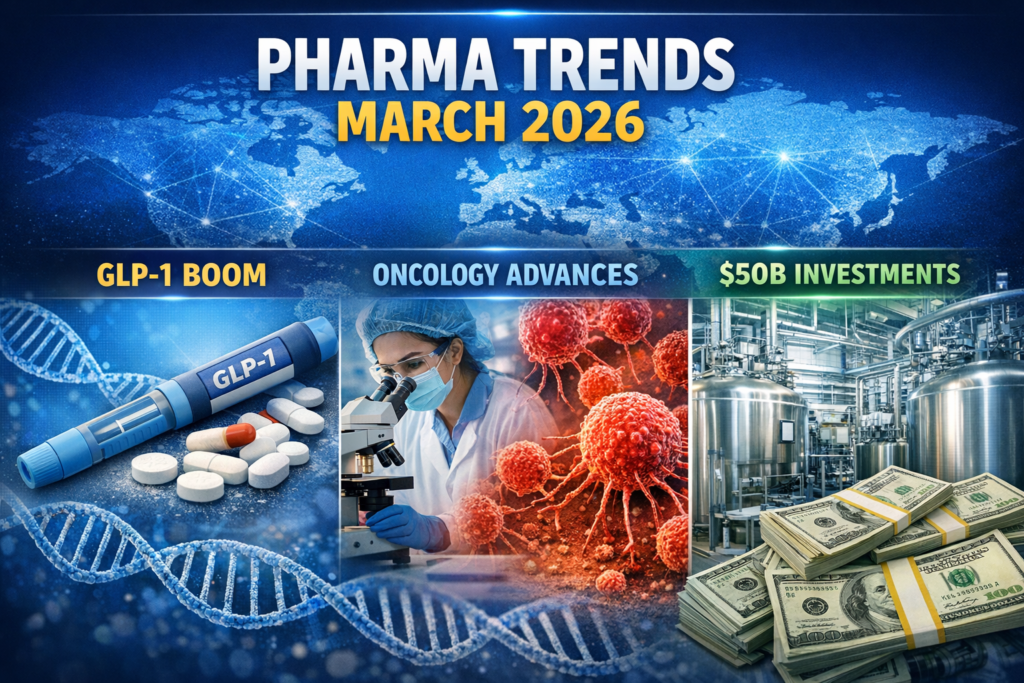
The global pharmaceutical industry experienced a highly transformative week from March 15 to March 21, 2026. Rapid innovation, strategic repositioning, and large-scale investments dominated the landscape, signalling a clear shift toward long-term, innovation-driven growth.
From the explosive rise of GLP-1 therapies to aggressive oncology expansion and multi-billion-dollar infrastructure commitments, the industry is evolving faster than ever.
GLP-1 Boom Reshaping the Market
One of the most dominant trends is the continued rise of GLP-1 receptor agonists, initially developed for diabetes but now revolutionizing obesity treatment.
Leading this surge is Eli Lilly and Company, which reported approximately $12.73 billion in Q1 2025 revenue. This growth is largely driven by its GLP-1 portfolio, positioning the company as a market leader in metabolic diseases.
To sustain demand, Eli Lilly is aggressively expanding manufacturing capacity—highlighting long-term confidence in the segment.
Meanwhile, Novo Nordisk continues to strengthen its dominance, reporting an 18% year-over-year revenue increase. Its advancements in oral peptide therapies represent a major innovation, improving patient convenience and adherence.
GLP-1 Beyond Weight Loss: New Frontiers
GLP-1 therapies are now being explored beyond diabetes and obesity.
Emerging research suggests potential applications in addiction treatment by influencing brain reward pathways. If clinically validated, this could:
- Open entirely new therapeutic markets
- Accelerate drug repurposing strategies
- Reduce development timelines and costs
This signals a major shift toward multi-indication blockbuster drugs.
Oncology Expansion to Counter Patent Cliffs
Oncology remains a critical growth pillar, especially as companies face patent expirations.
Merck & Co. is proactively addressing its upcoming “patent cliff” by expanding its oncology portfolio. With revenues exceeding $64 billion, the company is focusing on:
- Immuno-oncology innovation
- Pipeline expansion
- Strategic partnerships
This reflects a broader industry trend where oncology continues to offer high-value, innovation-driven returns.
AstraZeneca’s $50 Billion Investment
A major highlight of the week is the $50 billion U.S. investment by AstraZeneca.
The investment will focus on:
- Advanced R&D infrastructure
- Manufacturing expansion
- Rare disease innovation
- Respiratory therapies
This move underscores a key trend: localization of production and supply chain resilience.
AbbVie’s Post-Humira Reinvention
AbbVie is actively reshaping its strategy following the loss of exclusivity for Humira.
With revenues exceeding $56 billion, the company is investing in:
- Next-generation immunology
- Oncology pipelines
- Neuroscience innovation
This highlights a critical lesson: over-reliance on a single blockbuster drug creates long-term vulnerability.
Pfizer’s Shift Toward Biologics
Pfizer is transitioning its post-pandemic strategy toward biologics and advanced vaccines.
Key focus areas include:
- mRNA technology expansion
- Complex biologic therapies
- Next-generation vaccine platforms
Biologics offer longer lifecycle value, higher margins, and stronger protection from generic competition.
Johnson & Johnson’s Integrated Model
Johnson & Johnson is gaining attention for integrating pharmaceuticals with medical technology.
This approach combines:
- Drug therapies
- Medical devices
- Digital health solutions
The result is a more patient-centric, ecosystem-driven healthcare model, which is becoming a defining industry trend.
Rising Focus on Respiratory Health
Respiratory diseases are back in focus following new data on the burden of sleep apnea.
Companies like Sanofi and AstraZeneca are expected to increase investment in:
- Asthma and COPD
- Sleep-related disorders
- Chronic respiratory conditions
This aligns with the global shift toward managing long-term chronic diseases.
Regulatory Spotlight: FDA Recall
The U.S. Food and Drug Administration issued a recall warning related to frozen blueberries, sparking discussions around food safety.
While not directly pharma-related, it highlights:
- The growing overlap between food and drug regulation
- The importance of quality systems and compliance
- Increased public scrutiny on health-related industries
Key Industry Trends
The week’s developments highlight several major directions:
- GLP-1 therapies are the fastest-growing segment
- Oncology pipelines are expanding to offset patent losses
- Massive investments are reshaping infrastructure
- Biologics are becoming the future of treatment
- Pharma + MedTech integration is accelerating innovation
Bangladesh Perspective 🇧🇩
These global trends have direct implications for Bangladesh’s pharmaceutical sector.
Leading companies such as:
- Beximco Pharmaceuticals
- Square Pharmaceuticals
- Incepta Pharmaceuticals
are increasingly aligning with global shifts, particularly in:
- Biologics and biosimilars
- API manufacturing
- International regulatory expansion
Growing Job Opportunities
High-demand roles include:
- Production & Manufacturing
- QA/QC
- Regulatory Affairs
- Clinical Research
- Pharmacovigilance
Skills in Demand
To stay competitive:
- GMP expertise
- Biologics knowledge
- Data analytics
- FDA/EMA regulatory understanding
Conclusion
The pharmaceutical industry in March 2026 reflects a sector undergoing rapid transformation.
Driven by GLP-1 expansion, oncology innovation, and large-scale investments, companies are building resilient, future-ready business models.
Organisations like Eli Lilly, Novo Nordisk, Merck, and AstraZeneca are not just responding to change—they are defining the next era of global healthcare.