
🔬 Introduction to LC-MS/MS in Pharmaceutical QC

6
Liquid Chromatography–Tandem Mass Spectrometry (LC-MS/MS) using Triple Quadrupole (QqQ) technology has become a cornerstone analytical technique in pharmaceutical Quality Control (QC) laboratories due to its unparalleled sensitivity, selectivity, and robustness in analyzing complex drug substances and drug products. In modern GMP-compliant environments, especially in regulatory-focused markets such as Bangladesh under the supervision of Directorate General of Drug Administration, LC-MS/MS is widely adopted for trace-level impurity detection, bioanalytical quantification, and validation of pharmaceutical processes. Unlike traditional chromatographic methods, LC-MS/MS integrates separation and molecular identification, allowing analysts to confidently detect compounds even at extremely low concentrations within highly complex matrices such as biological fluids, finished dosage forms, and environmental samples. This technique is particularly valuable in ensuring product safety, efficacy, and compliance with global regulatory expectations, making it a critical tool for pharmaceutical companies striving for international market access and WHO prequalification.
⚙️ Principle of Triple Quadrupole LC-MS/MS
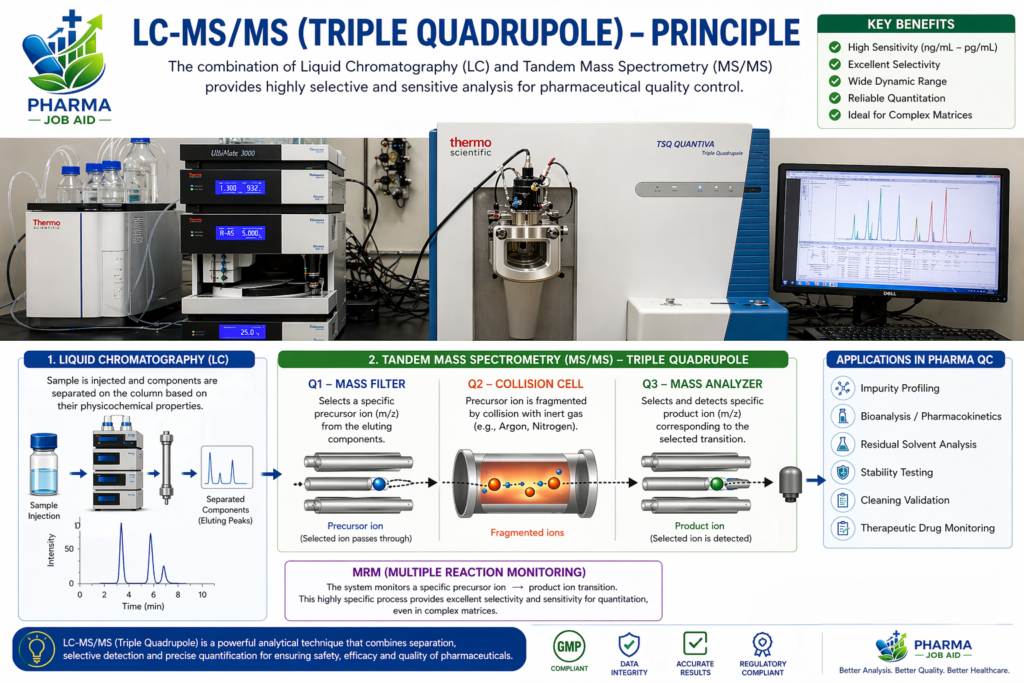
The working principle of Triple Quadrupole LC-MS/MS revolves around the integration of chromatographic separation and tandem mass spectrometric detection, enabling highly selective and sensitive analysis of pharmaceutical compounds. The LC component first separates analytes based on their physicochemical properties, ensuring that compounds enter the mass spectrometer at different retention times. Once separated, the analytes are ionized using soft ionization techniques such as Electrospray Ionization (ESI) or Atmospheric Pressure Chemical Ionization (APCI), which convert neutral molecules into charged ions without extensive fragmentation. The first quadrupole (Q1) acts as a mass filter, allowing only ions of a specific mass-to-charge ratio (precursor ions) to pass through, effectively removing background noise. These selected ions then enter the second quadrupole (Q2), also known as the collision cell, where they undergo controlled fragmentation through collision-induced dissociation (CID) with inert gases like nitrogen or argon. The resulting fragment ions (product ions) are then analyzed by the third quadrupole (Q3), which selectively detects ions of interest. This tandem process significantly enhances specificity, as the system monitors a unique precursor-to-product ion transition, making it highly reliable for quantitative and confirmatory analysis in pharmaceutical QC.
🔄 Workflow of LC-MS/MS Analysis
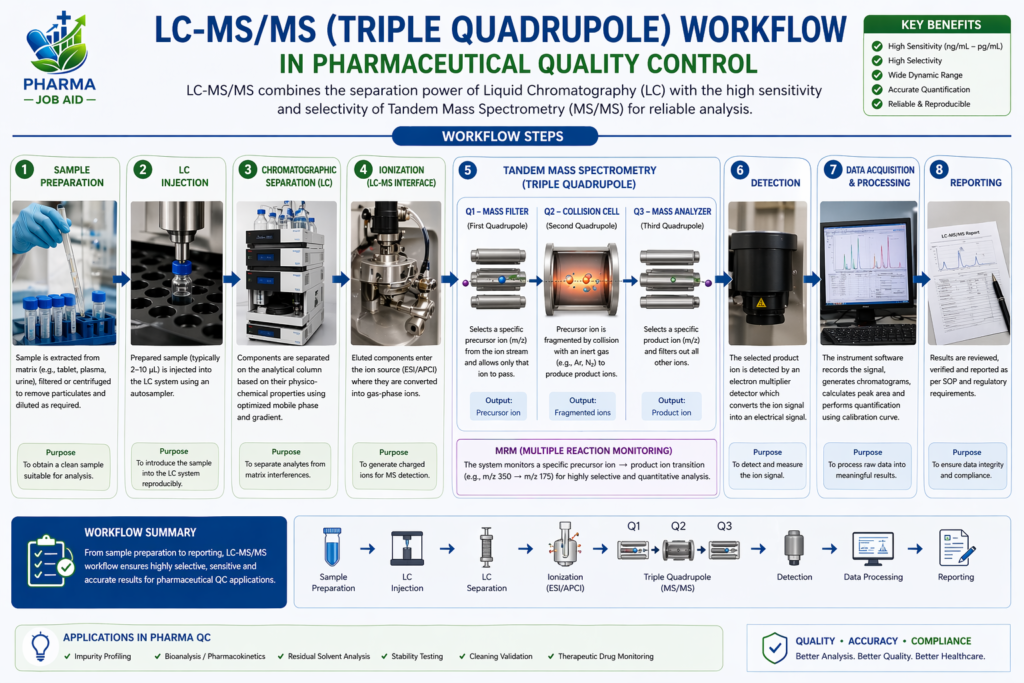
The LC-MS/MS analytical workflow in pharmaceutical QC laboratories involves a series of carefully controlled steps designed to ensure accurate and reproducible results. The process begins with sample preparation, where pharmaceutical samples such as tablets, injectables, or biological fluids are extracted, filtered, and sometimes diluted to match the method requirements. The prepared sample is then introduced into the liquid chromatography system, where it undergoes separation within a column packed with stationary phase material optimized for the target analytes. As the separated compounds elute from the column, they enter the ion source of the mass spectrometer, where they are ionized into charged particles. These ions are then transferred into the triple quadrupole system, where sequential mass filtering, fragmentation, and detection occur. The instrument software records the signal intensity corresponding to specific ion transitions, generating chromatograms and mass spectra. Finally, the data is processed and interpreted using validated analytical methods, ensuring compliance with regulatory guidelines such as those outlined by the International Council for Harmonisation. Each step in this workflow is critical, as any variation can impact the accuracy, precision, and reliability of the results.
🎯 Modes of Operation (MRM, SRM, Scan Modes)
One of the most powerful features of Triple Quadrupole LC-MS/MS is its ability to operate in multiple modes, each designed for specific analytical objectives in pharmaceutical QC. The most widely used mode is Multiple Reaction Monitoring (MRM), which involves monitoring specific precursor-to-product ion transitions for target analytes. This mode offers exceptional sensitivity and selectivity, making it ideal for trace-level quantification of impurities, degradation products, and active pharmaceutical ingredients (APIs). Selected Reaction Monitoring (SRM) is a similar approach but typically focuses on fewer transitions, often used in targeted analysis. In addition to these targeted modes, the instrument can operate in various scan modes, including full scan, product ion scan, and precursor ion scan, which are useful for method development, structural elucidation, and unknown compound identification. These versatile operating modes allow pharmaceutical analysts to tailor the method based on the analytical requirement, whether it is routine QC testing or advanced research applications. Regulatory agencies such as the U.S. Food and Drug Administration strongly recommend the use of MRM-based methods for bioanalytical and impurity analysis due to their high specificity and reproducibility.
💊 Applications in Pharmaceutical Quality Control
5
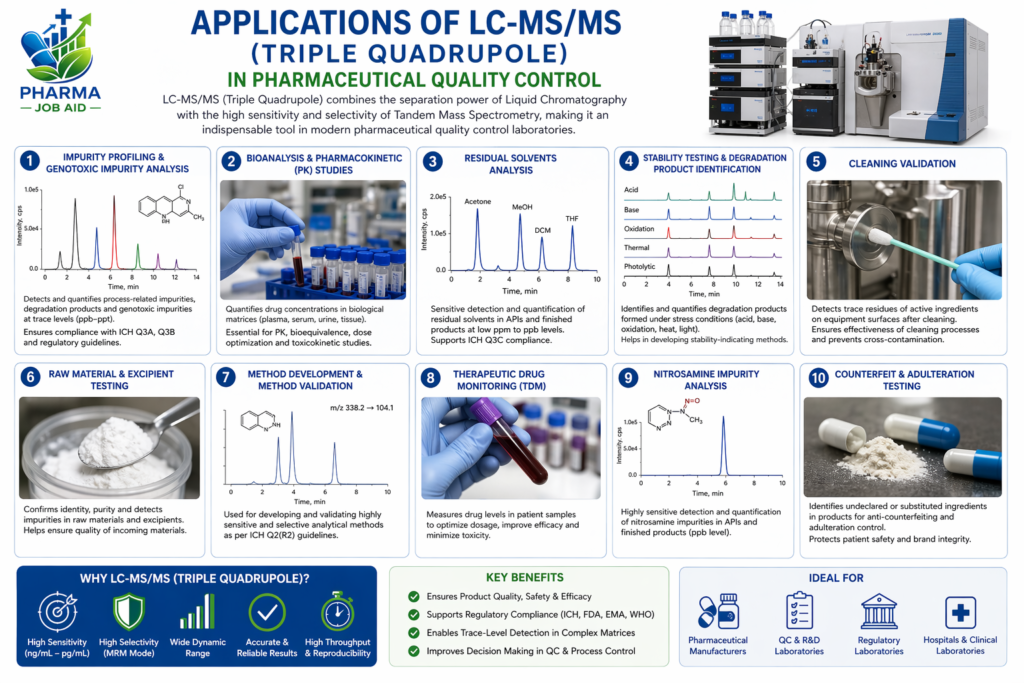
LC-MS/MS plays a vital role in multiple applications within pharmaceutical QC, significantly enhancing the ability to ensure product quality and patient safety. One of its primary applications is impurity profiling, where it detects and quantifies impurities at extremely low levels, ensuring compliance with ICH Q3A and Q3B guidelines. In bioanalytical studies, LC-MS/MS is used to measure drug concentrations in biological matrices such as plasma and urine, supporting pharmacokinetic and bioequivalence studies required for regulatory submissions. The technique is also widely used in stability testing to identify and characterize degradation products formed under various environmental conditions, thereby supporting the development of stability-indicating methods. Additionally, LC-MS/MS is essential in cleaning validation, where it detects trace residues from previous batches, ensuring there is no cross-contamination in manufacturing equipment. It is also applied in residual solvent analysis, environmental monitoring, and therapeutic drug monitoring. The World Health Organization emphasizes the importance of such advanced analytical techniques in maintaining global pharmaceutical quality standards.
📊 Advantages of Triple Quadrupole LC-MS/MS
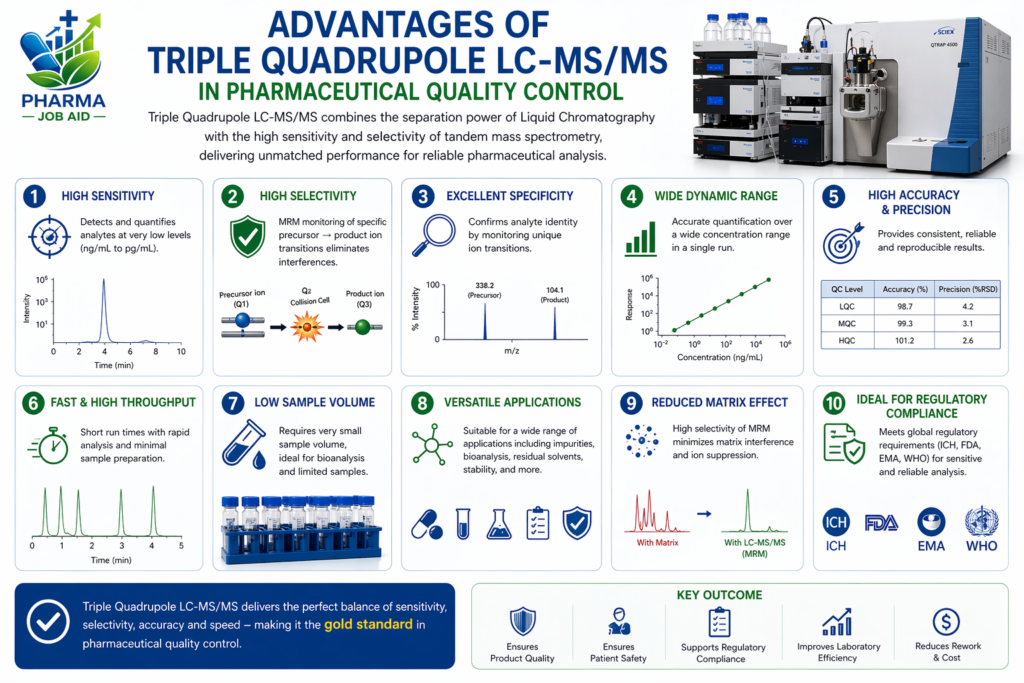
The adoption of Triple Quadrupole LC-MS/MS in pharmaceutical QC is largely driven by its numerous advantages over conventional analytical techniques. One of its most significant benefits is its extremely high sensitivity, allowing detection of compounds at nanogram to picogram levels, which is essential for impurity analysis and bioanalysis. The technique also offers exceptional selectivity due to its ability to monitor specific ion transitions, effectively eliminating interference from complex sample matrices. Another key advantage is its wide dynamic range, enabling accurate quantification across a broad concentration spectrum. LC-MS/MS also supports high-throughput analysis, making it suitable for routine QC environments where large numbers of samples need to be analyzed efficiently. Furthermore, the technique provides both qualitative and quantitative data, allowing simultaneous identification and quantification of compounds. These advantages make LC-MS/MS a preferred choice in pharmaceutical laboratories aiming to meet stringent regulatory requirements and maintain high standards of analytical performance.
⚠️ Limitations and Challenges
Despite its many advantages, LC-MS/MS also presents several challenges that must be carefully managed in pharmaceutical QC laboratories. One of the primary limitations is the high cost of instrumentation and maintenance, which can be a barrier for smaller pharmaceutical companies. The technique also requires highly skilled analysts for method development, operation, and data interpretation, as the complexity of the system demands a deep understanding of both chromatography and mass spectrometry. Another significant challenge is the occurrence of matrix effects, such as ion suppression or enhancement, which can impact the accuracy of quantitative results. These effects arise from co-eluting substances that interfere with ionization efficiency in the mass spectrometer. Additionally, method development can be time-consuming, as it involves optimization of multiple parameters including chromatographic conditions, ionization settings, and MRM transitions. Proper validation and system suitability testing are essential to ensure reliable performance, as required by regulatory bodies like the European Medicines Agency.
🧪 Method Development Strategy
Method development in LC-MS/MS is a critical process that directly impacts the reliability and regulatory acceptance of analytical results in pharmaceutical QC. It begins with a thorough understanding of the physicochemical properties of the analyte, including its polarity, molecular weight, and ionization behavior. Based on this information, suitable chromatographic conditions such as column type, mobile phase composition, and gradient program are selected to achieve optimal separation. The next step involves optimization of the mass spectrometric parameters, including ion source conditions, collision energy, and selection of precursor and product ions for MRM analysis. Internal standards, often isotopically labeled compounds, are used to improve accuracy and compensate for variability. The developed method is then subjected to rigorous validation as per guidelines from organizations such as Pharmaceutical Inspection Co-operation Scheme, ensuring it meets predefined acceptance criteria for accuracy, precision, specificity, and robustness. A well-developed method ensures consistent performance and regulatory compliance throughout its lifecycle.
📋 Method Validation in LC-MS/MS
Method validation is a regulatory requirement that ensures the reliability and reproducibility of analytical methods used in pharmaceutical QC. In LC-MS/MS, validation involves a comprehensive evaluation of parameters such as accuracy, precision, specificity, linearity, limit of detection (LOD), limit of quantification (LOQ), and robustness. Accuracy is assessed by comparing measured values with true values, while precision evaluates the consistency of results under repeated conditions. Specificity ensures that the method can accurately measure the analyte in the presence of other components such as impurities and excipients. Linearity determines the method’s ability to produce results proportional to the concentration of analyte over a specified range. LOD and LOQ define the sensitivity of the method, indicating the smallest amount of analyte that can be reliably detected and quantified. These validation parameters are defined in guidelines issued by the International Council for Harmonisation and are essential for regulatory submissions and GMP compliance.
🏭 Role in GMP and Regulatory Compliance


7
LC-MS/MS plays a crucial role in maintaining GMP compliance and ensuring data integrity in pharmaceutical QC laboratories. It supports key quality systems such as deviation management, out-of-specification (OOS) investigations, and corrective and preventive actions (CAPA). The technique provides highly reliable and traceable data, which is essential for maintaining compliance with data integrity principles such as ALCOA+ (Attributable, Legible, Contemporaneous, Original, Accurate). Regulatory agencies, including the Directorate General of Drug Administration and global bodies, require pharmaceutical companies to use validated analytical methods and maintain proper documentation for all QC activities. LC-MS/MS systems are equipped with advanced software that supports audit trails, electronic signatures, and secure data storage, ensuring compliance with regulatory requirements such as 21 CFR Part 11. Its role in ensuring product quality and patient safety makes it an indispensable tool in GMP-compliant pharmaceutical manufacturing.
🚀 Future Trends in LC-MS/MS
The future of LC-MS/MS in pharmaceutical QC is evolving rapidly with advancements in technology and increasing regulatory expectations. Automation is becoming more prevalent, reducing manual intervention and improving efficiency in high-throughput laboratories. The integration of artificial intelligence (AI) and machine learning is enhancing data analysis, enabling faster and more accurate interpretation of complex datasets. Hybrid mass spectrometry systems combining triple quadrupole with high-resolution mass analyzers are also gaining popularity, offering improved analytical capabilities. Additionally, advancements in ultra-high-performance liquid chromatography (UHPLC) are reducing analysis time while maintaining high resolution. Digitalization and cloud-based data management systems are further improving data integrity and accessibility. As pharmaceutical industries in Bangladesh and globally continue to expand, LC-MS/MS will remain a critical technology for ensuring quality, compliance, and innovation in drug development and manufacturing.
📌 Conclusion
LC-MS/MS (Triple Quadrupole) has transformed pharmaceutical quality control by providing unmatched analytical performance in terms of sensitivity, selectivity, and reliability. Its ability to detect and quantify compounds at trace levels makes it essential for impurity profiling, bioanalysis, and regulatory compliance. Despite its challenges, the benefits of this technology far outweigh its limitations, making it a standard tool in modern pharmaceutical laboratories. As regulatory requirements continue to evolve and the demand for high-quality medicines increases, LC-MS/MS will play an even greater role in ensuring the safety and efficacy of pharmaceutical products worldwide.