
Introduction to ICH Q1 Stability Testing
Stability testing is one of the most critical aspects of pharmaceutical QA/QC and regulatory affairs. It is an important tool providing scientific proof of the changing quality of drug substances and/or finished pharmaceutical products as a result of exposure to environmental factors such as temperature, humidity, and light.
Guidelines for stability have been developed by the International Council for Harmonisation of Technical Requirements for Pharmaceuticals for Human Use (ICH) in order to provide scientifically sound retest intervals, shelf life, and storage conditions recommendations.
Traditionally, the ICH Q1A(R2): Stability Testing of New Drug Substances and Products was used as a primary stability testing guideline for new drug substances and drug products. Also, ICH stability guideline series covers issues of photostability testing, new dosage forms, bracketing and matrixing, stability data evaluation.
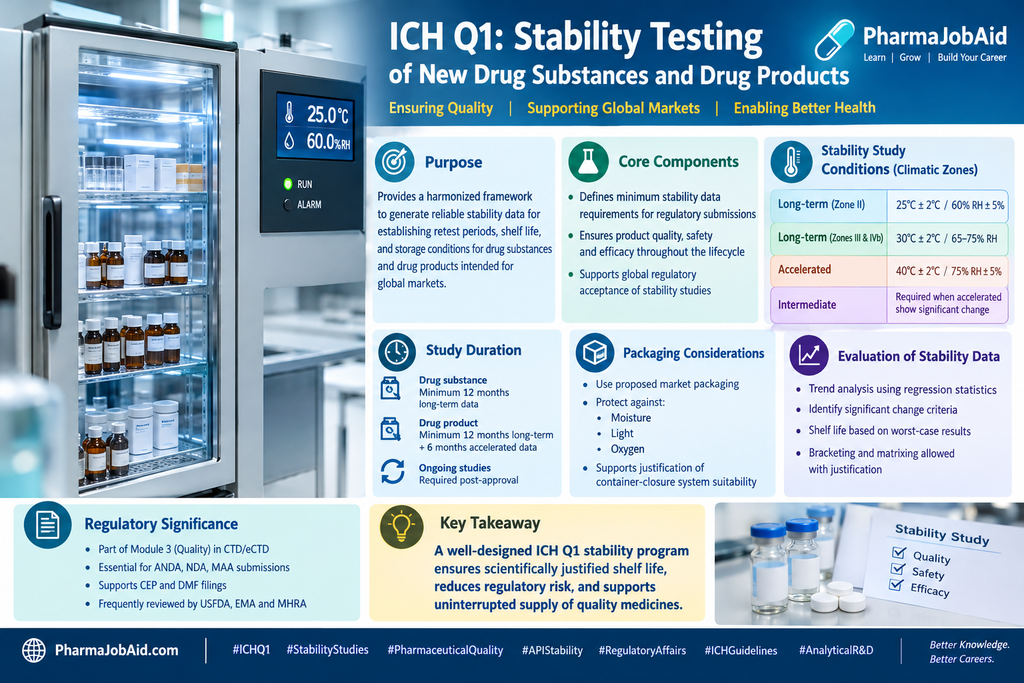
One of the recent regulatory news is that ICH Q1A(R2) has been revised and consolidated into ICH Q1: Stability Testing of Drug Substances and Drug Products guideline, which was released in April 2025. The purpose of the new ICH guideline is to consolidate and update the stability guidelines currently available. By October 2026, the pharmaceutical professionals are encouraged to ensure the official regulatory status of the ICH guideline prior to using it. Official ICH Q1A(R2) guideline | FDA’s consolidated draft Q1 guideline.
Knowledge of ICH stability guidelines is a must for the pharmaceutical professionals.
1. What Is the Purpose of ICH Q1?
The basic aim of stability studies is to determine the variations in the quality of the drug substance or drug product as a function of time and thereby define scientifically sound storage conditions and retest period or shelf life.
The primary aims are as follows:
- Determination of the retest period of a drug substance or an API.
- Determination of the shelf life of a pharmaceutical product.
- Establishment of storage conditions and labels.
- Determination of the influence of temperature, humidity, and light on the quality of the product.
- Identification of the degradation products and any changes in the properties of the product.
- Product development, submission, and management.
- To prove that the product conforms to the specifications during its shelf life.
An effectively designed stability study program enables manufacturers to provide medicines that will maintain their required qualities during the recommended storage.
2. Key Stability Testing Concepts
Before designing a stability study, pharmaceutical QA and QC professionals should understand the following terms.
| Term | Meaning |
| Stability study | A planned investigation of how product quality changes over time under specified conditions. |
| Long-term stability testing | Testing under the proposed storage conditions to support the assigned retest period or shelf life. |
| Accelerated stability testing | Testing under elevated environmental conditions to help assess degradation and support stability evaluation. |
| Intermediate stability testing | Testing at an intermediate condition when required by the applicable guideline and study results. |
| Retest period | The period during which a drug substance is expected to remain suitable for use, subject to appropriate testing. |
| Shelf life | The period during which a drug product is expected to meet its approved specifications under defined storage conditions. |
| Significant change | A predefined change in a stability attribute that triggers further evaluation under the applicable guideline. |
| Stability-indicating method | An analytical procedure capable of assessing relevant stability changes, including degradation where applicable. |
Important distinction: A drug substance generally has a retest period, whereas a finished drug product generally has an assigned shelf life.
3. Stability Testing Conditions and Climatic Zones
Stability testing conditions are selected according to the nature of the product, intended market, packaging system, and applicable regulatory requirements.
The traditional ICH Q1A(R2) framework provides the following commonly used conditions for conventional drug substances and drug products.
A. Long-term stability testing
Long-term studies evaluate product quality under the intended storage conditions over the proposed shelf life or retest period.
Common long-term conditions include:
| Temperature | Relative humidity | Application |
| 25°C ± 2°C | 60% RH ± 5% | Traditional ICH long-term condition |
| 30°C ± 2°C | 65% RH ± 5% | Alternative long-term condition in the traditional ICH framework |
| 30°C ± 2°C | 75% RH ± 5% | Common condition for hot and very humid markets, including WHO Zone IVb applications where applicable |
The correct condition must be selected based on the applicable regional or national requirements. The above conditions should not be treated as interchangeable options for every product or market.
For pharmaceutical products intended for Bangladesh and other hot, humid markets, the applicable DGDA and relevant WHO or regional stability requirements should be checked before approving the stability protocol.
B. Accelerated stability testing
The conventional accelerated stability condition is:
- Temperature: 40°C ± 2°C
- Relative humidity: 75% RH ± 5%, where applicable
- Typical study duration: Six months
Accelerated testing helps identify potential stability problems within a shorter period. However, accelerated data alone do not automatically justify the full shelf life of a pharmaceutical product.
C. Intermediate stability testing
Intermediate testing may be required when significant change occurs under accelerated conditions and the applicable guideline calls for further evaluation.
A traditional ICH intermediate condition is:
- Temperature: 30°C ± 2°C
- Relative humidity: 65% RH ± 5%, where applicable
- Typical duration: Six months when required under the applicable protocol.
The need for intermediate testing depends on the selected long-term condition, accelerated results, product characteristics, and applicable regulatory requirements.
Regulatory reference: ICH Q1A(R2) – Stability Testing of New Drug Substances and Products.
4. Stability Study Duration and Data Requirements
The study design and minimum data package depend on the type of product, the proposed shelf life or retest period, the submission stage, and the applicable guideline.
For conventional new drug substances and drug products under the traditional ICH Q1A(R2) framework, the following are common baseline expectations.
| Study type | Typical duration | Purpose |
| Long-term | At least 12 months of data at the time of the relevant initial registration submission | Supports the proposed retest period or shelf life |
| Accelerated | Six months | Evaluates stability under elevated conditions |
| Intermediate | Usually six months when required | Further evaluates stability when accelerated results indicate a need |
| Ongoing stability | Continues according to the approved or established program | Confirms continuing product quality after commercialization |
These durations are not universal requirements for every product or submission. Product-specific and regional requirements may differ.
Ongoing stability studies
After marketing authorization, manufacturers should maintain an appropriate ongoing stability program in accordance with applicable GMP and regulatory requirements.
The program should confirm that marketed batches continue to meet their established specifications throughout the assigned shelf life.
Typical activities include:
- Selecting representative batches according to the approved program.
- Placing batches into stability chambers at the required conditions.
- Testing samples at predetermined intervals.
- Reviewing analytical results and stability trends.
- Investigating out-of-specification (OOS) and unexpected results.
- Assessing the impact of adverse trends on product quality.
- Documenting conclusions and implementing CAPA when required.
Ongoing stability testing is an important part of pharmaceutical quality system management and post-approval compliance.
5. Which Tests Are Performed During Stability Studies?
The stability testing parameters depend on the dosage form, formulation, product specifications, and potential degradation pathways.
Common tests for tablets and capsules
- Description and appearance
- Assay of the active pharmaceutical ingredient
- Related substances and degradation products
- Dissolution
- Water content, where applicable
- Disintegration, where applicable
- Microbiological testing, when required
Common tests for liquid pharmaceutical products
- Appearance, color, and clarity
- Assay
- Related substances
- pH
- Viscosity, where applicable
- Preservative content, where applicable
- Microbial limits
- Other dosage-form-specific tests
Common tests for semisolid products
- Appearance and homogeneity
- Assay and degradation products
- pH, where applicable
- Viscosity or rheological characteristics
- Microbiological quality
- Preservative content, where applicable
- Other product-specific performance attributes
The approved stability protocol should define the tests, analytical methods, acceptance criteria, sampling intervals, and reporting requirements.
Not every test is required for every product. The selection should be scientifically justified and consistent with the approved specifications.
6. Importance of Packaging in Stability Studies
The container-closure system plays a critical role in protecting pharmaceutical products from environmental influences.
Stability studies should generally use the proposed market container-closure system or another scientifically justified configuration appropriate to the study objective.
Packaging considerations include:
Moisture protection: Hygroscopic materials and moisture-sensitive formulations may require suitable moisture-barrier packaging.
Light protection: Light-sensitive products may need amber containers, opaque packaging, or other suitable protective measures.
Oxygen protection: Oxygen-sensitive formulations may require packaging with suitable oxygen-barrier properties or other appropriate controls.
Container-closure integrity: The packaging system should maintain its protective function throughout the intended shelf life.
For example, a moisture-sensitive tablet packaged in an inadequate blister system may experience changes in hardness, dissolution, or degradation during storage.
QA should ensure that packaging selection is supported by relevant stability data and an appropriate scientific rationale.
7. How Is Shelf Life Determined?
Shelf-life assignment requires a scientific assessment of stability data generated under the defined study conditions.
The evaluation should consider the actual results, trends, variability, specifications, and relevant product characteristics.
A typical assessment includes:
- Reviewing the approved stability protocol and analytical results.
- Evaluating assay, degradation products, dissolution, and other relevant attributes.
- Identifying adverse trends and any results outside acceptance criteria.
- Applying appropriate statistical analysis when suitable.
- Assessing whether extrapolation beyond available long-term data is scientifically justified.
- Establishing suitable storage conditions and labeling statements.
- Documenting the rationale for the proposed shelf life.
ICH Q1E provides traditional guidance on evaluating stability data, including the use of statistical methods and circumstances in which extrapolation may be appropriate.
Example
Suppose a tablet formulation is proposed to have a 24-month shelf life.
The manufacturer generates long-term and accelerated stability data, evaluates assay and degradation-product trends, reviews dissolution results, and assesses whether all relevant quality attributes remain within approved limits.
The proposed shelf life must be supported by the complete stability assessment and applicable regulatory requirements. Six months of accelerated data alone should not be interpreted as automatic justification for a 24-month shelf life.
8. What Is Significant Change in Stability Testing?
Significant change refers to a predefined change in one or more stability attributes that requires evaluation under the applicable guideline.
Under the traditional ICH Q1A(R2) framework for drug products, examples include:
- A 5% change in assay from its initial value, or failure to meet the potency acceptance criteria using the applicable interpretation.
- Any degradation product exceeding its acceptance criterion.
- Failure to meet the acceptance criteria for appearance, physical attributes, or functionality.
- Failure to meet pH acceptance criteria, where applicable.
- Failure to meet dissolution acceptance criteria for the relevant dosage form.
The exact criteria and interpretation depend on the applicable guideline, product type, and approved specifications.
When significant change occurs, QA should assess the results, investigate potential causes, evaluate the need for additional testing, and determine whether the proposed shelf life or storage conditions remain justified.
9. Bracketing and Matrixing in Stability Studies
Bracketing and matrixing are reduced stability study designs that may be used when scientifically justified.
Bracketing
Bracketing involves testing selected samples representing the extremes of certain design factors, such as container sizes or fill volumes, instead of testing every intermediate configuration at every time point.
Example: A manufacturer markets the same formulation in three container sizes. If the conditions for bracketing are satisfied, the largest and smallest configurations may be selected for testing.
The applicability of bracketing must be justified because the extremes do not always represent the worst-case stability behavior.
Matrixing
Matrixing involves testing a selected subset of samples at specific time points according to a predefined design.
Example: Instead of testing every batch and packaging configuration at every scheduled interval, a scientifically justified matrixing design may distribute the testing across the study period.
Matrixing reduces testing requirements but should not compromise the reliability of the stability conclusions.
The study design must consider product variability, formulation differences, packaging configurations, batch characteristics, and the potential impact of omitted combinations.
10. Stability Chamber Management and GMP Compliance
Stability chambers are critical equipment in pharmaceutical manufacturing and quality control laboratories.
Their performance must be appropriately qualified, monitored, and maintained according to applicable GMP requirements and the company’s quality system.
Important controls include:
- Installation, operational, and performance qualification, as applicable.
- Temperature and relative humidity monitoring.
- Calibration of monitoring instruments.
- Alarm systems and excursion management.
- Preventive maintenance.
- Sample placement and identification.
- Access control and chamber mapping, where applicable.
- Backup arrangements and contingency planning.
- Documented evaluation of chamber excursions.
- Data integrity and record retention.
What should QA do when a stability chamber excursion occurs?
An excursion should be documented and assessed through the established quality system.
QA and relevant technical personnel should review the duration, magnitude, affected samples, available monitoring data, equipment status, and scientific evidence to determine the potential impact on stability results.
The assessment should be documented, and appropriate corrective and preventive actions should be implemented when necessary.
A chamber excursion should not automatically be considered harmless or automatically invalidate every result. The decision should be based on a documented, scientifically sound impact assessment.
11. Common Stability Study Deviations and CAPA
Stability studies may encounter deviations that require investigation and appropriate corrective and preventive action.
| Finding | Potential QA action |
| Stability chamber temperature excursion | Document the event, assess impact, and investigate the cause |
| Missing stability sample | Assess the study impact and document the deviation |
| Delayed stability testing | Evaluate the effect on the protocol and data interpretation |
| OOS assay result | Initiate the approved OOS investigation procedure |
| Unexpected increase in degradation products | Review analytical results, formulation, packaging, and storage conditions |
| Incomplete stability records | Investigate the documentation gap and implement appropriate corrective action |
| Repeated chamber alarms | Investigate equipment performance and assess the effectiveness of CAPA |
A sound investigation should distinguish the immediate cause from the root cause. Corrective actions should address the specific event, while preventive actions should reduce the likelihood of recurrence.
12. Role of QA, QC, and Regulatory Affairs in Stability Studies
Stability management requires coordination between several pharmaceutical departments.
Quality Assurance (QA)
QA typically oversees protocol approval, deviation management, change control, data integrity, CAPA, documentation review, and compliance with the established quality system.
Quality Control (QC)
QC performs or coordinates the required testing, follows approved analytical procedures, reviews laboratory data, and reports OOS or unexpected results through established procedures.
Research and Development (R&D)
R&D supports formulation development, degradation studies, analytical method development, packaging selection, and scientific interpretation of stability behavior.
Regulatory Affairs
Regulatory Affairs ensures that stability data support the registration dossier, proposed shelf life, storage conditions, labeling, and relevant post-approval submissions.
Warehouse and Production
Warehouse and Production personnel help maintain appropriate storage and handling conditions and support investigations when manufacturing or storage factors may influence product quality.
Effective communication among these departments is essential for reliable stability management.
13. Regulatory Importance of ICH Q1 in CTD/eCTD Submissions
Stability data form an important part of the Quality section of the Common Technical Document (CTD) and electronic Common Technical Document (eCTD).
Relevant stability information is generally presented in Module 3, including the applicable sections for drug substance and drug product stability.
The submission should contain the relevant protocols, study conditions, batch information, analytical results, evaluation, proposed retest period or shelf life, and storage statements.
Stability data may support marketing authorization applications and other regulatory activities, depending on the product and submission type.
Regulatory authorities may examine whether:
- The selected stability conditions are appropriate for the intended market.
- The batches are representative of the proposed commercial product.
- The analytical procedures are suitable for stability evaluation.
- The proposed shelf life is scientifically justified.
- Stability results meet the approved acceptance criteria.
- Unexpected trends and deviations have been adequately investigated.
- Ongoing stability commitments are managed appropriately.
For professionals working in Bangladesh, the applicable DGDA requirements should be reviewed alongside relevant WHO guidance and the requirements of any export markets.
14. Common Mistakes to Avoid in Stability Management
Pharmaceutical professionals should be aware of several common mistakes:
- Selecting stability conditions without considering the intended market.
- Confusing a drug substance’s retest period with a finished product’s shelf life.
- Assigning shelf life based solely on accelerated stability data.
- Using unsuitable or unrepresentative packaging.
- Failing to investigate OOS results and unexpected trends.
- Ignoring stability chamber excursions.
- Applying bracketing or matrixing without sufficient justification.
- Failing to maintain complete and traceable stability records.
- Neglecting ongoing stability studies after commercialization.
- Applying a draft guideline as though it were a finalized, effective requirement.
These mistakes may lead to regulatory deficiencies, inadequate shelf-life justification, and potential risks to product quality.
15. Frequently Asked Questions About ICH Q1
Q1. What is ICH Q1?
ICH Q1 is the stability guideline framework for evaluating the stability of drug substances and drug products and establishing suitable retest periods, shelf life, and storage conditions.
Q2. What is ICH Q1A(R2)?
ICH Q1A(R2) is the traditional harmonized guideline titled Stability Testing of New Drug Substances and Products. It provides core recommendations for stability study design and data requirements.
Q3. What is the usual accelerated stability condition?
For conventional products under the traditional ICH Q1A(R2) framework, the usual accelerated condition is 40°C ± 2°C and 75% RH ± 5%, where applicable.
Q4. How long is an accelerated stability study?
Six months is the typical accelerated study duration under the traditional framework. Product-specific requirements may differ.
Q5. What is the difference between long-term and accelerated stability testing?
Long-term testing evaluates product stability under intended storage conditions over time. Accelerated testing uses elevated conditions to help assess degradation and support stability evaluation.
Q6. Is intermediate stability testing always required?
No. Its necessity depends on the applicable guideline, selected long-term conditions, accelerated study results, and product characteristics.
Q7. Why is packaging important in stability studies?
Packaging protects the product against environmental influences such as moisture, light, and oxygen and can affect the product’s stability throughout its shelf life.
Q8. What is the difference between ICH Q1A and ICH Q1E?
ICH Q1A(R2) addresses the core stability study recommendations for new drug substances and products. ICH Q1E addresses the evaluation of stability data, including statistical analysis and possible extrapolation.
Q9. What is the current status of the consolidated ICH Q1 guideline?
A consolidated draft was published in April 2025 as part of the effort to combine and modernize the existing stability guideline series. Professionals should consult official ICH and regional regulatory sources for the latest status before implementing new recommendations.
Q10. Why should QA professionals understand ICH Q1?
Knowledge of stability testing supports protocol review, deviation investigations, CAPA, change control, ongoing stability management, regulatory submissions, and scientifically justified shelf-life decisions.
Conclusion
ICH Q1 stability testing is a fundamental component of pharmaceutical quality management. A well-designed stability program helps manufacturers understand product degradation, establish appropriate storage conditions, justify retest periods and shelf life, and demonstrate continued compliance with approved quality specifications.
For QA, QC, R&D, and Regulatory Affairs professionals, practical knowledge of stability protocols, climatic conditions, stability-indicating analytical methods, packaging suitability, trend analysis, and deviation management is essential.
Stability testing is not simply a regulatory submission requirement; it is an ongoing scientific and quality responsibility that supports the availability of safe, effective, and high-quality medicines.
Stay connected with PharmaJobAid.com for pharmaceutical QA, QC, GMP, regulatory affairs, interview preparation, and career development resources.
References
- International Council for Harmonisation (ICH). Quality Guidelines – Stability Guidelines.
- U.S. Food and Drug Administration (FDA). Q1A(R2): Stability Testing of New Drug Substances and Products.
- U.S. Food and Drug Administration (FDA). Q1: Stability Testing of Drug Substances and Drug Products – Draft Guidance.
- World Health Organization (WHO). TRS 1010, Annex 10: Stability Testing of Active Pharmaceutical Ingredients and Finished Pharmaceutical Products.
Disclaimer: This article is intended for educational and professional development purposes. Always consult the latest applicable guidelines, national regulatory requirements, and approved company procedures before implementing a stability study.