
🚨 EMA Releases New Guideline on the Chemistry of Active Substances (2026): What Pharma Professionals Must Know
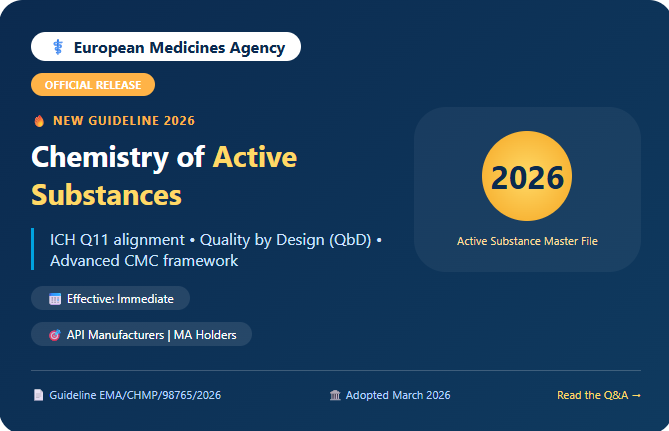
⚕️ European Medicines AgencyOFFICIAL RELEASE
🔥 NEW GUIDELINE 2026
Chemistry of Active Substances
ICH Q11 alignment • Quality by Design (QbD) • Advanced CMC framework
📅 Effective: Immediate🎯 API Manufacturers | MA Holders
2026
Active Substance Master File
📄 Guideline EMA/CHMP/98765/2026🏛️ Adopted March 2026Read the Q&A →
Introduction
The pharmaceutical regulatory landscape continues to evolve rapidly, and 2026 marks another significant milestone with the release of a new guideline by the European Medicines Agency (EMA).
Adopted on February 16, 2026, and set to come into effect on September 1, 2026, the “Guideline on the Chemistry of Active Substances” introduces updated expectations for the development, manufacture, and control of active pharmaceutical ingredients (APIs).
For pharmaceutical professionals in Bangladesh and across the globe, this guideline is not just a regulatory document—it is a roadmap for compliance, quality assurance, and global market access.
This article from PharmaJobAid breaks down everything you need to know, from technical requirements to career implications.
Why This EMA Guideline Matters
The active substance (API) is the core of any medicinal product. Regulatory authorities worldwide, including EMA, are strengthening expectations around API quality due to:
- Increasing global supply chain complexity
- Rising concerns about nitrosamine impurities
- Greater scrutiny on data integrity and manufacturing controls
- Expansion of international harmonization through International Council for Harmonisation (ICH)
This updated EMA guideline aligns with global regulatory standards while introducing stricter scientific and compliance expectations.
Compliance Timeline: Key Dates
- Adoption Date: February 16, 2026
- Effective Date: September 1, 2026
👉 This gives pharmaceutical companies approximately 6.5 months to ensure full compliance.
Scope and Applicability
✔ Applies To:
- New chemical active substances
- Existing active substances used in human medicinal products
❌ Excludes:
- Herbal products
- Biological and biotechnological products
- Radiopharmaceuticals
- Radiolabelled products
Regulatory Framework and Legal Basis
The guideline follows the globally accepted Common Technical Document (CTD) structure and aligns with European legislation, particularly:
- Directive 2001/83/EC
Key Implication:
Pharmaceutical companies must ensure that Module 3 (Quality)—specifically Section 3.2.S (Active Substance)—meets the updated EMA expectations.
Deep Dive: Active Substance Dossier (CTD Section 3.2.S)
The heart of the guideline lies in defining requirements for the Active Substance Master File (ASMF) or dossier.
1. Manufacture (Section 3.2.S.2)
🔬 Process Description
Companies must provide:
- A detailed narrative of the manufacturing process
- A schematic flow diagram
- Full disclosure of:
- Reagents
- Solvents
- Catalysts
👉 Transparency is now critical—regulators expect full traceability.
🧪 Starting Materials: A Major Focus Area
The guideline introduces stricter requirements:
- Starting materials must be:
- Scientifically justified
- Typically separated from the API by multiple synthesis steps
- Risk-based evaluation must include:
- Potential for nitrosamine formation
- Source and quality of raw materials
👉 This is especially important for manufacturers in Bangladesh supplying APIs to EU markets.
🔁 Recovery and Reprocessing
EMA allows material recovery—but with strict conditions:
- Must be scientifically justified
- Must not negatively impact impurity profile
- Requires full documentation
Reprocessing must:
- Follow Good Manufacturing Practice (GMP)
- Be clearly defined and validated
2. Characterisation and Impurities (Section 3.2.S.3)
🧬 Structure Elucidation
To confirm API structure, companies must use:
- Nuclear Magnetic Resonance (NMR)
- Infrared Spectroscopy (IR)
- Mass Spectrometry (MS)
👉 These are standard—but EMA now expects more robust data packages.
⚠️ Impurity Control Strategy
A critical update in 2026:
- Strong focus on:
- Mutagenic impurities
- Nitrosamines
Companies must:
- Identify potential impurities
- Establish acceptable limits
- Justify limits using:
- Toxicological data
- Risk assessments
3. Control of Active Substance (Section 3.2.S.4)
📋 Specifications
Minimum required tests:
- Description
- Identification
- Assay
- Impurity testing
👉 Specifications must be scientifically justified and aligned with manufacturing capability.
📊 Batch Analysis
Companies must submit:
- Data from at least 3 consecutive batches
Purpose:
- Demonstrate consistency
- Prove process reproducibility
4. Stability (Section 3.2.S.7)
Stability studies must include:
- Summary of results
- Conclusions
- Justification of:
- Re-test period
- Storage conditions
👉 Stability data must reflect real manufacturing and packaging conditions.
Key Updates in the 2026 Revision
1. Nitrosamine Risk Assessment (Major Highlight)
Nitrosamines remain a global regulatory priority.
EMA now requires:
- Full risk assessment if:
- Amines are present
- Nitrosating agents are used
- Implementation of:
- Risk mitigation strategies
- Control measures
👉 This aligns with global alerts seen in recent years.
2. Starting Material Site Approval
New requirement:
- Any change or addition of starting material manufacturing sites requires:
- Formal regulatory approval
- Variation submission
👉 This increases regulatory oversight across the supply chain.
3. Enhanced Impurity Control
Companies must now:
- Provide deeper impurity profiling
- Include worst-case scenario analysis
- Strengthen justification of limits
Impact on Pharmaceutical Industry in Bangladesh
The pharmaceutical sector in Bangladesh is rapidly growing and increasingly export-oriented.
Key Impacts:
🌍 Export Compliance
Companies exporting to Europe must:
- Upgrade documentation systems
- Strengthen quality control labs
- Align with EMA expectations
🏭 Manufacturing Upgrades
Manufacturers must:
- Improve process validation
- Enhance impurity detection capabilities
- Ensure GMP compliance
👨🔬 Workforce Demand
This guideline will increase demand for skilled professionals in:
- Regulatory Affairs
- Quality Assurance (QA)
- Quality Control (QC)
- Analytical R&D
👉 A great opportunity for job seekers on PharmaJobAid.
Career Opportunities: Why This Matters for You
This regulatory shift creates strong demand for professionals with expertise in:
🔹 Regulatory Affairs
- CTD dossier preparation
- EMA submission knowledge
🔹 Quality Assurance
- GMP compliance
- Deviation and CAPA management
🔹 Analytical Chemistry
- Impurity profiling
- Stability testing
🔹 Production
- Process validation
- Risk assessment
How PharmaJobAid Can Help
At PharmaJobAid, we are committed to helping you succeed in this evolving regulatory environment.
🚀 Our Services:
- CV & Resume Preparation
- Interview Preparation
- Regulatory Affairs Training
- Job Updates in Bangladesh Pharma Industry
👉 Stay ahead of industry changes and build a successful pharma career.
Practical Steps for Companies
To comply with the new EMA guideline, companies should:
✅ Immediate Actions
- Conduct gap analysis
- Review existing dossiers
- Identify high-risk APIs
✅ Mid-Term Actions
- Update impurity control strategies
- Re-evaluate starting materials
- Strengthen analytical methods
✅ Long-Term Strategy
- Invest in training
- Upgrade manufacturing systems
- Implement digital quality systems
Final Thoughts
The 2026 EMA guideline on the chemistry of active substances is more than just a regulatory update—it represents a shift toward greater transparency, scientific rigor, and patient safety.
For pharmaceutical companies, it is a challenge.
For professionals, it is an opportunity.
As global regulations continue to evolve, staying informed and skilled is the key to success.
📢 Stay Connected with PharmaJobAid
👉 Visit: https://pharmajobaid.com/
👉 Follow us for daily pharma job updates, regulatory news, and career tips.