
This comprehensive guide outlines the step-by-step indenting process for Active Pharmaceutical Ingredients (APIs) in the Bangladesh pharmaceutical industry, alongside a robust sourcing strategy designed for the 2026 market landscape.
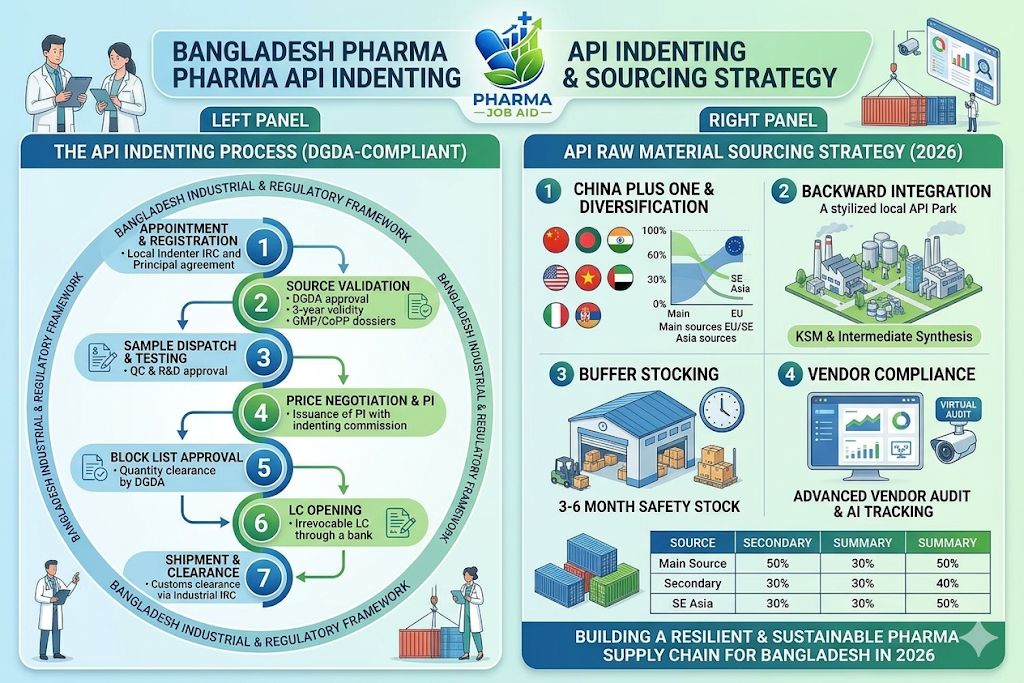
Part 1: The Step-by-Step API Indenting Process
In Bangladesh, the Directorate General of Drug Administration (DGDA) prohibits commercial traders from importing APIs. Only finished dosage formulators with a Drug Manufacturing License can import these materials. Indenting agents act as the vital bridge between foreign manufacturers and local pharmaceutical companies.
Step 1: Appointment of Indenting Agent
The process begins with the foreign API manufacturer (the Principal) appointing a local indenting agent in Bangladesh.
- Agency Agreement: A formal agreement is signed authorizing the agent to represent the Principal.
- Registration: The agent must register this agreement with the Chief Controller of Imports and Exports (CCI&E) to obtain an Indenting Registration Certificate (IRC).
Step 2: API Source Validation (DGDA Approval)
Before any transaction, the source must be validated by the DGDA. This is the most critical regulatory hurdle.
- Dossier Submission: The agent submits a technical dossier including the GMP Certificate, Certificate of Pharmaceutical Product (CoPP), and the Drug Master File (DMF).
- Documentation Requirements: All documents must be notarized or attested by the Bangladesh Embassy in the country of origin.
- Timeline: Usually takes 30 to 90 working days.
- Validity: Once approved, the source validation is valid for 3 years.
Step 3: Sample Dispatch and Testing
Once the source is validated, the local manufacturer (the buyer) requires samples for R&D and Quality Control (QC).
- Sample Quantity: Typically 500g to 5kg depending on the molecule.
- Laboratory Evaluation: The buyer’s QC lab tests the sample against pharmacopeial standards (USP, BP, or IP).
- R&D Approval: If the sample passes, the manufacturer’s R&D committee provides a “Green Signal” for commercial procurement.
Step 4: Price Negotiation and Proforma Invoice (PI)
The indenter facilitates price negotiations between the Principal and the Buyer.
- PI Issuance: Upon price agreement, the Principal issues a Proforma Invoice (PI) to the buyer.
- Indenting Commission: The PI must clearly mention the indenting commission (usually 1-5%) payable to the local agent in local currency.
Step 5: Block List Approval
The buyer must include the specific API and quantity in their “Block List”—a prior import permission system managed by the DGDA.
- The DGDA verifies if the quantity requested matches the buyer’s production capacity and the approved recipe.
- Without an approved Block List, the bank will not open a Letter of Credit (LC).
Step 6: Opening the Letter of Credit (LC)
Payments for APIs in Bangladesh are almost exclusively handled via Irrevocable Letters of Credit.
- The buyer opens the LC through a scheduled bank based on the approved PI and Block List.
- The bank ensures that the foreign supplier receives payment only after submitting the required shipping documents (Bill of Lading, COA, Packing List).
Step 7: Shipment and Customs Clearance
- Shipment: The Principal ships the goods (Air or Sea) and sends the original documents to the buyer’s bank.
- NOC from Indenter: In some cases, the indenter provides a No Objection Certificate (NOC) to facilitate the release.
- Customs: The buyer clears the API from the port using their Industrial IRC.
Part 2: API Raw Material Sourcing Strategy (2026)
With global supply chains facing increased tariff pressures and geopolitical volatility, Bangladesh’s “Big Pharma” companies are shifting from “Just-in-Time” to “Just-in-Case” sourcing.
1. The “China Plus One” Strategy
While China and India remain the primary sources for 80% of Bangladesh’s APIs, 2026 strategies focus on diversification.
- Secondary Sourcing: For every critical molecule (e.g., Metformin, Paracetamol, Azithromycin), companies now qualify at least one secondary source in Europe (Italy/Spain) or Southeast Asia (Vietnam/South Korea) to mitigate risk.
2. Backward Integration & Local API Parks
To reduce dependency on imports, the Bangladesh government and leading firms (like Beximco and Square) are investing heavily in the Active Pharmaceutical Ingredients (API) Industrial Park in Gazaria, Munshiganj.
- In-house Synthesis: Large firms are moving toward manufacturing their own Key Starting Materials (KSMs) and Intermediates.
- Tax Incentives: Sourcing from local API plants provides significant tax holidays and reduced import duties on machinery.
3. Strategic Safety Stocking
Given the 2025-2026 trend of fluctuating freight costs and shipping delays, procurement managers have moved to:
- Inventory Buffers: Maintaining a 3 to 6-month buffer of critical APIs instead of the traditional 1-month stock.
- Warehouse Expansion: Investing in climate-controlled, GMP-compliant warehousing to store larger volumes of raw materials.
4. Advanced Vendor Audit & Compliance
In 2026, sourcing is no longer just about price; it is about Regulatory Resilience.
- Virtual & Third-Party Audits: Utilizing AI-driven tracking and third-party auditors to ensure the Principal’s factory maintains WHO-GMP standards.
- Sustainability Sourcing: Increasing focus on “Green Chemistry” API sources to meet the requirements of export markets (EU/USA).
5. Financial Risk Mitigation
- Currency Hedging: Due to Taka-Dollar exchange rate volatility, companies are increasingly using forward contracts and currency hedging through their banks to lock in API prices months in advance.
- Tariff Monitoring: Sourcing teams now include “Tariff Analysts” to track global trade policy changes that might affect the cost of intermediates used by their Indian or Chinese suppliers.
Summary Table: Key Components of Sourcing Success
| Strategy Component | Focus Area | 2026 Implementation |
| Diversification | Geographic Risk | Qualifying suppliers in 3+ regions. |
| Cost Control | Logistics | Long-term contracts with shipping lines. |
| Quality | Compliance | Sourcing only from USFDA/CEP approved plants. |
| Self-Reliance | Localization | Transitioning 20% of high-volume APIs to local synthesis. |
By integrating a rigid regulatory indenting process with a flexible, multi-source procurement strategy, Bangladeshi pharmaceutical companies can maintain their growth trajectory and ensure the uninterrupted supply of life-saving medicines.