
This comprehensive guide details the structure, regulatory environment, and strategic operations of a pharmaceutical indenting firm in Bangladesh. Given the country’s status as a global generic drug hub, indenting is the “nervous system” that connects over 250 local manufacturers to global chemical producers.
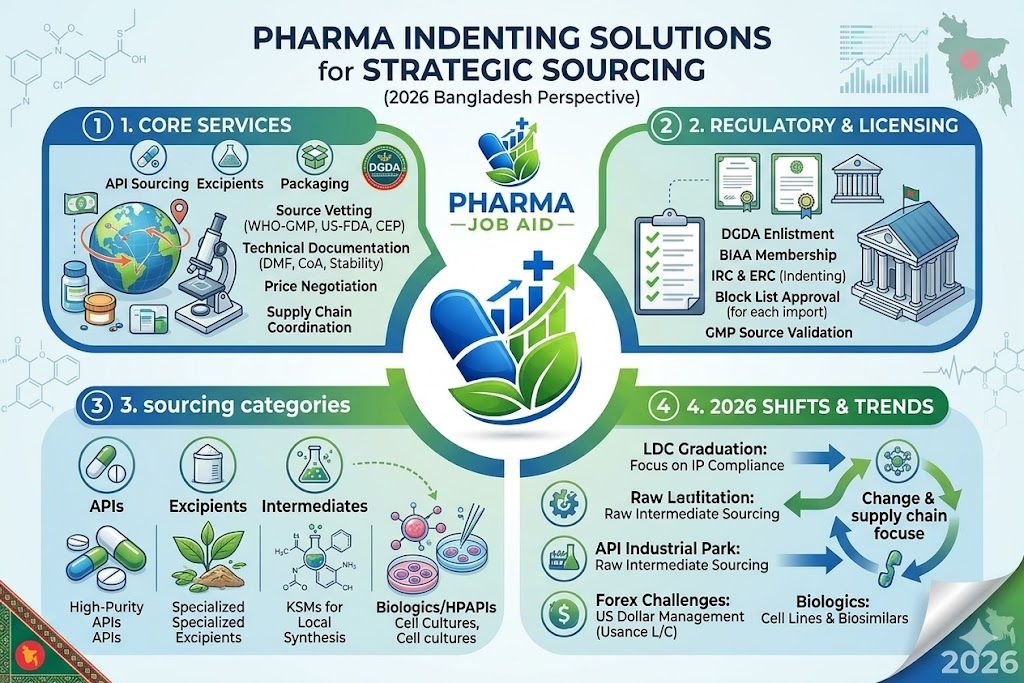
1. The Strategic Role of Indenters in Bangladesh
In the Bangladesh pharmaceutical industry, an indenter is more than a middleman; they are Technical and Regulatory Consultants.
- Import Dependency: Bangladesh imports approximately 80% of its Active Pharmaceutical Ingredients (APIs) and 90% of specialized excipients.
- The Bridge: Indenters facilitate the supply of these raw materials from major hubs like China (60%), India (30%), and Europe (10%).
- Regulatory Shield: They ensure that foreign manufacturers comply with the Directorate General of Drug Administration (DGDA) guidelines.
2. Legal and Licensing Framework
To operate a pharmaceutical indenting firm in 2026, you must navigate a multi-layered registration process.
A. Business Incorporation
Most firms register as a Private Limited Company through the RJSC (Registrar of Joint Stock Companies).
- Minimum Requirements: 2 Shareholders, 2 Directors.
- Documents: Memorandum of Association (MOA) and Articles of Association (AOA) specifically stating “Pharmaceutical Raw Material Indenting” as a business objective.
B. Indenting-Specific Licenses
- IRC & ERC (Indenting): Issued by the Office of the Chief Controller of Imports and Exports (CCI&E).
- BIAA Membership: Mandatory membership in the Bangladesh Indenting Agents’ Association.
- DGDA Enlistment: The most critical step. The indenter must be enlisted with the DGDA to represent foreign suppliers for specific substances.
3. The Operational Workflow (The “Indent” Process)
The indenting cycle in Bangladesh follows a strict regulatory path to ensure drug safety and foreign exchange control.
| Step | Action | Responsibility |
|---|---|---|
| 1. Inquiry | Manufacturer asks for a specific API (e.g., Metformin HCl) with USP/BP specs. | Pharma Manufacturer |
| 2. Sourcing | Indenter contacts global principals (suppliers) for Price & Technical Dossiers. | Indenting Firm |
| 3. Block List | Indenter provides a Proforma Invoice (PI); the pharma company applies for “Block List” approval from DGDA. | Both |
| 4. L/C Opening | Once DGDA clears the Block List, the manufacturer opens a Letter of Credit (L/C) via a local bank. | Manufacturer |
| 5. Commission | The foreign supplier pays the indenter a commission (usually 2–5%) in foreign currency through the Bangladesh Bank. | Supplier / Bank |
4. Technical Documentation Requirements
A professional indenter in Bangladesh must manage a “Technical Dossier” for every product. Local manufacturers will not buy without these:
- GMP Certificate: Good Manufacturing Practice certification from the supplier’s national authority.
- CEP / DMF: Certificate of Suitability (CEP) or Drug Master File (DMF) numbers.
- Stability Data: Proof that the raw material remains stable in Bangladesh’s humid climate (Zone IVb).
- Method of Analysis (MOA): So the local quality control (QC) lab can test the material upon arrival.
5. 2026 Industry Challenges & Transitions
The landscape for indenting is shifting rapidly due to several macroeconomic factors:
A. LDC Graduation (November 2026)
Bangladesh is losing its “Least Developed Country” status.
- Patent Impact: Previously, Bangladesh enjoyed a TRIPS waiver, allowing it to ignore drug patents. Post-2026, indenters must pivot toward sourcing Patented APIs through legal licensing or sourcing from patent-expired generic sources.
- Higher Compliance: Indenters will need to vet suppliers for even higher IP compliance standards.
B. The API Industrial Park (Munshiganj)
With local API production ramping up in the Munshiganj park, the role of indenters is evolving:
- From APIs to Intermediates: Instead of importing finished APIs, indenters are now sourcing Key Starting Materials (KSMs) and Advanced Intermediates for local synthesis.
- Chemical Sourcing: Increased demand for industrial-grade solvents and catalysts used in chemical reactions.
C. Forex and L/C Issues
Due to periodic USD shortages, indenters now act as financial negotiators.
- Deferred Payments: Negotiating 90-day to 180-day “Usance L/Cs” with foreign suppliers to help local manufacturers manage cash flow.
6. Emerging Sourcing Categories
Indenters are moving beyond simple painkillers and antibiotics into high-value segments:
- Biosimilars: Sourcing media and cell lines for biotech drugs.
- Oncology: Highly potent APIs (HPAPIs) for cancer treatment.
- Vaccine Raw Materials: Adjuvants and specialized vials.
- Nutraceuticals: Vitamins and herbal extracts, which have a growing market in Dhaka.
7. Strategic Tips for Success
- Principal Loyalty: Represent 2–3 high-quality Chinese or Indian manufacturers exclusively. Being a “general trader” is less profitable than being an “exclusive agent.”
- Regulatory Intelligence: Keep a close relationship with the DGDA. Knowing when a new drug is about to be approved allows you to source the API before your competitors.
- Technical Sales: Hire pharmacists as your sales team. In Bangladesh, an indenter needs to explain the impurity profile of a chemical to a factory’s Head of Quality.
Summary Table: Indenting Firm Startup Checklist
| Item | Estimated Cost (BDT) | Timeframe |
|---|---|---|
| RJSC Incorporation | 20,000 – 50,000 | 2 Weeks |
| Trade License | 10,000 – 15,000 | 1 Week |
| BIAA Membership | 25,000 – 40,000 | 3 Weeks |
| ERC (Indenting) | 10,000 – 20,000 | 2 Weeks |
| Office Setup (Dhaka) | 200,000 – 500,000 | Variable |
This sector remains one of the most lucrative “knowledge-based” businesses in Bangladesh, provided the firm can maintain the delicate balance between international suppliers and the rigorous local regulatory environment.