
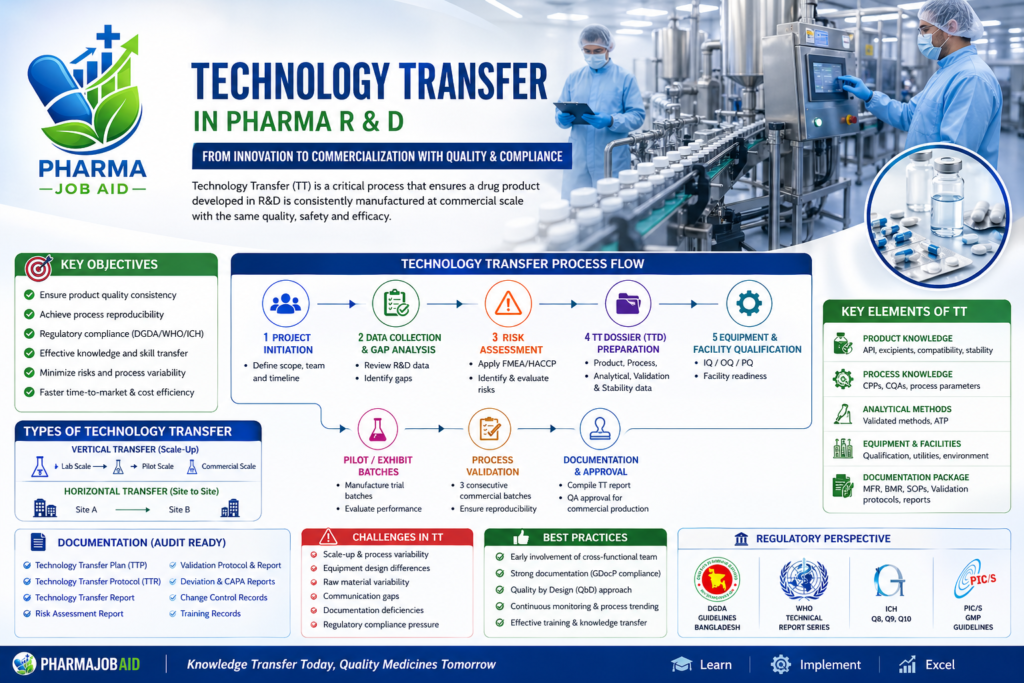
Introduction to Technology Transfer in Pharma R&D
Technology Transfer (TT) in pharmaceutical research and development is a highly structured, science-driven, and GMP-regulated process that ensures seamless movement of a drug product from development to commercial manufacturing. In modern pharmaceutical industries—especially within Bangladesh’s DGDA-regulated environment—technology transfer is not merely a technical handover; it is a critical quality assurance activity that determines whether a product developed in the laboratory can be consistently manufactured at scale without compromising its predefined quality attributes.
In practical terms, technology transfer bridges the gap between formulation development, process optimization, analytical validation, and large-scale production. A failure in this stage can result in batch rejection, regulatory non-compliance, product recall, or even market withdrawal. Therefore, pharmaceutical companies emphasize robust documentation, scientific understanding, and cross-functional collaboration throughout the technology transfer lifecycle.
Importance of Technology Transfer in Pharmaceutical Industry
Technology transfer plays a fundamental role in ensuring that pharmaceutical products meet quality, safety, and efficacy standards when transitioning from small-scale R&D environments to large-scale manufacturing facilities. One of the most significant aspects of technology transfer is maintaining product equivalence—meaning that the commercial batch must exhibit the same characteristics as the development batch in terms of dissolution, assay, impurity profile, and stability.
From a regulatory perspective, global guidelines such as ICH Q8 (Pharmaceutical Development), Q9 (Quality Risk Management), and Q10 (Pharmaceutical Quality System) emphasize the importance of knowledge management and process control during technology transfer. In Bangladesh, the Directorate General of Drug Administration (DGDA) expects pharmaceutical companies to demonstrate validated, reproducible processes supported by documented evidence. Without a structured TT process, companies risk failing audits, particularly during WHO prequalification or international regulatory inspections.
Moreover, technology transfer significantly impacts cost efficiency and time-to-market. A well-executed TT process minimizes process variability, reduces rework, and accelerates product launch timelines, which is crucial in competitive pharmaceutical markets.
Types of Technology Transfer in Pharma
Technology transfer in pharmaceuticals can be broadly categorized into vertical and horizontal transfer, each serving different strategic and operational purposes within the organization. Vertical technology transfer refers to the movement of a product through various stages of development—from laboratory scale to pilot scale and finally to commercial production. This type of transfer is inherently complex due to the challenges associated with scale-up, where physical and chemical parameters such as mixing efficiency, heat transfer, and drying kinetics may behave differently at larger volumes.
On the other hand, horizontal technology transfer involves transferring a product or process from one manufacturing site to another. This is commonly observed when companies expand production capacity, establish new facilities, or outsource manufacturing to contract manufacturing organizations (CMOs). Horizontal transfer requires careful evaluation of equipment equivalency, environmental conditions, and personnel competency to ensure that the receiving site can replicate the process without deviation.
Key Components of Technology Transfer
A successful technology transfer process is built upon a strong foundation of scientific knowledge and comprehensive documentation. One of the primary components is product knowledge, which includes detailed information about the active pharmaceutical ingredient (API), excipients, compatibility studies, and stability data. Understanding these factors is essential to predict how the product will behave under different manufacturing conditions.
Equally important is process knowledge, which defines the manufacturing steps, critical process parameters (CPP), and critical quality attributes (CQA). These parameters must be clearly identified and controlled to ensure consistent product quality. Analytical method transfer is another vital component, where validated testing procedures are transferred from R&D to quality control laboratories. This ensures that the receiving unit can accurately test and verify product quality.
Additionally, equipment and facility readiness plays a crucial role in technology transfer. Equipment must be properly qualified (IQ, OQ, PQ), and facilities must comply with GMP requirements, including HVAC systems, cleanroom classifications, and utility systems. Finally, all these elements must be supported by a comprehensive documentation package, including master formula records, batch manufacturing records, validation protocols, and standard operating procedures.
Technology Transfer Process: Step-by-Step Explanation
The technology transfer process begins with project initiation, where the scope, objectives, and timelines are clearly defined. A cross-functional team consisting of R&D, QA, QC, production, and engineering personnel is formed to oversee the process. This is followed by data collection and gap analysis, where existing development data is reviewed, and differences between the sending and receiving units are identified.
Risk assessment is a critical step in the TT process. Tools such as Failure Mode and Effects Analysis (FMEA) are used to identify potential risks and implement mitigation strategies. Once risks are assessed, a comprehensive Technology Transfer Dossier (TTD) is prepared, which includes all necessary information related to product formulation, manufacturing process, analytical methods, and validation strategy.
The next phase involves equipment qualification and facility preparation, ensuring that the receiving site is capable of handling the process. Pilot or exhibit batches are then manufactured to evaluate process performance under real production conditions. These batches provide valuable data that helps refine process parameters and identify potential issues.
Process validation follows, typically involving the manufacture of three consecutive commercial-scale batches to demonstrate process reproducibility. Finally, all data is compiled into a technology transfer report, which is reviewed and approved by the quality assurance department before commercial production begins.
Documentation Requirements in Technology Transfer
Documentation is the backbone of any technology transfer process and plays a crucial role in regulatory compliance. Pharmaceutical companies must maintain detailed records of every stage of the TT process, including the technology transfer plan, protocol, and final report. These documents serve as evidence that the process has been scientifically evaluated and meets GMP requirements.
In addition to TT-specific documents, other supporting records such as risk assessment reports, validation protocols, deviation reports, and CAPA (Corrective and Preventive Action) records must also be maintained. Proper documentation ensures transparency, traceability, and accountability, which are essential during regulatory inspections.
Challenges in Technology Transfer
Despite its importance, technology transfer is often associated with several challenges that can impact product quality and project timelines. One of the most common challenges is scale-up, where processes optimized at laboratory scale may not perform similarly at commercial scale due to differences in equipment and operating conditions. Equipment variability between sites can also lead to process inconsistencies, especially if the equipment design or capacity differs significantly.
Raw material variability is another critical factor, as differences in supplier quality can affect product performance. Communication gaps between R&D and production teams can further complicate the process, leading to misunderstandings and errors. Additionally, inadequate documentation can result in regulatory non-compliance and audit observations.
Role of Quality Assurance in Technology Transfer
Quality Assurance (QA) plays a central role in ensuring that the technology transfer process is conducted in compliance with regulatory requirements. QA is responsible for reviewing and approving all TT documents, overseeing validation activities, and ensuring that any deviations are properly investigated and resolved through CAPA. QA also ensures that all processes are aligned with GMP guidelines and that the final product meets predefined quality standards.
Regulatory Expectations and Compliance
Regulatory agencies such as DGDA, WHO, and international bodies require pharmaceutical companies to demonstrate that their manufacturing processes are well understood, controlled, and reproducible. Technology transfer is a key component of this requirement, as it provides documented evidence that the product can be consistently manufactured at commercial scale. Companies must also ensure compliance with ICH guidelines, particularly those related to pharmaceutical development, risk management, and quality systems.
Best Practices for Effective Technology Transfer
To ensure a successful technology transfer, pharmaceutical companies should adopt best practices such as early involvement of production teams, robust documentation practices, and implementation of Quality by Design (QbD) principles. Continuous monitoring and process optimization are also essential to maintain product quality over time. Training programs should be conducted to ensure that personnel are adequately prepared to handle the transferred process.
Conclusion
Technology Transfer in pharmaceutical R&D is a critical success factor that determines whether a product can transition from development to commercial production without compromising quality or regulatory compliance. By adopting a structured, science-based, and documentation-driven approach, pharmaceutical companies can ensure successful technology transfer, achieve regulatory approval, and maintain a competitive edge in the global market.