
Preformulation studies are the first critical scientific step in pharmaceutical development where a drug candidate (API – Active Pharmaceutical Ingredient) is characterized before formulation begins. These studies generate essential data about the physicochemical, mechanical, and biopharmaceutical properties of the drug, ensuring that the final dosage form is safe, stable, effective, and manufacturable.
In a DGDA/GMP-aligned environment, preformulation serves as the foundation for formulation design, process validation, and regulatory approval.
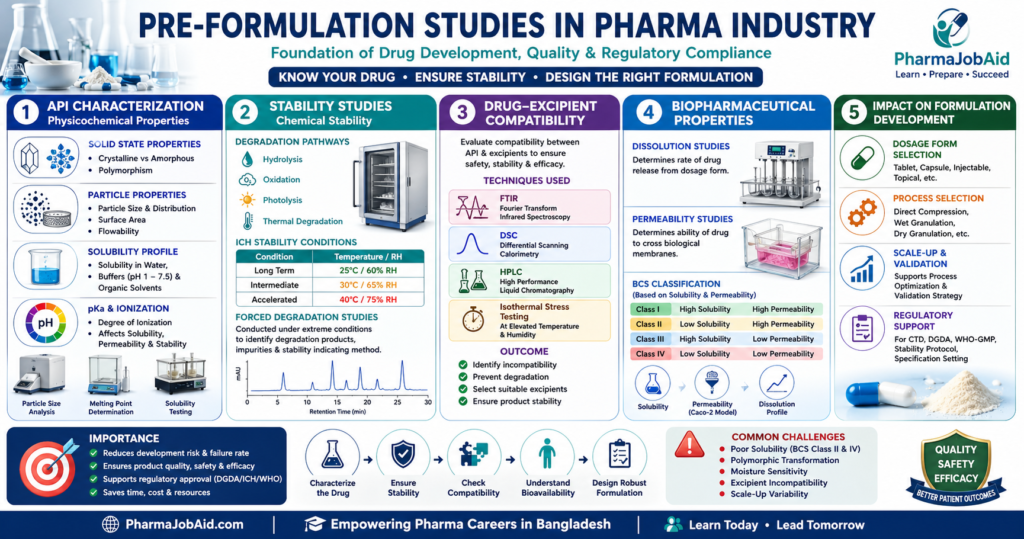
🔍 1. Objectives of Preformulation Studies
Preformulation aims to build a complete scientific profile of the API to guide formulation scientists.
Key Objectives:
- Identify physical and chemical properties of the drug
- Determine stability profile under various environmental conditions
- Evaluate drug–excipient compatibility
- Optimize bioavailability and dissolution behavior
- Support dosage form selection (tablet, capsule, injection, etc.)
- Provide data for ICH stability studies and regulatory filing
⚗️ 2. Physicochemical Properties of API


6
Understanding the physicochemical nature of a drug is essential for formulation success.
✔️ Solid-State Properties
- Crystalline vs Amorphous form
- Crystalline → stable but low solubility
- Amorphous → high solubility but less stable
- Polymorphism
- Different crystal forms affect dissolution and stability
✔️ Particle Properties
- Particle size & distribution → affects dissolution rate
- Surface area → impacts bioavailability
- Flow properties → important for tablet manufacturing
✔️ Solubility Profile
- Solubility in:
- Water
- Organic solvents
- Buffers (pH 1–7.5)
- Determines absorption and formulation strategy
✔️ pKa & Ionization
- Helps predict drug behavior in GI tract
- Influences permeability and solubility
🌡️ 3. Chemical Properties & Stability


7
Chemical stability is crucial for product shelf-life and safety.
✔️ Stability Studies
- Hydrolysis (moisture)
- Oxidation (oxygen exposure)
- Photolysis (light sensitivity)
- Thermal degradation (temperature)
✔️ Forced Degradation Studies
- Conducted under extreme conditions
- Helps identify:
- Degradation pathways
- Impurity profile
- Stability-indicating methods
✔️ ICH Conditions (Common)
- 25°C / 60% RH (Long-term)
- 30°C / 65% RH (Intermediate)
- 40°C / 75% RH (Accelerated)
🧫 4. Drug–Excipient Compatibility Studies


7
Ensures that inactive ingredients (excipients) do not negatively affect drug stability or efficacy.
✔️ Methods Used:
- FTIR (Fourier Transform Infrared Spectroscopy)
- DSC (Differential Scanning Calorimetry)
- HPLC analysis
- Isothermal stress testing
✔️ Outcomes:
- Detect incompatibilities (e.g., degradation, interaction)
- Select suitable excipients for formulation
💊 5. Biopharmaceutical Properties


6
These properties determine how the drug behaves inside the body.
✔️ Dissolution Studies
- Determines rate of drug release
- Critical for oral dosage forms
✔️ Permeability
- Ability of drug to cross biological membranes
- Studied using:
- Caco-2 cell models
- PAMPA systems
✔️ BCS Classification
- Based on solubility & permeability:
- Class I → High solubility & permeability
- Class II → Low solubility, high permeability
- Class III → High solubility, low permeability
- Class IV → Low solubility & permeability
🏭 6. Role in Formulation Development
Preformulation directly influences:
- Selection of dosage form
- Choice of excipients
- Manufacturing method:
- Direct compression
- Wet granulation
- Dry granulation
- Process optimization and scale-up
- Validation strategy (aligned with VMP)
📊 7. Importance in GMP & Regulatory Compliance
In Bangladesh pharma industry (DGDA-focused):
- Supports CTD dossier submission
- Essential for Product Development Report (PDR)
- Provides data for:
- Stability protocols
- Specification setting
- Risk assessment (FMEA linkage)
- Critical for audit readiness (WHO-GMP / PIC/S)
⚠️ 8. Common Challenges in Preformulation
- Poor solubility (BCS Class II & IV drugs)
- Polymorphic transformation during storage
- Moisture sensitivity
- Excipient incompatibility
- Scale-up variability
🧾 9. Conclusion
Preformulation studies are the scientific backbone of pharmaceutical development. Without proper preformulation data, formulation development becomes trial-and-error, increasing the risk of failure during scale-up, validation, or regulatory approval.
A strong preformulation strategy ensures:
- Faster development timelines
- Robust product quality
- Regulatory compliance (DGDA/WHO/ICH)
- Improved patient safety and therapeutic efficacy