
Scale-up is one of the most critical phases in pharmaceutical development, where a formulation developed at laboratory level is successfully transferred to pilot and commercial manufacturing—without compromising quality, safety, or efficacy.Scale-up in pharmaceutical R&D does not end with simple batch enlargement—it evolves into a multi-disciplinary, science-driven, and regulatory-intensive lifecycle that integrates formulation science, process engineering, quality systems, and compliance expectations. In modern pharmaceutical industries, particularly within Bangladesh where regulatory scrutiny by the Directorate General of Drug Administration is increasing alongside global alignment with the World Health Organization and U.S. Food and Drug Administration, scale-up must be approached as a data-backed, risk-controlled, and validation-oriented strategy rather than a trial-and-error activity. At its core, scale-up represents the translation of critical knowledge generated during formulation development into a reproducible manufacturing process, where each unit operation—mixing, granulation, drying, blending, compression, coating—must perform consistently despite significant increases in batch size and equipment capacity.
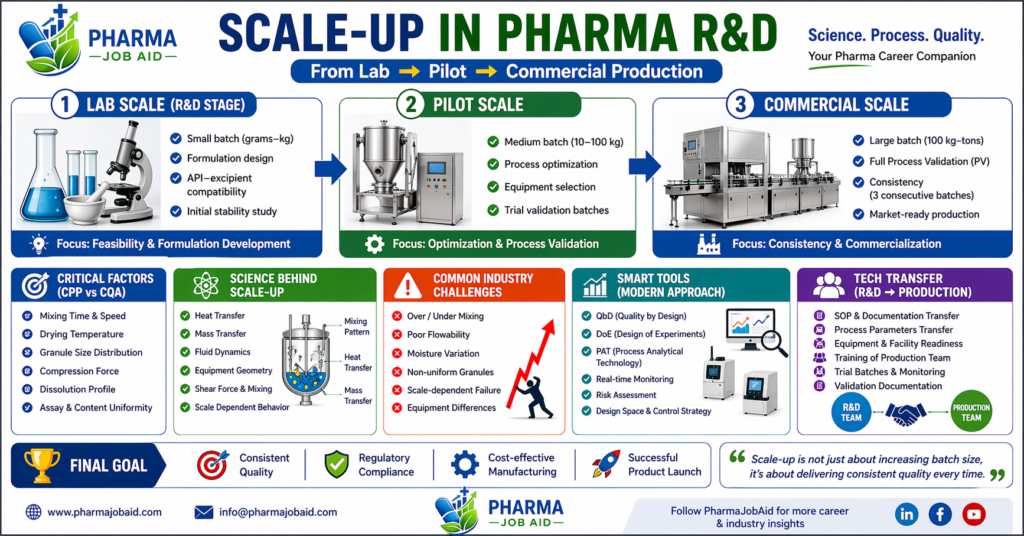
The complexity arises because physical forces such as shear, heat transfer, and mass transfer behave differently at larger scales; for example, a blending process that achieves uniformity in a small V-blender at lab scale may exhibit segregation or dead zones in a large industrial blender due to differences in geometry, fill volume, and rotational dynamics. Therefore, scientists must identify and control Critical Process Parameters (CPPs) that directly impact Critical Quality Attributes (CQAs) such as assay, content uniformity, dissolution profile, hardness, and stability, ensuring that product performance remains unchanged across scales.
🧪 1. What is Scale-Up?
Scale-up refers to the systematic enlargement of a formulation and process from:
- Lab scale (grams)
➡️ Pilot scale (kilograms)
➡️ Commercial scale (tons)
The goal is to ensure:
- Same product quality
- Same process performance
- Same regulatory compliance
⚙️ 2. Scale-Up Workflow (Step-by-Step)

7
➤ Stage 1: Laboratory Scale Development
- Batch size: 1 g – 1 kg
- Focus: Formulation design & feasibility
- Activities:
- API-excipient compatibility
- Initial process selection (wet granulation, direct compression)
- Stability studies (accelerated)
➤ Stage 2: Pilot Scale
- Batch size: 10 kg – 100 kg
- Purpose: Process optimization & reproducibility
Key activities:
- Equipment selection (e.g., lab mixer → high shear granulator)
- Optimization of:
- Mixing time
- Binder addition rate
- Drying temperature
- Initial Process Validation Trials
➤ Stage 3: Commercial Scale
- Batch size: 100 kg – several tons
- Objective: Full-scale production readiness
Activities:
- Final Process Validation (PV)
- Technology Transfer to manufacturing site
- Batch consistency confirmation (3 consecutive batches)
⚡ 3. Key Scale-Up Parameters (Critical Factors)
🔹 Physical Parameters
- Mixing speed & time
- Particle size distribution
- Flow properties
🔹 Process Parameters
- Temperature control
- Drying efficiency
- Compression force
🔹 Equipment Parameters
- Equipment geometry differences
- Scale-dependent heat/mass transfer
- Shear force variation
👉 These are defined as:
- CPP (Critical Process Parameters)
- CQA (Critical Quality Attributes)
🧠 4. Scientific Principles Behind Scale-Up
Scale-up is not just “increasing batch size”—it involves applying engineering principles:
➤ Similarity Principles:
- Geometric similarity (same equipment design ratio)
- Dynamic similarity (same mixing pattern)
- Kinematic similarity (same flow behavior)
➤ Important Concepts:
- Reynolds Number (flow behavior)
- Heat transfer coefficient
- Mass transfer efficiency
⚠️ 5. Common Challenges in Scale-Up
- ❌ Overmixing or undermixing
- ❌ Non-uniform granule size
- ❌ Equipment differences
- ❌ Heat buildup in large batches
- ❌ Scale-dependent drying issues
👉 Example (Bangladesh pharma context):
A tablet showing proper dissolution at lab scale may fail in commercial batches due to:
- Increased compression force
- Improper granule moisture
📊 6. Scale-Up Tools & Strategies
✔️ Quality by Design (QbD)
- Risk-based approach
- Design Space development
✔️ Process Analytical Technology (PAT)
- Real-time monitoring
- Moisture sensors, NIR spectroscopy
✔️ Design of Experiments (DoE)
- Statistical optimization
- Identifies interaction effects
🏭 7. Regulatory Requirements (DGDA / WHO / FDA)
Scale-up must comply with:
- World Health Organization (WHO GMP)
- U.S. Food and Drug Administration (FDA Guidelines)
- Directorate General of Drug Administration (Bangladesh DGDA)
Required Documentation:
- Process Validation Protocol
- Technology Transfer Report
- Batch Manufacturing Record (BMR)
- Scale-Up Report
🔄 8. Technology Transfer (R&D → Production)
Scale-up ends with successful Tech Transfer:
- Transfer of:
- Process parameters
- Equipment specifications
- SOPs
- Includes:
- Training of production team
- Engineering verification
- Trial batch monitoring
📈 9. Real-Life Example (Tablet Manufacturing)
| Stage | Batch Size | Key Observation |
|---|---|---|
| Lab | 500 g | Good flow, uniform blend |
| Pilot | 50 kg | Slight sticking issue |
| Commercial | 500 kg | Compression variation |
👉 Solution:
- Adjust lubricant concentration
- Optimize compression force
🎯 10. Final Summary
Scale-up is a bridge between innovation and commercialization. A successful scale-up ensures:
- ✅ Consistent product quality
- ✅ Regulatory compliance
- ✅ Cost-effective manufacturing
- ✅ Market readiness
🚀 PharmaJobAid Tip (Industry Insight)
In Bangladesh pharma industries, DGDA inspectors often focus on:
- Scale-up justification
- CPP–CQA linkage
- Process validation consistency
👉 Always maintain:
- Documented evidence
- Scientific rationale
- Audit-ready reports