
🔬 Introduction to NMR in Pharma QC
Nuclear Magnetic Resonance (NMR) is one of the most powerful and sophisticated analytical techniques used in pharmaceutical quality control (QC) for the identification, characterization, and quantification of drug substances and finished products. In modern pharmaceutical industries—especially those operating under strict regulatory frameworks such as DGDA, WHO GMP, and ICH guidelines—NMR plays a critical role in ensuring that every product meets predefined quality, safety, and efficacy standards. Unlike routine QC tools that primarily separate or detect compounds, NMR provides a direct insight into molecular structure, making it indispensable for confirming chemical identity and detecting subtle structural variations.
⚙️ Principle of Nuclear Magnetic Resonance
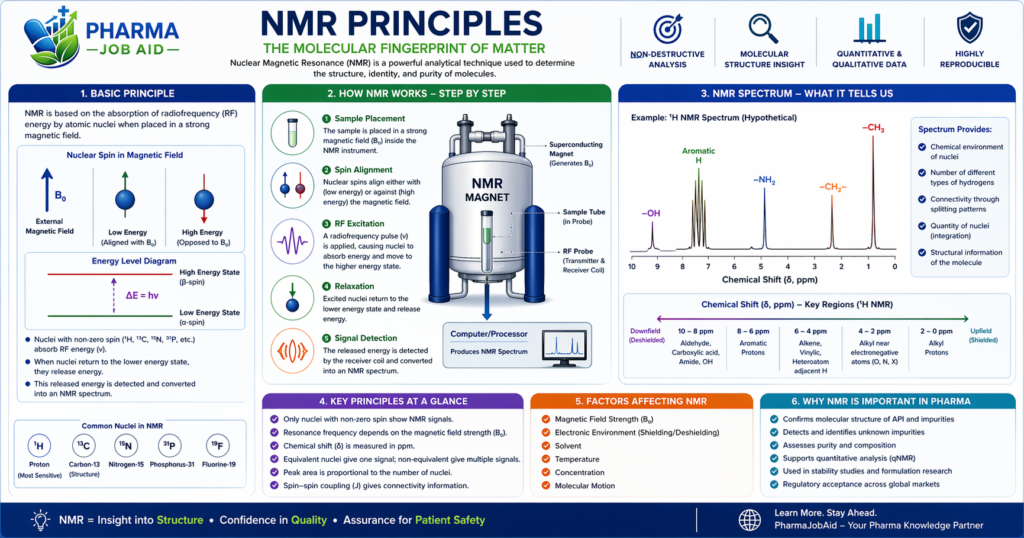
The working principle of NMR is based on the magnetic properties of atomic nuclei such as hydrogen (¹H) and carbon (¹³C). When a sample is placed in a strong magnetic field, these nuclei align with the field and can absorb specific radiofrequency energy. Upon absorbing this energy, the nuclei transition to a higher energy state and then relax back, emitting signals that are detected by the instrument. These signals are converted into an NMR spectrum, where each peak corresponds to a specific chemical environment within the molecule. The position, intensity, and splitting of these peaks provide detailed information about molecular structure, functional groups, and atomic connectivity. This ability to generate a “molecular fingerprint” makes NMR uniquely valuable in pharmaceutical QC.
🧩 Instrumentation and System Components
An NMR system consists of several high-precision components that work together to produce accurate and reproducible results. The superconducting magnet is the core of the system, generating a powerful and stable magnetic field essential for high-resolution spectra. The radiofrequency (RF) transmitter and receiver system is responsible for sending pulses to excite the nuclei and capturing the emitted signals. The sample probe holds the sample, typically dissolved in a deuterated solvent to avoid interference from hydrogen signals. Finally, the data processing system converts raw signals into interpretable spectra using advanced software, enabling analysts to perform peak integration, chemical shift analysis, and structural interpretation. Proper calibration and maintenance of these components are essential to ensure compliance with GMP requirements.
🧪 Types of NMR Techniques in Pharmaceutical QC
In pharmaceutical QC laboratories, several types of NMR techniques are routinely used depending on the complexity of the analysis. Proton NMR (¹H-NMR) is the most widely used technique due to its sensitivity and ability to provide detailed information about hydrogen atoms in a molecule. Carbon-13 NMR (¹³C-NMR) complements proton NMR by revealing the carbon framework of the compound, which is especially useful for complex molecules. Advanced techniques such as two-dimensional NMR (2D-NMR), including COSY, HSQC, and HMBC, are used for in-depth structural elucidation and impurity identification. These advanced methods are particularly valuable in research, development, and troubleshooting stages within the pharmaceutical lifecycle.
🧪 Quantitative NMR (qNMR): A Game-Changer in Assay
Quantitative NMR (qNMR) has emerged as a highly reliable technique for determining the purity and content of pharmaceutical substances. Unlike chromatographic methods such as High Performance Liquid Chromatography, qNMR does not always require a reference standard of the analyte. Instead, it uses an internal or external standard with known purity, and quantification is based on peak area integration, which is directly proportional to the number of nuclei present. This makes qNMR particularly useful for reference standard qualification, assay determination, and impurity quantification. In regulatory environments, qNMR is increasingly accepted as a primary method due to its traceability and accuracy.
🔍 Impurity Profiling and Degradation Analysis
One of the most critical applications of NMR in pharmaceutical QC is impurity profiling. NMR can detect structural differences between the main compound and its impurities, even when they have similar chromatographic behavior. It is especially useful for identifying unknown impurities and degradation products formed during stability studies. While Mass Spectrometry provides molecular weight information, NMR complements it by offering detailed structural insights. This combination is often used in forced degradation studies to understand degradation pathways and ensure product stability over its shelf life.
🧬 Role of NMR in API Development and Regulatory Filing
In the lifecycle of an Active Pharmaceutical Ingredient (API), NMR plays a fundamental role from early development to regulatory submission. During drug development, it is used to confirm the structure of newly synthesized molecules and intermediates. In regulatory dossiers such as CTD (Common Technical Document), NMR data is included in sections related to drug substance characterization (Module 3.2.S). Regulatory authorities expect clear, well-annotated spectra with peak assignments and interpretation. In Bangladesh, DGDA-aligned companies follow WHO and ICH guidelines, where NMR data supports claims of identity, purity, and consistency of the API.
🏭 NMR in Method Validation and Transfer
For QC laboratories operating under GMP, method validation is a mandatory requirement. NMR methods must demonstrate specificity (ability to distinguish analyte from impurities), precision (repeatability), accuracy (closeness to true value), and robustness (resistance to small variations). During method transfer between R&D and QC labs, parameters such as instrument calibration, probe type, and magnetic field strength must be carefully aligned. Documentation should include validation protocols, reports, and raw data in compliance with data integrity principles. This is particularly important during audits by DGDA, WHO, or international regulatory bodies.
📊 Integration with Other Analytical Techniques
NMR is rarely used in isolation in pharmaceutical QC. Instead, it forms part of a comprehensive analytical strategy alongside techniques like Mass Spectrometry and Fourier Transform Infrared Spectroscopy. While chromatography separates components and MS identifies molecular mass, NMR provides the final confirmation of molecular structure. This complementary approach ensures a robust understanding of pharmaceutical products, particularly for complex formulations and biological molecules.
⚠️ Practical Challenges in Routine QC Use
Although NMR is extremely powerful, its routine use in QC laboratories can be challenging. The high operational cost, including cryogens such as liquid helium, requires significant investment. Instrument downtime due to maintenance or magnet quenching can disrupt analytical schedules. Additionally, interpreting NMR data for complex molecules demands advanced expertise, which necessitates continuous training of QC analysts. Despite these challenges, many leading pharmaceutical companies maintain NMR capabilities due to its unmatched analytical depth.
🌍 Future Trends: NMR in Pharma 4.0 Environment
With the advancement of digital technologies, NMR is evolving into a smarter and more integrated analytical tool. Modern systems are incorporating automation, AI-assisted spectral interpretation, and remote monitoring, aligning with Pharma 4.0 initiatives. Benchtop NMR instruments are also emerging, offering lower-cost alternatives for routine analysis, although with reduced sensitivity compared to high-field systems. In the future, NMR is expected to play a greater role in real-time release testing (RTRT) and continuous manufacturing environments.
🧩 Advanced Instrumentation & Qualification (IQ/OQ/PQ)
A GMP-compliant NMR setup requires robust qualification and lifecycle management:
- Installation Qualification (IQ): Verifies correct installation, utilities (power, vibration control), shielding, and cryogen systems.
- Operational Qualification (OQ): Confirms instrument performance—frequency accuracy, resolution (line width), sensitivity, and RF calibration.
- Performance Qualification (PQ): Routine checks using certified standards (e.g., line shape, S/N ratio) to ensure ongoing suitability.
Critical subsystems include the superconducting magnet (field stability), shim system (field homogeneity), probe (cryoprobe/room temp), and temperature control unit. In audits, trend charts of performance checks and maintenance logs are frequently reviewed.
⚗️ Method Development Strategy (ICH Q2(R2)-Aligned)
Developing an NMR method for QC involves a structured approach:
- Specificity: Demonstrate that API signals are well-resolved from excipients/impurities.
- Linearity & Range: Validate integration vs. concentration across the intended range.
- Accuracy & Precision: Use spiked samples/internal standards to confirm recovery and repeatability.
- Robustness: Assess effects of temperature, solvent, pulse angle, relaxation delay, and number of scans.
Selection of deuterated solvent (D₂O, CDCl₃, DMSO-d₆) impacts solubility and chemical shifts. Lock, shim, and referencing (TMS or residual solvent peaks) must be standardized via SOPs to ensure inter-lab reproducibility.
🧪 Quantitative NMR (qNMR): Primary Method with Metrological Traceability
qNMR is increasingly recognized as a primary ratio method, offering traceability to SI units. The core concept is that integral area ∝ number of contributing nuclei. With a suitable internal standard (e.g., maleic acid, dimethyl sulfone), analysts can determine assay, potency, and impurity levels without an analyte reference standard. Compared with High Performance Liquid Chromatography, qNMR reduces dependency on reference standard purity assignments and can simplify value assignment for in-house standards. Proper relaxation delay (≥5×T₁) and pulse calibration are essential to avoid quantitative bias.
🔍 Impurity Profiling, Genotoxic Impurities & Degradation Pathways
NMR excels in structural elucidation of impurities that co-elute in chromatography. In forced degradation studies (acid/base hydrolysis, oxidation, photolysis, thermal stress), NMR helps:
- Assign structural changes (e.g., hydrolysis products, rearrangements)
- Differentiate isomers and tautomers
- Support identification of genotoxic impurities when coupled with orthogonal data
While Mass Spectrometry provides exact mass and fragmentation, NMR confirms bond connectivity and stereochemistry, completing the structural picture required in regulatory submissions.
🧬 Solid-State NMR (ssNMR) & Polymorphism Control
For solid dosage forms, solid-state NMR (ssNMR) is invaluable for:
- Polymorph identification and control (critical for bioavailability and stability)
- Amorphous vs. crystalline content determination
- Drug–excipient interactions in formulations
Given that polymorphic transitions can trigger OOS/OOT events, ssNMR provides a non-destructive, definitive tool to support investigations and CAPA.
💊 Formulation & Excipient Interaction Studies
NMR can probe molecular interactions in formulations:
- Hydrogen bonding between API and excipients
- Solvation/desolvation phenomena
- Compatibility during pre-formulation screening
These insights reduce risk of stability failures, support change control decisions, and strengthen QbD (Quality by Design) justifications.
🎯 Applications of NMR in Pharmaceutical Quality Control
NMR has a wide range of applications in pharmaceutical QC, making it a versatile analytical tool. One of its primary uses is the identification of active pharmaceutical ingredients (APIs), where it confirms the chemical structure by comparing the obtained spectrum with a reference standard. It is also extensively used for purity assessment, detecting impurities, residual solvents, and degradation products that may not be easily identified by other techniques. In drug development, NMR plays a crucial role in structure elucidation, helping scientists determine the exact arrangement of atoms in new compounds. Additionally, quantitative NMR (qNMR) enables accurate determination of compound concentration without requiring a reference standard, which is particularly useful in assay development and validation. NMR is also applied in stability studies to monitor chemical changes over time under various environmental conditions.
📊 Advantages of NMR in QC Laboratories
One of the major advantages of NMR is that it is a non-destructive technique, allowing samples to be recovered after analysis. It requires minimal sample preparation and provides highly reproducible results, which is essential for regulatory compliance. Unlike techniques such as High Performance Liquid Chromatography or Mass Spectrometry, NMR can deliver both qualitative and quantitative data in a single experiment. Furthermore, it does not always require a reference standard, especially in qNMR applications, making it cost-effective in certain analytical scenarios despite the high initial investment.
⚠️ Limitations and Challenges
Despite its numerous advantages, NMR has certain limitations that must be considered in pharmaceutical QC. The high cost of equipment and maintenance makes it less accessible for smaller laboratories. It also requires highly skilled personnel to operate the instrument and interpret complex spectra accurately. Compared to techniques like Mass Spectrometry, NMR has lower sensitivity, making it less suitable for detecting trace-level impurities. Additionally, the requirement for relatively larger sample quantities can be a constraint in some cases.
🏭 NMR in GMP and DGDA Regulatory Environment
In Bangladesh’s pharmaceutical industry, NMR is typically used in central QC or R&D laboratories under strict GMP compliance. All analytical activities must adhere to data integrity principles (ALCOA+), ensuring that data is attributable, legible, contemporaneous, original, and accurate. NMR spectra must be properly documented, reviewed, and archived according to approved SOPs. During DGDA, WHO, or international regulatory audits, NMR data may be reviewed as part of API characterization, impurity profiling, and method validation documentation. Proper training, instrument qualification (IQ/OQ/PQ), and periodic calibration are mandatory to maintain compliance and ensure data reliability.
🧠 Conclusion
NMR is far more than a routine analytical tool—it is a highly advanced molecular analysis technique that provides unmatched insight into the structure and composition of pharmaceutical compounds. Its ability to deliver precise, reproducible, and detailed information makes it indispensable in ensuring product quality, regulatory compliance, and patient safety. While it comes with higher costs and technical complexity, its value in modern pharmaceutical QC—especially in areas such as structure confirmation, impurity profiling, and quantitative analysis—makes it a cornerstone of advanced analytical laboratories.