
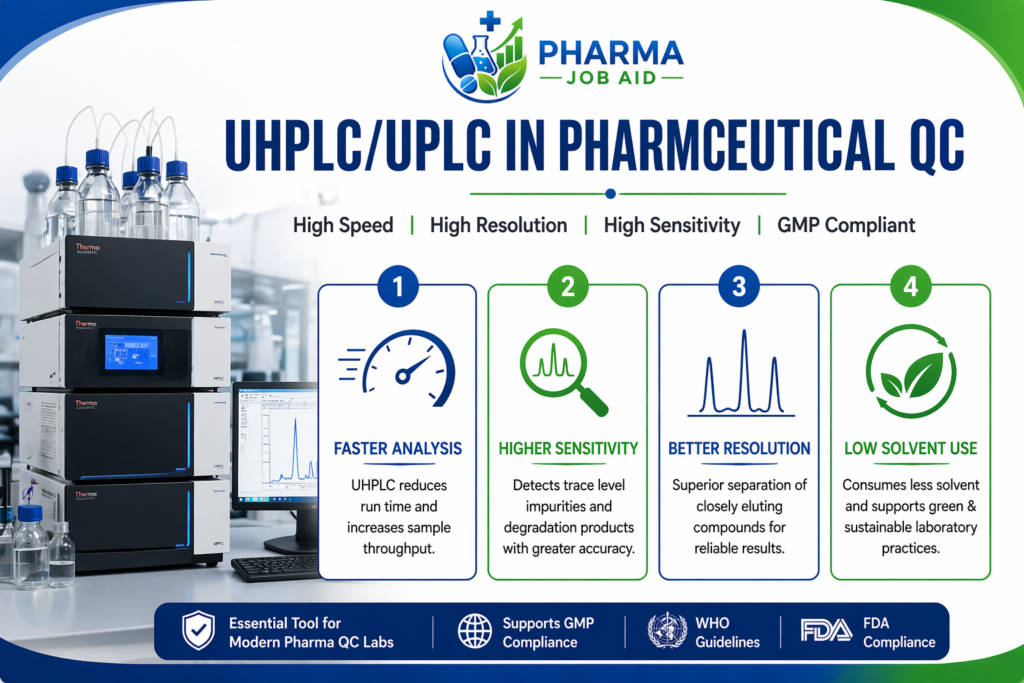
Ultra High Performance Liquid Chromatography, commonly known as UHPLC or UPLC, is an advanced chromatographic technique widely used in pharmaceutical Quality Control laboratories for fast, accurate, and highly sensitive analysis of raw materials, finished products, stability samples, impurities, degradation products, and cleaning validation samples. It is considered an upgraded version of traditional HPLC because it uses smaller particle-size columns, higher pressure, and improved detector performance to achieve better separation in a shorter time.
What is UHPLC/UPLC?
UHPLC is a liquid chromatography technique that operates at very high pressure and uses columns packed with very small particles, usually below 2 microns. Because of the smaller particle size, the surface area for interaction between the sample and stationary phase increases, resulting in sharper peaks, higher resolution, faster analysis, and better sensitivity.
The term UPLC is often used as a branded term, while UHPLC is the general technical term. In pharmaceutical QC, both terms are commonly used to describe high-efficiency liquid chromatography systems.
Importance of UHPLC in Pharmaceutical QC
In pharmaceutical Quality Control, analytical results must be accurate, reproducible, and scientifically justified. UHPLC plays an important role because it can detect very low levels of impurities and degradation products. This is especially important for stability studies, impurity profiling, assay testing, dissolution sample analysis, and method validation.
Compared with conventional HPLC, UHPLC reduces analysis time and solvent consumption. This helps QC laboratories increase productivity while maintaining GMP compliance. For companies handling large sample loads, UHPLC can significantly improve laboratory efficiency.
Working Principle of UHPLC
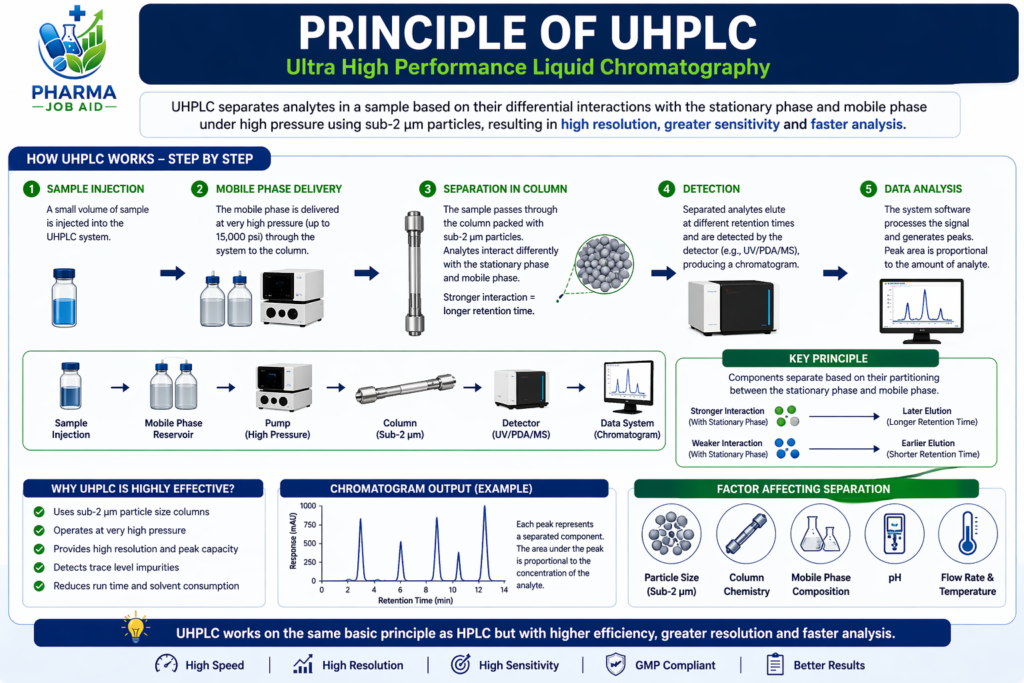
UHPLC works on the same basic principle as HPLC. A liquid mobile phase carries the sample through a column containing a stationary phase. Different components of the sample interact differently with the stationary phase and mobile phase. As a result, they elute from the column at different retention times.
The detector measures each separated component and generates chromatographic peaks. The area or height of the peak is used for quantitative analysis, while retention time helps in identification.
Major Components of UHPLC System
A UHPLC system generally includes a solvent reservoir, degasser, high-pressure pump, autosampler, column oven, analytical column, detector, and data processing software. The pump must be capable of handling very high pressure. The autosampler must inject very small volumes accurately, and the detector must be sensitive enough to capture narrow UHPLC peaks.
Common detectors used with UHPLC include UV detector, PDA detector, fluorescence detector, refractive index detector, evaporative light scattering detector, charged aerosol detector, and mass spectrometry detector.
Applications of UHPLC in QC
UHPLC is widely used for assay testing, where the active pharmaceutical ingredient is quantified in tablets, capsules, injections, suspensions, creams, and other dosage forms. It is also used for related substances testing, where known and unknown impurities are separated and quantified.
In stability studies, UHPLC helps detect degradation products formed under temperature, humidity, light, or stress conditions. In cleaning validation, it can detect trace levels of active ingredients or residues on equipment surfaces. UHPLC is also useful in dissolution testing, content uniformity, blend uniformity, preservative assay, and method transfer activities.
UHPLC vs HPLC
UHPLC provides faster analysis, sharper peaks, better resolution, and lower solvent consumption than traditional HPLC. However, UHPLC systems and columns are more expensive and require careful maintenance. Methods developed on HPLC may need optimization before transfer to UHPLC because column dimensions, particle size, flow rate, pressure, and gradient conditions may be different.
In a GMP QC laboratory, method transfer from HPLC to UHPLC must be properly validated or verified according to regulatory expectations.
GMP Considerations
UHPLC analysis must be performed using approved methods, qualified instruments, calibrated equipment, trained analysts, and controlled documentation. System suitability must be checked before sample analysis. Parameters such as retention time, theoretical plates, tailing factor, resolution, %RSD, and signal-to-noise ratio must meet acceptance criteria.
Data integrity is also very important. Chromatographic data must be complete, accurate, attributable, legible, contemporaneous, original, and accurate. Audit trails, user access control, electronic records, and proper review of chromatograms are essential for GMP compliance.
Advantages of UHPLC
UHPLC offers several advantages in pharmaceutical QC. It reduces run time, improves peak resolution, increases sensitivity, saves solvent, lowers waste generation, and improves sample throughput. It is highly useful for complex formulations where multiple components or impurities need to be separated within a short time.
Limitations of UHPLC
Despite its advantages, UHPLC also has some limitations. The instrument cost is high, columns are sensitive to particulate matter, and mobile phases must be properly filtered and degassed. Small particle-size columns can generate high back pressure, so the system must be properly maintained. Analysts also need strong technical knowledge to troubleshoot pressure problems, peak splitting, carryover, baseline noise, and system suitability failures.
UHPLC/UPLC in Pharmaceutical QC (Advanced GMP Perspective)
Building on the fundamentals, UHPLC/UPLC is not just an analytical upgrade—it is a strategic tool in modern GMP-driven pharmaceutical Quality Control systems, especially under increasing regulatory expectations from authorities like WHO, US FDA, EMA, and DGDA (Bangladesh).
Method Development in UHPLC (QC-Oriented Approach)
UHPLC method development is more critical than HPLC due to higher efficiency and sensitivity. A poorly optimized method can lead to co-elution, peak distortion, or system pressure issues.
Key Method Development Parameters:
- Column selection: C18 (most common), C8, Phenyl, HILIC depending on analyte polarity
- Particle size: Typically 1.7 µm or smaller
- Mobile phase composition: Buffer + organic solvent (Acetonitrile/Methanol)
- pH control: Critical for ionizable compounds
- Flow rate optimization: Lower flow but higher efficiency
- Gradient vs isocratic: Gradient preferred for impurity profiling
- Injection volume: Very small (typically 1–5 µL) to avoid peak distortion
In QC labs, methods must be:
- Robust
- Reproducible
- Stability-indicating
- Regulatory compliant
Method Validation (ICH Q2(R2) / GMP Perspective)
UHPLC methods used in QC must be validated as per International Council for Harmonisation guidelines (ICH Q2).
Critical Validation Parameters:
- Specificity → Ability to separate API, impurities, excipients
- Linearity → Typically 80–120% of working concentration
- Accuracy (Recovery) → 98–102% (typical acceptance)
- Precision
- Repeatability (%RSD ≤ 2%)
- Intermediate precision
- LOD & LOQ → Very low in UHPLC due to high sensitivity
- Robustness → Small changes in pH, flow, temperature
- System Suitability
- Tailing factor
- Theoretical plates
- Resolution (>2 between critical peaks)
For Bangladesh GMP environment, validation reports must be:
- Audit-ready
- Traceable
- Signed and approved (QA authorization mandatory)
System Suitability (QC Routine Compliance)
Before every analysis, system suitability must be verified:
| Parameter | Typical Limit |
|---|---|
| %RSD (Peak Area) | ≤ 2% |
| Tailing Factor | ≤ 2 |
| Theoretical Plates | High (depends on column) |
| Resolution | ≥ 2 |
| Retention Time | Consistent |
Failure in system suitability = Analysis is invalid (GMP critical finding)
UHPLC in Stability-Indicating Methods
UHPLC is highly preferred for stability studies because it can:
- Detect trace-level degradation products
- Resolve closely related impurities
- Reduce analysis time for long-term studies
Stability Conditions (Typical):
- 25°C / 60% RH (Long-term)
- 30°C / 65% RH (Intermediate)
- 40°C / 75% RH (Accelerated)
UHPLC helps ensure compliance with:
- World Health Organization stability guidelines
- ICH Q1A requirements
Impurity Profiling & Regulatory Expectations
Modern regulatory bodies require detailed impurity profiling:
- Identification of known impurities
- Quantification of unknown impurities
- Qualification thresholds
UHPLC is ideal because:
- High resolution separates closely eluting impurities
- High sensitivity detects impurities at ppm levels
This is critical for:
- ANDA submissions
- Dossier preparation (CTD Module 3)
- Product lifecycle management
Column Chemistry & Selection Strategy
Column selection directly impacts separation quality.
Common UHPLC Columns:
- C18 (ODS): General purpose (most APIs)
- Phenyl-Hexyl: Aromatic compounds
- HILIC: Polar compounds
- C8: Faster elution for non-polar compounds
Important Considerations:
- Column temperature (often 30–50°C)
- Back pressure monitoring
- Column life cycle tracking (GMP requirement)
Troubleshooting in UHPLC (QC Reality)
Common problems and root causes:
| Problem | Possible Cause | Corrective Action |
|---|---|---|
| High back pressure | Blocked column/filter | Replace filter, flush system |
| Peak tailing | Column contamination | Column wash/regeneration |
| Peak splitting | Injection issue | Reduce injection volume |
| Baseline noise | Mobile phase impurity | Use fresh filtered solvent |
| Carryover | Autosampler contamination | Needle wash optimization |
In GMP audit, improper troubleshooting documentation can lead to major observation.
Data Integrity & Compliance (ALCOA+ Principle)
UHPLC systems must comply with data integrity principles:
ALCOA+:
- Attributable
- Legible
- Contemporaneous
- Original
- Accurate
- Complete, Consistent, Enduring, Available
System Requirements:
- Audit trail enabled
- User access control
- Electronic signature
- Backup and data archival
Regulators like US Food and Drug Administration strictly monitor chromatographic data integrity.
UHPLC in Cleaning Validation
UHPLC is highly sensitive for detecting residues:
- Swab samples
- Rinse samples
- Trace-level API detection
Key Parameters:
- Limit of detection (LOD) must meet cleaning limits
- Recovery studies required
- Matrix interference must be evaluated
UHPLC vs HPLC (Technical Comparison Table)
| Parameter | HPLC | UHPLC |
|---|---|---|
| Particle Size | 3–5 µm | <2 µm |
| Pressure | Low–Moderate | Very High |
| Run Time | Longer | Shorter |
| Resolution | Moderate | High |
| Sensitivity | Good | Excellent |
| Solvent Use | High | Low |
| Cost | Lower | Higher |
Future Trends of UHPLC in Pharma QC
UHPLC is evolving rapidly with:
- UHPLC-MS/MS integration for ultra-trace analysis
- Automation and robotic sample handling
- AI-assisted chromatography optimization
- Real-time release testing (RTRT)
- Green analytical chemistry (low solvent usage)
Conclusion
UHPLC/UPLC is a powerful and modern analytical tool in pharmaceutical Quality Control. It supports faster, more sensitive, and more reliable testing of pharmaceutical products. For QC laboratories working under GMP requirements, UHPLC improves analytical efficiency while supporting regulatory compliance, product quality, and patient safety. As pharmaceutical products become more complex, UHPLC will continue to play a major role in assay, impurity testing, stability studies, method validation, and routine batch release testing.