
Introduction
The UV-visible spectrophotometer is one of the most widely used analytical instruments in pharmaceutical quality control (QC) laboratories. It plays a critical role in the identification, assay, and purity evaluation of drug substances and finished products. Due to its simplicity, accuracy, and compliance with global regulatory expectations (such as WHO, ICH, and GMP), this instrument is considered a foundational tool in pharmaceutical analysis.
In Bangladesh’s pharmaceutical industries, UV-visible spectrophotometry is routinely used in compliance with DGDA guidelines and pharmacopoeial standards such as USP, BP, and IP.
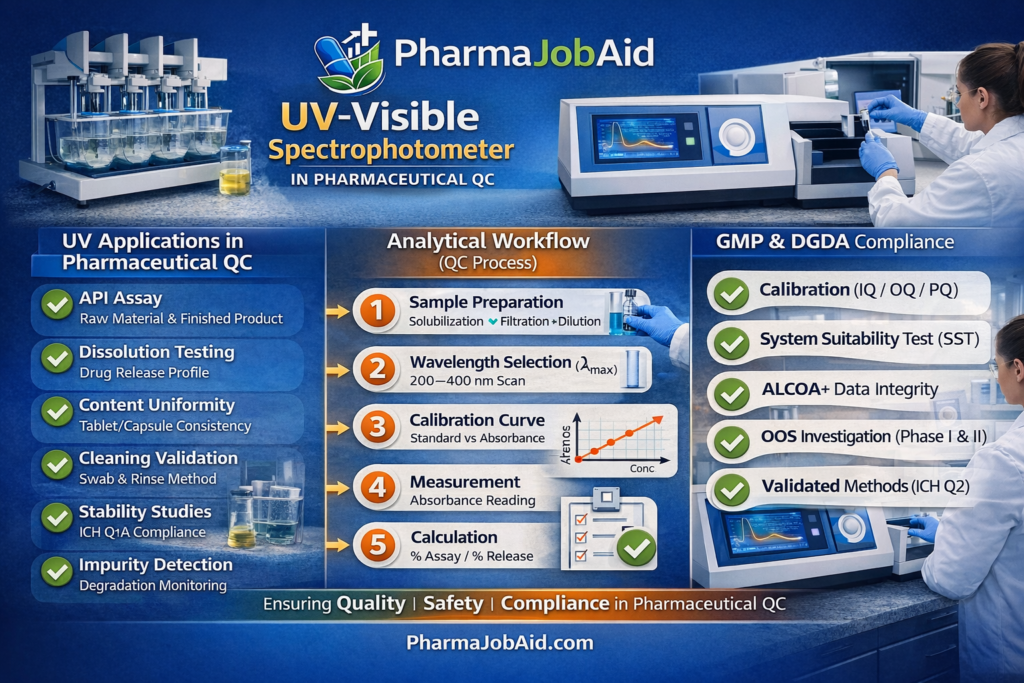
Principle of UV-Visible Spectrophotometry
UV-Visible spectrophotometry is based on the absorption of ultraviolet (200–400 nm) and visible (400–800 nm) light by molecules. When a beam of light passes through a solution, part of the light is absorbed by the analyte, and the remaining light is transmitted.
The quantitative relationship between absorbance and concentration is defined by:
A=εlc
Where:
- A = Absorbance
- ε = Molar absorptivity
- l = Path length of the cuvette (cm)
- c = Concentration of the solution
This principle allows analysts to determine the concentration of a substance accurately.
Types of UV-Visible Spectrophotometers
Different configurations are used in pharmaceutical QC labs:
- Single Beam Spectrophotometer
Measures sample and blank separately; cost-effective but less stable. - Double Beam Spectrophotometer
Simultaneously measures sample and reference, providing higher accuracy and stability. - Diode Array Spectrophotometer
Captures entire spectra instantly; useful for rapid analysis and impurity profiling.
Key Components of the Instrument
A UV-Visible spectrophotometer consists of the following major parts:
- Light Source: Deuterium lamp (UV region) and Tungsten lamp (Visible region)
- Monochromator: Selects a specific wavelength
- Sample Holder (Cuvette): Usually quartz (for UV) or glass (for visible)
- Detector: Converts light into an electrical signal
- Display/Software System: Shows absorbance and spectrum
Applications in Pharmaceutical QC
1. Assay of Active Pharmaceutical Ingredient (API)
UV spectrophotometry is commonly used for the quantitative determination of APIs in raw materials and finished dosage forms.
2. Identification Test
Drug substances can be identified by their characteristic absorption maxima (λmax).
3. Dissolution Testing
Used to measure drug release profiles in dissolution studies.
4. Content Uniformity
Ensures consistent distribution of API in tablets and capsules.
5. Impurity Detection
Helps in detecting impurities and degradation products when they absorb UV light.
6. Cleaning Validation
Used to verify the absence of product residues on equipment surfaces.
Advantages of the QC Laboratory
- Simple and cost-effective method
- Rapid analysis with minimal sample preparation
- High reproducibility and accuracy
- Suitable for routine QC testing
- Compliant with pharmacopoeial methods
Limitations
- Not suitable for non-UV absorbing compounds
- Lower specificity compared to HPLC
- Interference from excipients or solvents
- Requires proper calibration and validation
Calibration and Qualification (GMP Perspective)
In pharmaceutical QC, UV-Visible spectrophotometers must be qualified and calibrated according to GMP requirements:
- Installation Qualification (IQ)
- Operational Qualification (OQ)
- Performance Qualification (PQ)
Typical Calibration Checks:
- Wavelength accuracy
- Photometric accuracy
- Stray light test
- Resolution test
Calibration is usually performed using certified reference standards (e.g., potassium dichromate).
SOP & Compliance (DGDA / GMP Style)
In a Bangladeshi pharmaceutical environment, the use of a UV-visible spectrophotometer must follow strict SOP controls:
- Instrument logbook maintenance
- Daily calibration/verification records
- Analyst training and qualification
- Use of validated analytical methods
- Data integrity compliance (ALCOA+)
- Periodic review (maximum 3 years as per SOP policy)
Advanced Understanding of UV-Visible Spectrophotometer in Pharmaceutical QC


7
Method Development in UV Spectrophotometry
In pharmaceutical QC, method development is a critical step to ensure that the UV method is specific, accurate, and reproducible.
Key Steps in Method Development:
1. Selection of Solvent
The solvent must not absorb at the λmax of the analyte. Common solvents include:
- Methanol
- Ethanol
- Distilled Water
- 0.1N HCl / Buffer solutions
2. Determination of λmax
A scan is performed between 200–400 nm to identify the wavelength of maximum absorbance.
3. Preparation of Standard Curve
Multiple concentrations are prepared, and absorbance is plotted vs concentration to ensure linearity.
4. Sample Preparation Technique
Proper dilution, filtration, and degassing are essential to avoid interference.
Method Validation Parameters (ICH Q2 Guideline)
For regulatory compliance, UV methods must be validated according to ICH Q2 (R1):
1. Linearity
The method must show a direct proportional relationship between absorbance and concentration.
2. Accuracy
Recovery studies (typically 98–102%) ensure correctness of results.
3. Precision
- Repeatability (intra-day)
- Intermediate precision (inter-day, analyst-to-analyst)
4. Specificity
Ability to measure analyte without interference from excipients or impurities.
5. Limit of Detection (LOD) & Limit of Quantitation (LOQ)
Indicates sensitivity of the method.
6. Robustness
Small changes (pH, wavelength, solvent) should not significantly affect results.
UV Spectrophotometer in Dissolution Testing
UV plays a major role in dissolution profiling, which is essential for product release and bioequivalence studies.
Process Overview:
- Samples are withdrawn from dissolution medium
- Filtered and diluted
- Absorbance measured at λmax
- % Drug release calculated
This ensures compliance with pharmacopoeial specifications such as USP/BP.
Troubleshooting in UV Analysis
Common issues faced in QC labs and their solutions:
| Problem | Possible Cause | Corrective Action |
|---|---|---|
| No absorbance | Wrong wavelength | Re-scan to find λmax |
| High baseline noise | Dirty cuvette | Clean or replace cuvette |
| Non-linear calibration | Preparation error | Re-prepare standards |
| Drift in absorbance | Lamp instability | Check lamp condition |
| Negative absorbance | Improper blank | Prepare fresh blank |
Data Integrity & GMP Compliance (ALCOA+)
In pharmaceutical QC, UV data must follow ALCOA+ principles:
- Attributable → Analyst name, date, signature
- Legible → Clear readable records
- Contemporaneous → Recorded at the time of analysis
- Original → Raw data must be preserved
- Accurate → No manipulation
Additional requirements:
- Audit trail review
- Controlled software access
- Backup and archival system
Comparison with Other Analytical Instruments
| Parameter | UV-Vis | HPLC | FTIR |
|---|---|---|---|
| Principle | Absorbance | Separation + Detection | Molecular vibration |
| Specificity | Low | High | Medium |
| Cost | Low | High | Medium |
| Speed | Fast | Moderate | Fast |
| Application | Routine QC | Impurity profiling | Identification |
Real-Time Pharmaceutical Examples (Bangladesh Context)
In Bangladesh pharma industries like Beximco Pharma, Square Pharma, Incepta, UV spectrophotometry is widely used for:
- Paracetamol assay at ~243 nm
- Metronidazole analysis
- Ibuprofen dissolution testing
- Multivitamin formulation analysis
These methods are validated and approved by DGDA and follow pharmacopoeial standards.
Safety & Good Laboratory Practices (GLP)
To ensure safe and reliable operation:
- Always use clean and matched cuvettes
- Avoid touching optical surfaces
- Use appropriate PPE (gloves, lab coat)
- Handle solvents carefully (especially methanol)
- Maintain proper documentation
Future Trends in UV Spectrophotometry
The pharmaceutical industry is moving towards:
- Automation & Integration with LIMS
- Diode Array Technology for rapid spectral analysis
- AI-based data interpretation
- Miniaturised portable UV instruments
- Green analytical chemistry approaches (reduced solvent use)
Advanced Analytical Techniques in UV Spectrophotometry
Beyond routine assay testing, UV-Visible spectrophotometry is also used in advanced analytical approaches in pharmaceutical QC laboratories.
1. Derivative Spectrophotometry
This technique enhances resolution by converting normal spectra into first or second derivatives.
Applications:
- Resolving overlapping peaks
- Multi-component analysis
- Impurity detection in complex formulations
2. Simultaneous Equation Method
Used when two or more components absorb at different wavelengths.
- Multiple absorbance values are measured
- Mathematical equations are applied
- Concentrations are calculated simultaneously
3. Area Under Curve (AUC) Method
Instead of single wavelength, absorbance over a range is considered.
Benefit: Reduces error due to minor wavelength shifts.
System Suitability Testing (SST) – GMP Requirement
Before performing analysis, System Suitability Test (SST) ensures that the instrument is functioning properly.
Typical SST Parameters:
- Absorbance repeatability (%RSD ≤ 2%)
- Baseline stability
- Wavelength accuracy
- Resolution capability
This is mandatory before sample analysis as per GMP and pharmacopoeial expectations.
Wavelength Accuracy & Photometric Accuracy
Wavelength Accuracy Check
Performed using standards such as:
- Holmium oxide filter
- Didymium filter
Photometric Accuracy
Performed using:
- Potassium dichromate solution
These checks ensure reliability of results and are part of OQ/PQ protocols.
Handling OOS (Out of Specification) Results in UV Analysis
In pharmaceutical QC, OOS results must be handled as per SOP and regulatory guidelines.
Stepwise Approach:
- Phase I Investigation (Laboratory Error Check)
- Analyst error
- Instrument calibration issue
- Sample preparation error
- Phase II Investigation (Full Investigation)
- Manufacturing process review
- Raw material variability
- Environmental factors
- CAPA Implementation
- Root cause identification (Fishbone + 5 Why)
- Corrective & Preventive Actions
- Documentation
- Complete investigation report
- QA approval required
Integration with Other QC Systems
UV spectrophotometers are increasingly integrated with:
- LIMS (Laboratory Information Management System)
- ERP systems (SAP)
- Electronic Batch Records (EBR)
This ensures:
- Data traceability
- Reduced human error
- Regulatory compliance
Environmental & Sustainability Consideration
Modern pharmaceutical QC labs are adopting green analytical chemistry principles:
- Reduced solvent consumption
- Use of eco-friendly solvents
- Energy-efficient instruments
- Waste minimization
UV spectrophotometry supports green practices due to minimal reagent usage.
Audit Readiness & Common Observations (DGDA / WHO Audit)
Common Audit Findings:
- Incomplete calibration records
- Missing SST documentation
- Improper baseline correction
- Untrained analyst operation
- Data integrity gaps
Best Practices:
- Maintain updated logbooks
- Ensure SOP compliance
- Conduct periodic internal audits
- Training & qualification of analysts
Real Case Study (Pharma QC Scenario – Bangladesh)
Case: Low Assay Result in Tablet Analysis
Observation:
Assay result found 92% (specification: 95–105%)
Investigation:
- Re-analysis confirmed result
- Calibration curve verified
- Sample preparation reviewed
Root Cause:
Improper dilution due to pipetting error
CAPA:
- Analyst retraining
- Calibration of pipettes
- SOP revision for dilution procedure
Advanced Calculations in UV Analysis
% Assay Calculation Formula:
%Assay=AstandardAsample×WsampleWstandard×Purity×100
Where:
- A = Absorbance
- W = Weight
This formula is widely used in routine QC analysis.
Documentation Practices (GDP – Good Documentation Practice)
- Use indelible ink
- No overwriting (single line correction)
- Signature with date
- Controlled formats
- Traceable raw data
Training Requirement for QC Analysts
A QC analyst must be trained in:
- Instrument operation
- Calibration procedures
- SOP understanding
- Data integrity (ALCOA+)
- Deviation & OOS handling
1. Assay of Active Pharmaceutical Ingredients (API) – Detailed Application
The most critical application of UV spectrophotometry in QC is the quantitative assay of APIs in raw materials and finished dosage forms.
Practical Workflow (DGDA/GMP Style):
- Accurately weigh API or powdered tablet
- Dissolve in suitable solvent (e.g., methanol or buffer)
- Sonicate to ensure complete extraction
- Filter using 0.45 µm filter
- Dilute to required concentration
- Measure absorbance at λmax
Example (Bangladesh Industry):
- Paracetamol Tablets → λmax ≈ 243 nm
- Ciprofloxacin → λmax ≈ 271 nm
Critical Control Points:
- Use freshly prepared standard solution
- Avoid turbidity (affects absorbance)
- Maintain absorbance within 0.2–0.8 AU range
2. Dissolution Testing – In-Depth
UV spectrophotometry is widely used in dissolution testing, which simulates drug release in physiological conditions.
Workflow:
- Dissolution apparatus (USP Type I/II) runs
- Samples withdrawn at specific time intervals
- Filtered immediately to remove undissolved particles
- Diluted appropriately
- Absorbance measured at λmax
- % drug release calculated
Why UV is Preferred:
- Rapid measurement
- No need for complex separation (unlike HPLC)
- Suitable for routine batch release
Regulatory Importance:
- Required for bioequivalence studies
- Critical for product approval by DGDA
3. Content Uniformity Testing
Ensures that each dosage unit contains the intended amount of API.
Procedure:
- Individual tablets are analyzed separately
- Each tablet dissolved and analyzed by UV
- Results compared against specification (typically 85–115%)
Importance:
- Detects variability in blending and compression
- Ensures dose consistency for patient safety
4. Cleaning Validation (Residue Analysis)
UV spectrophotometry is extensively used in cleaning validation studies.
Two Common Methods:
1. Swab Method:
- Swab collected from equipment surface
- Extracted in solvent
- Analyzed by UV
2. Rinse Method:
- Final rinse water collected
- Directly analyzed
Key Concept:
- Detect trace level residue of previous product
GMP Importance:
- Prevents cross-contamination
- Mandatory for multiproduct facilities
5. Stability Studies & Degradation Kinetics
UV spectrophotometer is used in stability testing to monitor degradation of drugs over time.
Application Areas:
- Accelerated stability studies
- Forced degradation studies (acid, base, oxidation, light)
- Shelf-life determination
Example:
- Monitoring decrease in absorbance over time indicates degradation
Kinetic Study:
- Helps determine rate of degradation
- Supports expiry date assignment
6. Impurity & Degradation Product Monitoring
Although UV is less specific than HPLC, it still plays a role in:
- Detecting UV-active impurities
- Monitoring degradation peaks
- Supporting stability indicating methods
Limitation:
- Cannot separate overlapping impurities (requires HPLC confirmation)
7. Identification Test (Fingerprinting)
Each drug has a unique UV absorption spectrum.
Application:
- Compare sample spectrum with reference standard
- Confirm identity of API
Example:
- Vitamin B complex shows multiple peaks
- NSAIDs show characteristic absorption patterns
8. Multi-Component Analysis
UV spectrophotometry can analyze multiple APIs in combination drugs.
Methods Used:
- Simultaneous equation method
- Absorbance ratio method
- Derivative spectroscopy
Example:
- Combination of Paracetamol + Caffeine
9. Water Quality Testing in Pharma
UV spectrophotometry is used to test:
- Organic impurities in purified water
- TOC estimation (supporting technique)
- UV absorbance at 254 nm
GMP Relevance:
- Ensures water system compliance
10. In-Process Quality Control (IPQC)
UV spectrophotometer supports real-time monitoring during manufacturing.
Applications:
- Blend uniformity
- Granule analysis
- Intermediate product testing
Benefit:
- Early detection of process deviation
11. Raw Material Testing
Used for identification and assay of incoming raw materials.
Example:
- API purity check
- Excipients like preservatives (e.g., parabens)
12. Bioanalytical Screening (Basic Level)
Although advanced bioanalysis uses LC-MS, UV is used for:
- Preliminary screening
- Plasma sample analysis (simple cases)
13. Forced Degradation Study (ICH Requirement)
UV spectrophotometer is used to study drug behavior under stress conditions:
- Acid hydrolysis
- Base hydrolysis
- Oxidative degradation
- Photolytic degradation
Outcome:
- Understand degradation pathway
- Develop stability-indicating methods
14. Pharmaceutical Research & Development (R&D)
UV spectrophotometry is heavily used in R&D:
- Drug solubility studies
- Partition coefficient determination
- Drug-excipient compatibility
15. Advanced Real-Life QC Case (Bangladesh Pharma)
Case: Dissolution Failure Investigation
Observation:
Batch shows only 70% release (specification: NLT 80%)
Investigation:
- UV method verified
- Calibration curve checked
- Dissolution apparatus calibrated
Root Cause:
Improper granulation → poor drug release
CAPA:
- Process optimization
- Binder concentration adjustment
- Re-validation
16. Regulatory & Pharmacopoeial Applications
UV methods are officially described in:
- USP (United States Pharmacopeia)
- BP (British Pharmacopoeia)
- ICH Guidelines
- WHO Technical Reports
These methods are accepted by DGDA Bangladesh for product approval.
17. Degradation Kinetics & Shelf-Life Prediction (Advanced Application)
UV-Visible spectrophotometry is extensively used to study degradation kinetics, which is critical for assigning product expiry dates.
Concept:
Drug degradation follows kinetic models such as:
- Zero-order
- First-order
- Second-order
Most Common in Pharma: First-Order Kinetics
lnC=lnC0−kt
Where:
- C₀ = Initial concentration
- C = Concentration at time t
- k = Rate constant
- t = Time
Application:
- Monitor decrease in absorbance over time
- Plot log concentration vs time
- Determine degradation rate
Outcome:
- Accurate shelf-life estimation (t90)
- Stability-indicating method development
18. Photostability Testing (ICH Q1B Guideline)
UV spectrophotometer is used in light-induced degradation studies.
Procedure:
- Expose drug to UV and visible light
- Measure absorbance at intervals
- Compare with protected sample
Importance:
- Determines sensitivity to light
- Helps in packaging decisions (amber bottle, alu-alu blister)
19. Blend Uniformity Analysis (Advanced IPQC)
UV spectrophotometry ensures uniform mixing of API in granules.
Workflow:
- Sample taken from multiple blender locations
- Dissolved and analyzed
- Results compared statistically
Acceptance Criteria:
- %RSD typically ≤ 5%
GMP Impact:
- Ensures consistent dosage across tablets
20. Extractables & Leachables Study (Support Tool)
UV is used as a screening tool in packaging compatibility studies.
Application:
- Detect UV-absorbing leachables from plastic containers
- Monitor interaction between packaging and drug
Limitation:
- Confirmatory testing requires HPLC/GC-MS
21. Nitrosamine Risk Screening (Preliminary Level)
With increasing regulatory focus (EMA, USFDA), UV can support:
- Initial screening of UV-active nitrosamine impurities
- Trend monitoring
(Final confirmation always requires LC-MS/MS)
22. Reaction Monitoring in API Manufacturing
UV spectrophotometer is used in real-time monitoring of chemical reactions.
Application:
- Track reactant consumption
- Monitor product formation
- Optimize reaction time
Benefit:
- Reduces batch failure
- Improves yield
23. Colorimetric Analysis in Pharmaceutical QC
UV-Visible spectrophotometry supports color-based assays.
Examples:
- Iron determination using color complex
- Phosphate estimation
- Protein analysis (Biuret method)
Advantage:
- High sensitivity
- Simple procedure
24. Determination of pKa and Drug Ionization
UV spectroscopy helps determine pKa values, which are critical for:
- Drug solubility
- Absorption prediction
- Formulation development
Principle:
- Measure absorbance at different pH
- Plot absorbance vs pH
25. Partition Coefficient (Log P) Determination
Used in R&D and formulation development.
Application:
- Measure drug distribution between aqueous and organic phase
- Analyze concentration using UV
Importance:
- Predicts drug permeability
- Supports bioavailability studies
26. Protein & Biopharmaceutical Analysis (Basic QC Support)
In biotech/pharma:
- Protein concentration measured at 280 nm
- DNA/RNA at 260 nm
Application:
- Vaccine QC
- Biologics development
27. Herbal & Nutraceutical Product Analysis
UV spectrophotometry is widely used in:
- Herbal extract standardization
- Flavonoid and phenolic content determination
- Vitamin assay
Bangladesh Context:
Growing herbal market uses UV for routine QC due to cost-effectiveness.
28. Forensic & Regulatory Investigation Support
UV spectrophotometer assists in:
- Counterfeit drug detection
- Comparison of genuine vs fake product spectra
Importance:
- Supports regulatory enforcement (DGDA inspections)
29. Cleaning Validation – Advanced Risk-Based Approach
Risk-Based Calculation:
- Maximum Allowable Carryover (MACO)
- Acceptance limits based on toxicity
UV is used to verify residue below calculated limits.
30. Analytical Method Transfer (QC to QC / R&D to QC)
UV methods are transferred between labs.
Key Requirements:
- Comparative study
- Precision verification
- Analyst training
31. Trending & Statistical Analysis (MRM Use)
UV results are used in:
- Trend analysis (monthly/yearly)
- Control charts
- CAPA tracking
Example:
- Gradual decline in assay → process drift
32. Advanced Data Interpretation
UV spectra can provide:
- Peak shift → pH change
- Peak broadening → impurity presence
- Decrease in intensity → degradation
33. Digitalization & Pharma 4.0 Integration
Modern UV systems are integrated with:
- AI-based analytics
- Cloud data storage
- Predictive maintenance systems
Aligned with ISPE Pharma 4.0 concept.
34. High-Throughput UV Analysis
Using microplate readers:
- Multiple samples analyzed simultaneously
- Used in R&D and screening labs
35. Risk Assessment (FMEA Approach for UV Analysis)
Example Risk Factors:
- Lamp failure
- Wavelength drift
- Analyst error
Control Measures:
- Preventive maintenance
- Calibration schedule
- Training
36. Real Audit Scenario (Critical Observation)
Observation:
Wavelength calibration overdue → invalid results
Risk:
Incorrect assay results → product quality risk
CAPA:
- Immediate recalibration
- SOP revision
- QA monitoring
37. Common Regulatory References
- ICH Q2 (Method Validation)
- ICH Q1A (Stability)
- ICH Q1B (Photostability)
- USP <857> UV-Visible Spectroscopy
- WHO TRS guidelines
Extended Interview Preparation
Q5: What is Beer-Lambert Law limitation?
At high concentration, deviation occurs due to molecular interaction.
Q6: What is stray light?
Unwanted light reaching the detector affecting accuracy.
Q7: Why is baseline correction important?
To eliminate solvent and instrument noise.
Q8: What is the absorbance range for accurate measurement?
Typically 0.2 – 0.8 AU.
Q1: What is λmax?
It is the wavelength at which a substance shows maximum absorbance.
Q2: Why is a quartz cuvette used in the UV region?
Because glass absorbs UV light, while quartz transmits it.
Q3: Difference between UV and HPLC?
UV is less specific and simpler, while HPLC provides higher separation and specificity.
Q4: What is a blank solution?
A solution without an analyte is used for baseline correction.
Conclusion
The UV-Visible Spectrophotometer remains an essential instrument in pharmaceutical quality control due to its reliability, simplicity, and regulatory acceptance. From routine assay testing to dissolution studies, it ensures product quality, safety, and compliance with global standards. For professionals preparing for pharmaceutical jobs, mastering this instrument is a fundamental requirement.