
High Performance Liquid Chromatography (HPLC) is one of the most advanced and widely used analytical techniques in pharmaceutical Quality Control (QC). It is used to separate, identify, and quantify chemical components present in drug substances and finished dosage forms. In modern pharmaceutical industries, particularly those regulated by the Directorate General of Drug Administration, HPLC is considered an essential instrument for ensuring product quality and compliance before batch release.
⚙️ Principle of HPLC
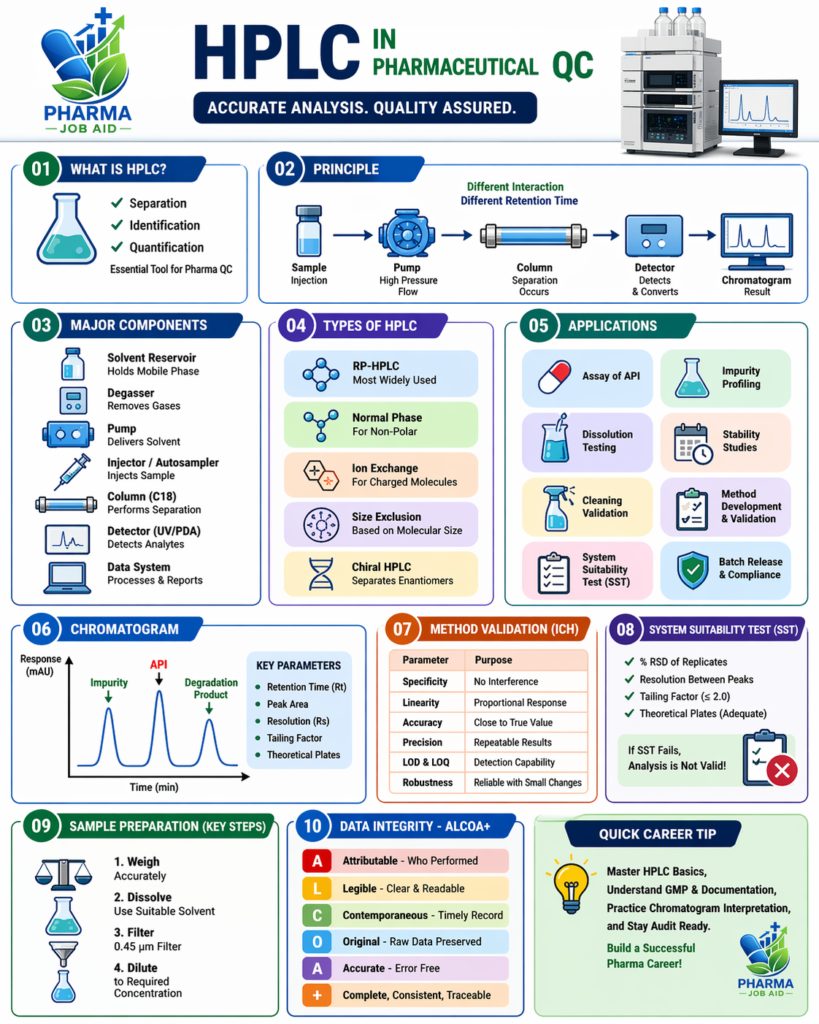
HPLC works on the principle of differential interaction between two phases: the mobile phase (liquid solvent) and the stationary phase (solid material inside the column). When a sample is injected into the system, its components travel at different speeds depending on their chemical nature and interaction with these phases. This leads to separation, and each compound appears as a peak in the chromatogram at a specific retention time. The retention time helps identify the compound, while the peak area is used to determine its concentration.
🧪 Applications of HPLC in Pharmaceutical QC
In pharmaceutical QC laboratories, HPLC plays a critical role in multiple analytical activities. It is used for assay of active pharmaceutical ingredients (API) to ensure correct potency, as well as for impurity profiling, which is essential for detecting harmful or unwanted substances. It is also widely applied in dissolution testing, where drug release from tablets or capsules is measured, and in stability studies to monitor degradation over time. Additionally, HPLC is used in cleaning validation to confirm that no residues remain on manufacturing equipment. These applications are aligned with global regulatory expectations, including those from the International Council for Harmonisation.
🔧 Major Components of HPLC System
A typical HPLC system consists of several integrated components that work together to achieve accurate analysis. The solvent reservoir holds the mobile phase, which is delivered by a high-pressure pump at a controlled flow rate. The sample is introduced into the system through an injector or autosampler. The column, often packed with C18 stationary phase in reverse-phase HPLC, is where the actual separation occurs. The detector, usually UV or PDA, identifies compounds as they elute from the column. Finally, a computerized data system records and processes the chromatogram, providing quantitative results. Each component must be properly maintained to ensure reliable and reproducible performance.
📊 System Suitability and GMP Compliance
Before any analysis is performed, the HPLC system must pass a System Suitability Test (SST) to verify its performance. Parameters such as repeatability (%RSD), tailing factor, resolution, and theoretical plates are evaluated according to pharmacopeial standards like United States Pharmacopeia and British Pharmacopoeia. If the system fails SST, the analysis is considered invalid under GMP requirements.
From a regulatory perspective, HPLC methods must also be validated to demonstrate accuracy, precision, specificity, linearity, and robustness. These requirements are enforced by global authorities such as the World Health Organization and are critical for maintaining data integrity and audit readiness.
⚠️ Common Issues and Troubleshooting
During routine operation, HPLC systems may encounter problems such as peak tailing, high back pressure, baseline drift, or poor resolution. These issues can arise from factors like column contamination, air bubbles in the mobile phase, incorrect method parameters, or detector malfunction. Proper troubleshooting, regular maintenance, and adherence to SOPs are essential to ensure consistent system performance and avoid deviations during QC analysis.
📚 Method Validation in HPLC
Method validation is a critical requirement in pharmaceutical QC to ensure that the HPLC method consistently produces reliable and accurate results. According to guidelines from the International Council for Harmonisation, validation parameters include accuracy, precision, specificity, linearity, range, robustness, limit of detection (LOD), and limit of quantification (LOQ). Each parameter must be experimentally verified and documented. For example, precision is evaluated through repeatability (%RSD), while accuracy is confirmed through recovery studies. A validated method ensures confidence during routine analysis and regulatory inspections.
🧬 HPLC Method Development in QC Laboratory
Before validation, a robust method development process is required. This involves selecting the appropriate column (commonly C18), optimizing mobile phase composition (buffer + organic solvent), adjusting pH, flow rate, and detection wavelength. Analysts often perform trial-and-error experiments to achieve proper separation, peak symmetry, and resolution. Method development is especially critical for new products, impurities, or stability-indicating methods, where separation of closely related compounds is required.
🧪 Sample Preparation Techniques for HPLC
Proper sample preparation is essential to obtain accurate and reproducible results. In pharmaceutical QC, samples such as tablets, capsules, or suspensions must be carefully processed before injection. This typically includes weighing, dissolving, sonication, filtration (0.45 µm filter), and dilution to the required concentration. Any error in sample preparation can directly affect assay results, making it a critical step in the analytical process.
⚙️ HPLC Column Selection & Care
The column is the heart of the HPLC system, and its selection significantly impacts method performance. Columns vary based on length, particle size, pore size, and stationary phase chemistry. Reverse-phase C18 columns are most commonly used in pharmaceutical analysis due to their versatility. Proper column care, including flushing after use, avoiding contamination, and maintaining suitable storage conditions, is essential to prolong column life and ensure consistent results.
🧼 Preventive Maintenance of HPLC
Routine maintenance of HPLC systems is essential for smooth operation and compliance with GMP. Preventive maintenance includes cleaning solvent lines, replacing filters, checking pump seals, degassing mobile phase, and calibrating detectors. Regular maintenance reduces downtime, prevents unexpected failures, and ensures consistent analytical performance during audits and inspections.
📊 Calibration & Qualification (IQ/OQ/PQ)
HPLC instruments must undergo proper qualification and calibration to meet regulatory requirements. This includes:
- IQ (Installation Qualification): Verifies correct installation
- OQ (Operational Qualification): Confirms system operates within limits
- PQ (Performance Qualification): Ensures consistent performance in real conditions
These activities are mandatory under GMP guidelines and are regularly reviewed during inspections by authorities such as the World Health Organization and Directorate General of Drug Administration.
⚠️ Deviation Handling in HPLC Analysis
In QC laboratories, any unexpected result or system failure must be handled through a deviation management system. For example, if SST fails or chromatogram results are out of specification (OOS), an investigation must be conducted to determine the root cause. Tools like 5-Why analysis and Fishbone diagram (Man, Machine, Method, Material) are commonly used. Corrective and Preventive Actions (CAPA) must be implemented to prevent recurrence, ensuring compliance with GMP standards.
📈 Data Integrity & Documentation (ALCOA+)
Data generated from HPLC must comply with strict data integrity principles, commonly known as ALCOA+:
- Attributable (who performed the analysis)
- Legible (clear and readable records)
- Contemporaneous (recorded at the time of activity)
- Original (raw data preserved)
- Accurate (error-free data)
Additional principles include completeness, consistency, and traceability. Regulatory authorities expect full audit trails and secure data management systems to prevent data manipulation.
🌍 Regulatory Expectations & Audit Readiness
Pharmaceutical companies must ensure that HPLC operations meet global regulatory expectations. Guidelines from United States Pharmacopeia, British Pharmacopoeia, and World Health Organization define standards for analytical testing. During audits, inspectors focus on method validation, system suitability, calibration records, logbooks, and data integrity. Any non-compliance can lead to regulatory observations or warning letters.
🇧🇩 HPLC Practice in Bangladesh Pharmaceutical Industry
In Bangladesh, pharmaceutical companies extensively use HPLC for both local market supply and export to regulated markets. Compliance with Directorate General of Drug Administration and international standards is essential. Many companies follow WHO-GMP and export-oriented requirements, making HPLC expertise highly valuable. Analysts are expected to follow SOPs strictly, maintain documentation, and ensure audit readiness at all times.
👨🔬 Advanced Trends in HPLC Technology
Modern pharmaceutical industries are moving toward advanced HPLC technologies such as:
- UPLC (Ultra Performance Liquid Chromatography) for faster analysis
- Automation & Autosamplers for high-throughput testing
- PDA & MS Detectors for enhanced detection capability
- Software Integration for data integrity and audit trails
These advancements improve efficiency, sensitivity, and compliance, making analytical processes more robust and reliable.
🚀 Career Scope of HPLC in PharmaJobAid
HPLC expertise is one of the most in-demand technical skills in the pharmaceutical industry. Professionals with strong knowledge of HPLC can pursue careers as QC Analysts, QA Officers, Validation Engineers, and R&D Scientists. In Bangladesh, candidates with hands-on HPLC experience have a competitive advantage in job placement and career growth. Platforms like PharmaJobAid help candidates prepare for such roles by providing practical knowledge, SOPs, and interview preparation resources.
🏁 Final Conclusion
HPLC is not just an analytical instrument—it is the foundation of pharmaceutical quality assurance. From method development to validation, routine analysis, and regulatory compliance, HPLC ensures that every medicine meets strict quality standards before reaching patients. Its importance in impurity detection, stability studies, and dissolution testing makes it indispensable in modern pharmaceutical manufacturing.
For students, fresh graduates, and professionals aiming to build a successful career in the pharmaceutical industry, mastering HPLC is essential. Strong theoretical knowledge combined with practical experience and GMP understanding will ensure long-term success in this highly competitive field
.
🔧 Column Chemistry & Selectivity Optimization
Column selection is a critical factor in HPLC performance. While C18 columns are most commonly used, other chemistries such as C8, phenyl, cyano, and amino columns are selected based on analyte properties. Selectivity can be adjusted by modifying:
- Mobile phase composition (organic solvent ratio)
- pH of buffer (affects ionization of analytes)
- Ionic strength (controls interaction with stationary phase)
For ionizable compounds, pH control is crucial, as it determines whether the compound is in ionized or neutral form, directly impacting retention and peak shape. Advanced analysts often use gradient elution instead of isocratic methods to improve separation of complex mixtures.
⚗️ Mobile Phase Optimization Strategy
Mobile phase selection is one of the most critical steps in method development. Typically, a combination of aqueous buffer (e.g., phosphate buffer) and organic solvent (e.g., acetonitrile or methanol) is used. The pH is carefully adjusted to ensure analyte stability and optimal separation.
Buffer selection must consider:
- pKa of analyte
- Compatibility with detector
- Solubility and stability
Degassing and filtration of mobile phase are mandatory to prevent air bubbles and particulate contamination, which can lead to baseline noise and pressure fluctuations.
📊 Quantitative Analysis & Calibration Curve
HPLC quantification is based on the relationship between peak area and analyte concentration. A calibration curve is prepared using standard solutions at different concentrations. The linearity of this curve is evaluated using correlation coefficient (R²), which should typically be ≥ 0.999 for pharmaceutical methods.
Accuracy is determined by recovery studies, while precision is evaluated through repeatability and intermediate precision. These quantitative parameters ensure that the method produces reliable results suitable for regulatory submission.
🔍 Impurity Profiling & Regulatory Limits
Impurity profiling is one of the most critical applications of HPLC. According to guidelines from the International Council for Harmonisation (Q3A/Q3B), impurities must be identified, quantified, and controlled within acceptable limits.
Types of impurities include:
- Process-related impurities
- Degradation products
- Residual solvents
HPLC methods must be sensitive enough to detect impurities at very low levels (often in ppm). Proper impurity profiling ensures drug safety and regulatory compliance.
⚠️ Out of Specification (OOS) & Investigation
In pharmaceutical QC, HPLC results may sometimes fall outside specification limits, known as Out of Specification (OOS) results. These require a structured investigation process as per GMP guidelines.
The investigation includes:
- Review of raw data and chromatogram
- Verification of system suitability
- Re-analysis (if justified)
- Root cause analysis (using tools like Fishbone and 5-Why)
Any confirmed OOS result must lead to appropriate CAPA to prevent recurrence. This process is strictly monitored during audits by authorities such as the World Health Organization.
🧾 Documentation & Audit Trail in HPLC
HPLC generates a large volume of data, all of which must be properly documented. This includes:
- Analytical worksheets
- Chromatograms
- Calibration records
- System suitability reports
- Audit trail logs
Modern HPLC software systems include secure audit trails that record every action performed by the analyst. This ensures transparency and compliance with data integrity requirements.
🧠 Risk-Based Approach in HPLC (Quality Risk Management)
A risk-based approach is increasingly applied in pharmaceutical QC. Using tools like FMEA (Failure Mode and Effects Analysis), analysts can identify potential risks in HPLC analysis such as system failure, incorrect integration, or sample preparation errors.
Risk mitigation strategies include:
- Regular maintenance schedules
- SOP-based operation
- Analyst training programs
- System suitability verification
This aligns with ICH Q9 (Quality Risk Management) and enhances overall system reliability.
🤖 Digitalization & Pharma 4.0 in HPLC
With the advancement of Pharma 4.0, HPLC systems are becoming more integrated with digital technologies. Modern systems offer:
- Automated sample handling
- Remote monitoring
- Real-time data analysis
- Integration with Laboratory Information Management Systems (LIMS)
These technologies improve efficiency, reduce human error, and enhance compliance with regulatory requirements.
👨🔬 Real-Time Challenges in QC Laboratories
Despite its advantages, HPLC operation in QC laboratories faces several challenges, including:
- High operational cost (solvents, columns, maintenance)
- Need for skilled analysts
- Complex method development
- Strict regulatory compliance
In Bangladesh, many companies invest heavily in training and infrastructure to overcome these challenges and maintain global competitiveness.
🔬 Advanced Detector Technologies in HPLC
Beyond conventional UV detectors, modern HPLC systems utilize advanced detectors to enhance sensitivity and selectivity. Photodiode Array (PDA) detectors allow simultaneous detection across multiple wavelengths, enabling peak purity analysis and identification of co-eluting compounds. Fluorescence detectors offer extremely high sensitivity for compounds that exhibit fluorescence, making them suitable for trace-level analysis. Mass Spectrometry (LC-MS) integration provides structural information, allowing precise identification of unknown impurities and degradation products. These advanced detectors are increasingly used in research, stability studies, and regulatory submissions for complex molecules.
⚗️ Gradient vs Isocratic Elution (In-depth Understanding)
HPLC methods can be categorized into isocratic and gradient elution techniques. In isocratic elution, the mobile phase composition remains constant throughout the run, making it suitable for simple mixtures. However, for complex samples with multiple components, gradient elution is preferred. In gradient methods, the composition of the mobile phase changes over time (e.g., increasing organic solvent concentration), allowing better separation and shorter run times. Gradient methods are widely used in impurity profiling and stability-indicating methods due to their superior resolving power.
🧬 Stability-Indicating Method (SIM) Development
A stability-indicating method is a validated analytical procedure that can accurately and specifically measure the active ingredient in the presence of degradation products. During method development, forced degradation studies are performed under stress conditions such as heat, light, acid, base, and oxidation. HPLC is then used to ensure that all degradation products are well separated from the main peak. This is a regulatory requirement under International Council for Harmonisation Q1A (Stability Testing) and Q2 (Analytical Validation).
🧪 Forced Degradation Study (Regulatory Approach)
Forced degradation studies help understand the degradation pathways of a drug and establish its stability profile. Typical stress conditions include:
- Acid hydrolysis (e.g., HCl treatment)
- Base hydrolysis (e.g., NaOH treatment)
- Oxidation (e.g., hydrogen peroxide)
- Thermal degradation (elevated temperature)
- Photolytic degradation (UV light exposure)
HPLC is used to analyze stressed samples and identify degradation peaks. This information is critical for formulation development, packaging selection, and shelf-life determination.
📊 Robustness & Ruggedness in HPLC
Robustness refers to the ability of an HPLC method to remain unaffected by small variations in method parameters such as flow rate, pH, temperature, and mobile phase composition. Ruggedness, on the other hand, evaluates the reproducibility of results under different conditions such as different analysts, instruments, or laboratories. Both parameters are essential during method validation to ensure consistent performance in real-world conditions.
🧾 Audit Observations Related to HPLC (Real GMP Insights)
During regulatory inspections, several common observations related to HPLC are frequently reported. These include:
- Incomplete method validation data
- Lack of proper system suitability documentation
- Missing or manipulated audit trails
- Inadequate calibration records
- Poor chromatogram integration practices
Regulatory authorities such as the World Health Organization and Directorate General of Drug Administration emphasize strict compliance in these areas. Addressing these gaps through proper SOPs and training is essential for maintaining audit readiness.
⚠️ Integration Errors & Data Manipulation Risks
Chromatogram integration is a critical step in HPLC analysis, where peak areas are calculated. Manual integration errors or intentional manipulation can significantly impact results. Therefore, regulatory bodies require:
- Use of validated software
- Restricted user access levels
- Audit trail review
- Justification for any manual integration
Maintaining transparency in data processing is essential to ensure data integrity and regulatory compliance.
🧠 Analytical Lifecycle Management (ALM) in HPLC
Modern pharmaceutical industries follow the concept of Analytical Lifecycle Management (ALM), which includes:
- Method Development
- Method Validation
- Method Transfer
- Routine Use
- Continuous Monitoring & Improvement
This lifecycle approach ensures that HPLC methods remain reliable and compliant throughout the product lifecycle. It aligns with current regulatory expectations and promotes continuous quality improvement.
🔄 Method Transfer & Verification
When a method is transferred from R&D to QC or from one site to another, a method transfer study must be conducted. This ensures that the receiving laboratory can reproduce the method with equivalent accuracy and precision. Parameters such as system suitability, assay results, and impurity profiles are compared between sending and receiving labs. Successful method transfer is essential for consistent product quality across manufacturing sites.
🏭 HPLC in Different Dosage Forms
HPLC application varies depending on the dosage form being analyzed. For solid dosage forms like tablets and capsules, sample preparation involves dissolution and filtration. For liquid formulations, dilution is often sufficient. For injectables, strict aseptic handling and filtration are required. In semi-solid formulations like creams and ointments, extraction techniques are used before analysis. Each dosage form requires specific sample preparation techniques to ensure accurate results.
🌡️ Temperature Control & Its Impact
Temperature plays a significant role in HPLC separation. Column ovens are used to maintain a constant temperature, which improves reproducibility and peak shape. Changes in temperature can affect retention time, viscosity of the mobile phase, and overall system pressure. Maintaining controlled temperature conditions is essential for achieving consistent and reliable results.
🧪 Solvent Selection & Environmental Considerations
HPLC consumes a significant amount of organic solvents such as acetonitrile and methanol. These solvents are expensive and have environmental impacts. Modern laboratories are adopting green chemistry approaches, such as reducing solvent consumption, using eco-friendly solvents, and recycling waste. This not only reduces operational costs but also supports environmental sustainability initiatives.
📈 Future Trends of HPLC in Pharma Industry
The future of HPLC is evolving with advancements in technology and regulatory expectations. Some key trends include:
- Increased use of UPLC for faster and higher resolution analysis
- Integration with Artificial Intelligence (AI) for data analysis
- Enhanced automation and robotics for sample handling
- Real-time release testing (RTRT) using advanced analytics
These innovations will further strengthen the role of HPLC in pharmaceutical quality control and regulatory compliance.
🧪 Dissolution Sample Analysis by HPLC (Deep QC Practice)
In pharmaceutical QC laboratories, one of the most routine yet critical applications of HPLC is dissolution sample analysis. After performing dissolution testing using USP Apparatus (Type I/II), samples are withdrawn at specific time intervals and analyzed using HPLC to determine the percentage of drug released. The method must be highly specific to ensure that excipients or degradation products do not interfere with the API peak. Proper filtration, dilution, and sometimes use of internal standards are required to ensure accuracy. Dissolution profiles generated through HPLC are essential for product approval, batch release, and comparison studies such as bioequivalence.
⚗️ Buffer Preparation & pH Control (Critical GMP Aspect)
Buffer preparation is one of the most sensitive steps in HPLC analysis. Even slight variation in pH can significantly affect retention time, peak shape, and resolution, especially for ionizable compounds. Buffers such as phosphate, acetate, or citrate are commonly used, and their pH must be adjusted using calibrated pH meters. As per GMP requirements, buffer preparation must follow a controlled SOP with proper documentation, including weight, pH adjustment, filtration, and labeling. Incorrect buffer preparation is a common root cause of chromatographic failure in QC laboratories.
🧬 Peak Purity & Specificity Evaluation
Peak purity assessment is essential to confirm that a chromatographic peak represents a single component. Using PDA detectors, analysts can evaluate the spectral homogeneity of peaks across wavelengths. If peak purity fails, it may indicate co-elution of impurities or degradation products. Specificity, a key validation parameter, ensures that the method can accurately measure the analyte in the presence of other components such as excipients, impurities, and degradation products. This is particularly important in stability-indicating methods.
📊 Trending Analysis & OOT (Out of Trend) in HPLC
Apart from OOS (Out of Specification), pharmaceutical QC also monitors Out of Trend (OOT) results. These are results that fall within specification but show unusual variation compared to historical data. Trend analysis is performed using statistical tools to monitor assay values, impurity levels, and system suitability parameters over time. Any abnormal trend must be investigated to prevent potential quality issues. This aligns with continuous quality improvement and is often reviewed during Management Review Meetings (MRM).
🔍 HPLC in Cleaning Validation (Residue Analysis)
HPLC plays a vital role in cleaning validation, where it is used to detect trace levels of drug residues on manufacturing equipment. Swab or rinse samples are collected from equipment surfaces and analyzed using highly sensitive HPLC methods. The results are compared against predefined acceptance criteria (e.g., ppm level). This ensures that there is no cross-contamination between products, which is critical in multi-product manufacturing facilities. Regulatory authorities strictly evaluate cleaning validation data during audits.
⚠️ Carryover & Its Control in HPLC
Carryover refers to the presence of residual analyte from a previous injection affecting subsequent runs. This can lead to false high results, especially in impurity analysis. Carryover is controlled by:
- Proper needle wash and autosampler cleaning
- Use of blank injections between samples
- Optimizing injection volume
- Regular system cleaning
Carryover checks are often included in system suitability or validation studies to ensure method reliability.
🧾 HPLC Logbook & Documentation Practice (DGDA Style)
In GMP-compliant laboratories, proper documentation is as important as the analysis itself. HPLC usage must be recorded in logbooks, including:
- Date and time of analysis
- Analyst name
- Instrument ID
- Method reference
- Column details
- Sample details
Any system failure, maintenance, or deviation must also be documented. During audits by Directorate General of Drug Administration or World Health Organization, these records are thoroughly reviewed to ensure traceability and compliance.
🧠 Human Error & Analyst Qualification
Despite automation, human factors remain a significant risk in HPLC analysis. Errors such as incorrect sample preparation, wrong method selection, or improper integration can impact results. Therefore, analyst qualification and training are essential. Analysts must undergo:
- Initial training on HPLC operation
- Method-specific training
- Periodic requalification
- GMP and data integrity training
Competency assessment ensures that analysts can perform accurate and reliable analysis consistently.
🔄 Change Control in HPLC Method & System
Any change in HPLC method parameters, column type, mobile phase composition, or instrument configuration must be managed through a formal change control system. The impact of the change must be assessed, and if necessary, partial or full method revalidation must be performed. This ensures that changes do not negatively affect method performance or product quality. Change control is a critical GMP requirement and is closely monitored during inspections.
📈 HPLC in Continuous Process Verification (CPV)
In modern pharmaceutical manufacturing, HPLC is used in Continuous Process Verification (CPV) to monitor process performance in real time. Data from HPLC analysis are used to evaluate critical quality attributes (CQAs) and ensure that the process remains in a state of control. This approach supports quality by design (QbD) and enhances overall product quality.
🌍 Comparison: HPLC vs Other Analytical Techniques
While HPLC is widely used, it is often compared with other analytical techniques:
- UV Spectroscopy → Simple but less specific
- Gas Chromatography (GC) → Suitable for volatile compounds
- Titration → Less sensitive and less specific
- LC-MS → More advanced but expensive
HPLC provides the best balance of sensitivity, specificity, and versatility, making it the preferred choice in pharmaceutical QC laboratories.
🧪 Real Case Example (Pharma QC Insight)
In a typical Bangladesh pharmaceutical company, an HPLC assay of a tablet may show slightly lower results (e.g., 96.5%). Investigation may reveal:
- Sample preparation error (incomplete dissolution)
- Column degradation (poor peak shape)
- Mobile phase pH variation
Using root cause analysis tools like 5-Why, the issue can be identified and corrected. CAPA may include retraining of analysts, column replacement, and stricter SOP control. This practical approach reflects real GMP practices followed during audits.
🏭 Integration with QMS (Quality Management System)
HPLC is fully integrated into the pharmaceutical Quality Management System (QMS). It is linked with:
- Deviation management
- CAPA system
- Change control
- Training management
- Document control
All HPLC-related activities must align with SOPs and GMP requirements to ensure compliance and audit readiness.
🚀 Final Professional Insight
At an advanced level, HPLC is not just about running samples—it is about scientific understanding, regulatory compliance, and quality assurance integration. A skilled analyst must think critically, interpret data accurately, and respond effectively to deviations.
For professionals aiming to excel in the pharmaceutical industry, especially in Bangladesh, mastering HPLC with a deep understanding of GMP, validation, troubleshooting, and regulatory expectations is essential. It is one of the most powerful tools that ensures every medicine released to the market is safe, effective, and of the highest quality.
👨🔬 Importance of HPLC in Pharma Career
In Bangladesh’s pharmaceutical industry, HPLC is one of the most demanded technical skills for roles such as QC Analyst, QA Officer, and R&D Scientist. Professionals must not only understand the operational aspects of HPLC but also be familiar with GMP documentation, deviation handling, and CAPA processes to meet audit expectations. Strong expertise in HPLC significantly improves employability and career growth, especially for candidates preparing through platforms like PharmaJobAid.
🏁 Conclusion
HPLC is the backbone of pharmaceutical quality control, ensuring that every medicine meets strict standards of safety, quality, and efficacy. From API analysis to impurity detection and stability studies, its role is indispensable in modern pharmaceutical manufacturing. For students and professionals aiming to build a successful career in the pharma industry, mastering HPLC is not just an advantage—it is a necessity.