
A groundbreaking development in cancer research has revealed that the well-known antiparasitic drug Ivermectin may significantly slow the growth of endocrine-resistant breast cancer, one of the most aggressive and difficult-to-treat forms of the disease.
According to recent laboratory studies, Ivermectin reduced tumor cell growth by more than 50% within just 24 hours, marking a potentially transformative step in oncology treatment strategies.
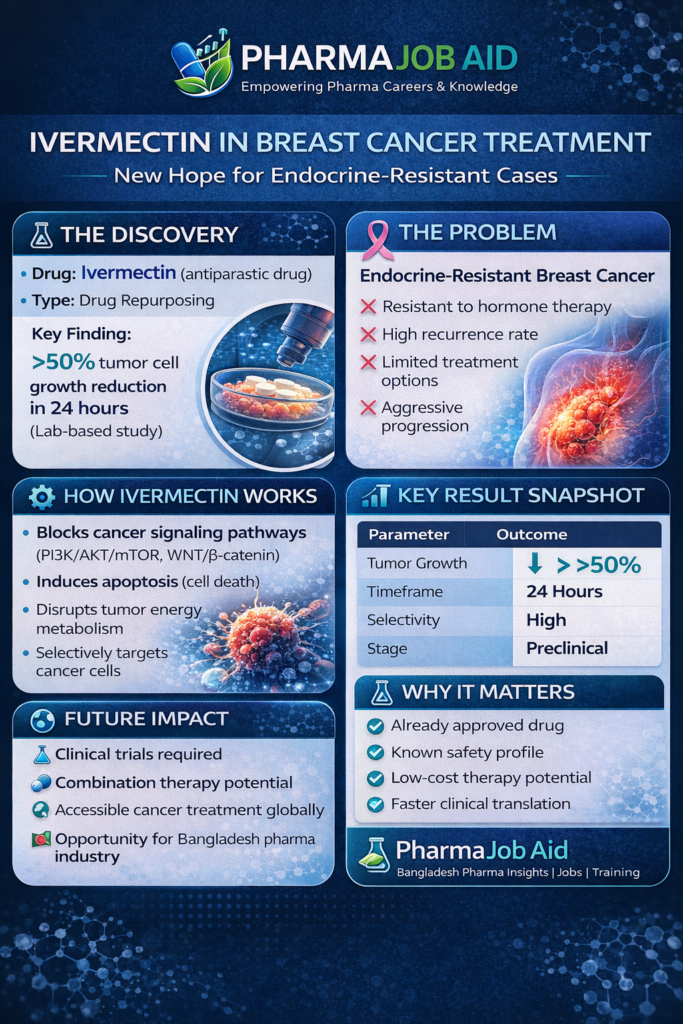
Understanding Endocrine-Resistant Breast Cancer
Breast cancer is not a single disease—it includes multiple subtypes. One of the most challenging is endocrine-resistant breast cancer, which develops when tumors no longer respond to hormone-based treatments such as:
- Tamoxifen
- Aromatase inhibitors
- Fulvestrant
Why This Type Is Dangerous
- ❌ Resistance to standard therapies
- ❌ Faster disease progression
- ❌ Limited treatment alternatives
- ❌ Higher recurrence risk
This resistance significantly reduces treatment effectiveness, making new therapeutic approaches essential.
The Breakthrough Discovery
Researchers have found that Ivermectin—a drug widely used for parasitic infections—can interfere with cancer cell growth mechanisms.
Key Findings
- 🔬 Over 50% tumor reduction in 24 hours (lab studies)
- 🎯 Selective targeting of cancer cells
- 🧬 Minimal damage to healthy cells
- ⚡ Rapid inhibition of cancer cell proliferation
These results highlight Ivermectin’s potential as a repurposed anti-cancer agent.
How Ivermectin Fights Cancer Cells
Although still under investigation, scientists believe Ivermectin works through multiple biological mechanisms:
1. Blocking Cancer Signaling Pathways
It disrupts pathways such as:
- PI3K/AKT/mTOR
- WNT/β-catenin
These pathways are essential for tumor growth and survival.
2. Triggering Apoptosis
Ivermectin may force cancer cells into programmed cell death, a process often defective in resistant cancers.
3. Inhibiting Energy Production
By affecting mitochondrial function, the drug reduces the energy supply needed for tumor growth.
4. Enhancing Treatment Sensitivity
It may increase the effectiveness of existing therapies when used in combination.
Drug Repurposing: A Game-Changer in Pharma
This discovery highlights the growing importance of drug repurposing—using existing drugs for new medical applications.
Why It Matters
- ✅ Faster development timeline
- ✅ Lower research costs
- ✅ Known safety profile
- ✅ Easier regulatory pathway
Since Ivermectin is already widely used and studied, it becomes an attractive candidate for oncology research.
Current Limitations and Future Research
Despite promising early results, it’s important to remain cautious:
⚠️ These findings are based on laboratory (in vitro) studies, not human clinical trials.
Scientific Evidence: What the Research Says
1. PLOS ONE Study (2025) – Core Evidence
A landmark study published in PLOS ONE demonstrated that Ivermectin has significant anti-cancer effects on endocrine-resistant breast cancer cells.
🔗 Source: Read Full Study
Key Findings:
- Ivermectin inhibited cancer cell growth in resistant cell lines (MCF-7/LCC2 & LCC9)
- Effective concentration (IC₅₀) observed within 24 hours
- Reduced cell invasion and metastasis potential
- Suppressed epithelial-to-mesenchymal transition (EMT)
- Interfered with Wnt signaling pathway, a key cancer progression pathway
👉 The study concludes that Ivermectin has antiproliferative and anti-invasive properties, supporting its potential for repurposing in oncology.
2. Mechanistic Confirmation via PubMed Central (PMC)
🔗 Source: View PMC Article
The PMC-indexed version reinforces the same findings:
- Ivermectin targets drug-resistant breast cancer cells
- Demonstrates selectivity (less toxicity in normal cells)
- Inhibits tumor growth through multiple pathways
👉 This strengthens the reliability of the findings, as PMC serves as a globally recognized biomedical database.
3. Supporting Oncology Research on Ivermectin
Earlier studies also support these findings:
- Ivermectin induces apoptosis and autophagy in breast cancer cells
- Disrupts PAK1/Akt/mTOR signaling pathways
- Shows selective toxicity toward cancer cells
👉 Evidence suggests multi-target anti-cancer activity beyond a single pathway.
Mechanism of Action (Simplified for Pharma Professionals)
1. EMT Inhibition (Anti-Metastatic Effect)
- Reduces proteins like vimentin and Snail
- Prevents cancer cells from spreading
2. Wnt Signaling Suppression
- Downregulates Wnt5a/b, LRP6, Axin1
- Blocks tumor growth signaling
👉 This is critical because Wnt signaling is linked to drug resistance and metastasis.
3. Apoptosis & Autophagy Activation
- Forces cancer cells into programmed death
- Disrupts cancer cell survival mechanisms
4. Selective Targeting
- Cancer cells are more sensitive than normal cells
- Suggests better safety profile compared to chemotherapy
Link with Aggressive Breast Cancer Types (TNBC Context)
While the study focuses on endocrine-resistant cancer, its implications extend to Triple-Negative Breast Cancer, one of the most aggressive forms.
Why TNBC Matters:
- Lacks ER, PR, HER2 receptors
- Limited targeted therapies
- High recurrence rate
- Poor prognosis
👉 TNBC accounts for 10–15% of breast cancer cases and is harder to treat due to lack of therapeutic targets.
Current Treatment Landscape vs Emerging Approaches
Existing Treatments for Aggressive Breast Cancer:
- Chemotherapy (standard backbone)
- Immunotherapy (e.g., pembrolizumab)
- PARP inhibitors
- Antibody-drug conjugates
Recent advances show that combination therapies are improving outcomes in aggressive cancers.
City of Hope Insight: Drug Combination Strategy
🔗 Source: https://www.cityofhope.org/stories-of-hope/triple-negative-drug-combo
Research from City of Hope highlights:
- Multi-drug combinations are key for aggressive cancers
- Targeted + immunotherapy combinations are emerging
- Precision medicine is the future
👉 This aligns with the idea that Ivermectin may work best as part of combination therapy, not standalone.
Why Ivermectin Is a Strong Candidate for Repurposing
Key Advantages:
- ✅ Well-established safety profile
- ✅ Widely available and affordable
- ✅ Multi-target mechanism
- ✅ Potential synergy with existing cancer therapies
Economic Impact
For countries like Bangladesh:
- Lower treatment costs
- Local manufacturing feasibility
- Increased accessibility
Limitations of Current Research
Despite promising findings, important limitations exist:
⚠️ Studies are in vitro (lab-based)
⚠️ No large-scale human clinical trials yet
⚠️ Optimal cancer dosing unknown
⚠️ Long-term safety in oncology unclear
👉 Clinical trials are essential before real-world application.
Future Research Directions
Researchers are now focusing on:
- Clinical trials (Phase I–III)
- Combination with:
- Chemotherapy
- Immunotherapy
- Targeted drugs
- Drug delivery optimization (nano-formulations)
- Biomarker-based patient selection
Regulatory Considerations
Before clinical use:
- Approval from FDA
- Evaluation by Directorate General of Drug Administration
- Compliance with oncology clinical guidelines
Next Steps in Research
- Clinical trials in cancer patients
- Determining optimal dosage for oncology use
- Studying long-term safety
- Exploring combination therapies
Regulatory approval from authorities like the FDA will be essential before clinical use.
Implications for Global and Bangladesh Pharma Industry
This discovery could have a major impact, especially in countries like Bangladesh:
Opportunities
- Expansion into oncology drug development
- Local manufacturing of repurposed therapies
- Increased participation in global clinical trials
- Affordable cancer treatment solutions
The Directorate General of Drug Administration will play a key role in evaluating such therapies locally.
Conclusion: A Promising Future Ahead
The discovery that Ivermectin can significantly inhibit endocrine-resistant breast cancer growth represents a major step forward in cancer research.
While still in early stages, this innovation:
- Opens new pathways for treating resistant cancers
- Demonstrates the power of drug repurposing
- Offers hope for more accessible and affordable therapies
If future clinical trials confirm these findings, Ivermectin could become a valuable addition to the global fight against cancer—especially for patients with limited treatment options.
📌 Key Takeaways
- Ivermectin reduced tumor growth by >50% in 24 hours (lab studies)
- Shows potential against endocrine-resistant breast cancer
- Works by disrupting cancer survival pathways
- Represents a low-cost, repurposed treatment opportunity
- Requires clinical validation before real-world use