
Training Management in the Pharmaceutical Industry in Bangladesh: Complete GMP, SOP & Compliance Guide for Pharma Professionals
1. Introduction: Why Training is the Backbone of Pharma Quality
In the pharmaceutical industry, quality is not ensured by machines alone—it is driven by people. Every batch manufactured, every test performed, and every regulatory submission depends on trained and competent personnel.
In Bangladesh, the pharmaceutical sector has evolved into a globally competitive industry exporting to over 150 countries. With this expansion, regulatory expectations from organizations like:
- World Health Organization (WHO)
- U.S. FDA
- European Medicines Agency (EMA)
have increased significantly.
👉 These regulators require:
- Proper employee training
- Documented records
- Competency evaluation
- Continuous improvement systems
🔴 Key GMP Principle:
An untrained employee is a direct risk to product quality and patient safety.
2. What is Training Management in Pharma?
Training management is not just teaching—it is a controlled lifecycle system integrated into the Quality Management System (QMS).
Core Components:
- Qualification → Ensuring baseline knowledge
- Training Execution → Structured delivery
- Competency Evaluation → Performance verification
- Documentation → Audit-ready records
👉 In pharma, training = compliance + competency + traceability
3. GMP Perspective: Why Training is Mandatory
Under Good Manufacturing Practice (GMP):
“Personnel must be trained in the operations they perform.”
This means:
- Production staff must understand manufacturing processes
- QC analysts must understand analytical methods
- QA personnel must understand compliance systems
🚨 Reality:
Most deviations, OOS, and audit failures are linked to training gaps.
4. Scope of Training in Pharmaceutical Industry
Training in pharma is comprehensive and covers multiple domains:
✔ Core Training Areas:
- Induction Training
- GMP & GDP Training
- SOP Training
- Technical Training
- EHS (Safety) Training
- QMS Training
- External Training
👉 Training is not just technical—it includes:
- Compliance
- Safety
- Behavior
- Documentation practices
5. Objectives of Training System
5.1 Compliance Objective
Ensures adherence to:
- GMP
- Regulatory guidelines
- Internal SOPs
5.2 Quality Objective
Reduces:
- Human error
- Deviations
- Batch failures
5.3 Safety Objective
Prevents:
- Workplace accidents
- Chemical exposure
- Contamination
5.4 Business Objective
Improves:
- Productivity
- Efficiency
- Cost control
6. Roles & Responsibilities in Training System
👤 Employee
- Attend training
- Complete assessments
- Work only when competent
👨🏫 Trainer / SME
- Deliver accurate training
- Use updated materials
- Evaluate participants
🏢 Department Head
- Identify training needs
- Prepare training matrix
- Monitor compliance
🛡 QA (Most Critical)
- Maintain records
- Ensure compliance
- Monitor system effectiveness
🏭 Plant Head
- Provide resources
- Ensure system implementation
7. Types of Training in Pharmaceutical Industry
7.1 Induction Training
Foundation training for new employees:
- GMP basics
- Company policies
- Safety awareness
❗ Mistake to avoid: Treating induction as a formality.
7.2 GMP & Compliance Training
Covers:
- GMP principles
- Good Documentation Practices (GDP)
- Data Integrity (ALCOA+)
👉 Most audit failures occur due to poor GMP understanding.
7.3 SOP Training
Ensures employees follow standardized procedures.
Process:
- Reading
- Explanation
- Demonstration
- Assessment
✔ Mandatory for:
- New SOPs
- Revised SOPs
7.4 On-the-Job Training (OJT)
Hands-on practical training:
- Real equipment
- Real processes
- Supervisor guidance
👉 Without OJT, employees cannot perform tasks effectively.
7.5 Technical Training
Includes:
- HPLC operation
- Equipment handling
- Software systems (SAP, LIMS)
7.6 EHS Training (Safety)
Focus areas:
- Fire safety
- PPE usage
- Hazard control
7.7 External Training
Conducted by:
- Regulatory bodies
- Industry experts
Examples:
- GMP workshops
- Regulatory seminars
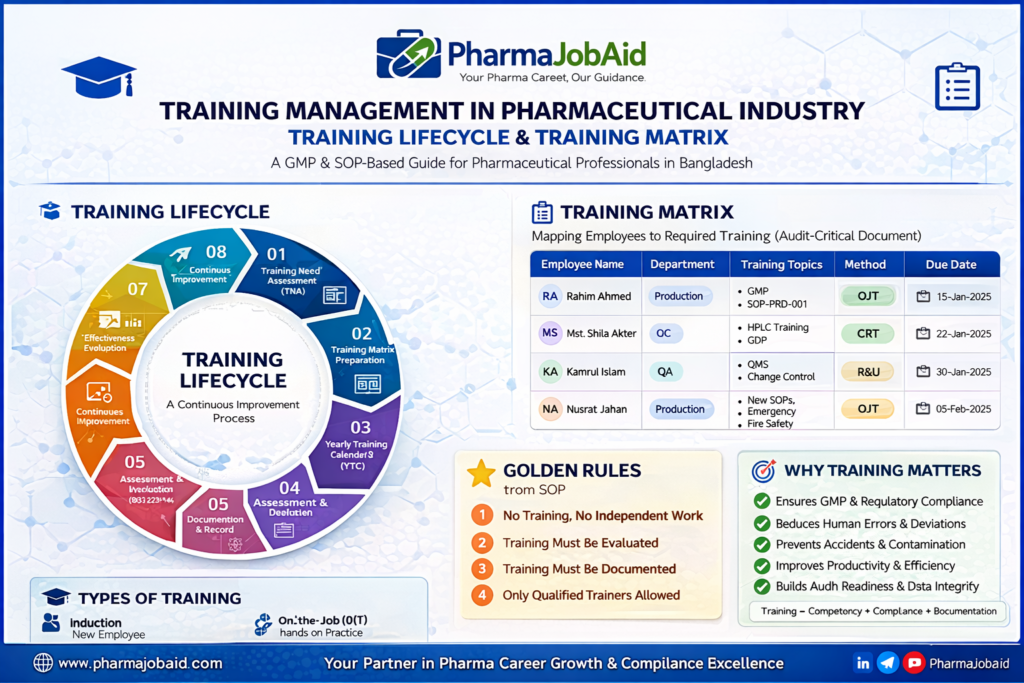
8. Training Lifecycle (SOP-Based System)
Training follows a closed-loop lifecycle:
- Training Need Assessment (TNA)
- Training Matrix Preparation
- Yearly Training Calendar (YTC)
- Training Delivery
- Assessment
- Documentation
- Effectiveness Evaluation
- Continuous Improvement
👉 Training is not a one-time activity—it is a continuous system.
9. Training Need Assessment (TNA)
What is TNA?
A structured process to identify:
- What training is needed
- Who needs it
- Why it is required
Sources:
- Job roles
- Audit findings
- Deviations & CAPA
- SOP changes
- New technology
10. Training Matrix (Audit-Critical Document)
The training matrix maps employees against required training.
Key Elements:
- Employee name
- Training topics
- Method (OJT, CRT, R&U)
- Status
- Due date
🔴 Golden Rule:
No employee can work independently without completing the training matrix.
11. Yearly Training Calendar (YTC)
A structured annual training plan.
Includes:
- GMP refresher
- SOP updates
- Data integrity training
Inputs:
- Audit findings
- CAPA
- Regulatory updates
12. Training Delivery Methods
📘 Read & Understood (R&U)
Low-risk SOP training
🏫 Classroom Training (CRT)
Theory-based sessions
⚙ On-the-Job Training (OJT)
High-risk, practical training
👉 Method selection depends on risk level
13. Training Assessment & Evaluation
SOP Requirement:
- Minimum passing marks: 80%
Types:
- Written tests
- Oral assessment
- Practical evaluation
👉 If failed:
- Retraining required
- Reassessment mandatory
14. Training Effectiveness
Assessment alone is not enough.
Measure effectiveness by:
- Reduction in deviations
- Error rate decrease
- Audit success rate
- Productivity improvement
15. Training Documentation (Audit Critical)
Golden Rule:
👉 If it is not documented, it is not done.
Required Records:
- Attendance sheets
- Assessment results
- Training matrix
- Training calendar
GDP Requirements:
- Signed
- Dated
- Legible
- Traceable
16. Record Retention Policy
- Training records: 3 years after employee leaves
- Other documents: 5 years
👉 Auditors may request historical records.
17. Digital Transformation: LMS in Pharma
What is LMS?
Learning Management System for training automation.
Benefits:
- Automated tracking
- Online assessments
- Real-time dashboards
- Reduced paperwork
📈 Bangladesh pharma is shifting from paper → digital systems
18. Audit Readiness for Training System
Auditors Check:
- Training matrix
- Assessment records
- Trainer qualification
- Documentation traceability
Common Audit Failures:
- Missing records
- Untrained staff
- No assessment
19. Common Challenges in Bangladesh Pharma
- Paper-based systems
- Lack of assessment
- Time constraints
- Unskilled trainers
20. Best Practices for Training Management
✔ Conduct proper TNA
✔ Maintain updated training matrix
✔ Follow YTC strictly
✔ Use risk-based training
✔ Implement LMS
✔ Ensure audit readiness
21. Career Opportunities in Training Management
Entry Level:
- Production Executive
- QC Analyst
- QA Executive
Mid-Level:
- Training Coordinator
- QA Training Executive
Senior Level:
- Compliance Manager
- Training Manager
High-Demand Roles:
- GMP Trainer
- Auditor
- Data Integrity Specialist
22. PharmaJobAid Career Roadmap
1️⃣ Learn GMP & SOP
2️⃣ Gain QA exposure
3️⃣ Handle training systems
4️⃣ Move to compliance roles
23. Bangladesh Industry Insight
Leading companies like:
- Square Pharmaceuticals
- Beximco Pharmaceuticals
- Incepta Pharmaceuticals
require strong training systems for:
- Export approval
- Regulatory audits
- Quality assurance
24. Final Conclusion
Training management in the pharmaceutical industry is a regulated, SOP-driven system that ensures:
✔ Product quality
✔ Regulatory compliance
✔ Patient safety
👉 Training = Competency + Compliance + Documentation
Companies with strong training systems achieve:
- Better audit outcomes
- Higher efficiency
- Global competitiveness
🚀 Call to Action
👉 Visit PharmaJobAid: https://pharmajobaid.com/
📌 Get pharma jobs, SOP guides, and career growth resources