
Introduction: The Rise of Regulatory Intelligence in Modern Pharma
The pharmaceutical industry is undergoing one of the most transformative periods in its history. With increasing globalization, rapid technological innovation, and stricter regulatory scrutiny, companies must operate with unprecedented precision and agility. At the center of this transformation lies regulatory intelligence (RI)—a discipline that has evolved from a support function into a core strategic pillar.
Regulatory intelligence is no longer just about tracking guidelines or compiling regulatory updates. It is about predicting regulatory trends, informing strategic decisions, and ensuring seamless compliance across global markets.
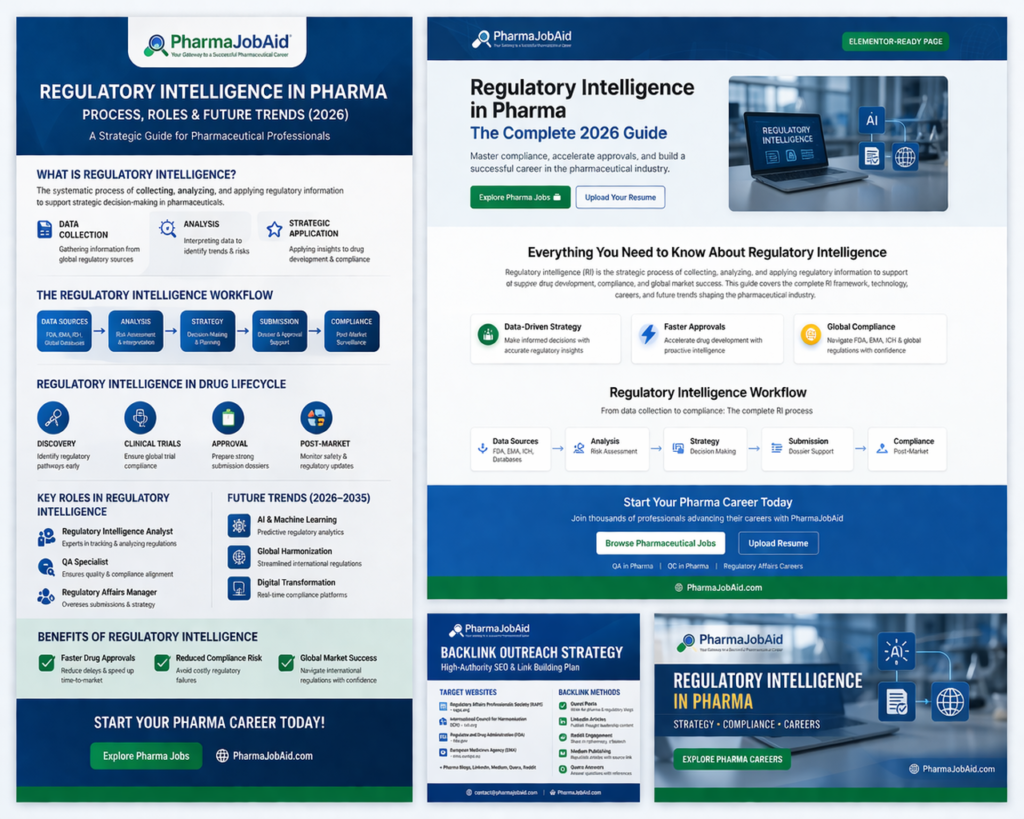
For pharmaceutical professionals, especially those working in quality assurance (QA), quality control (QC), regulatory affairs, and clinical development, mastering regulatory intelligence is essential for career growth.
👉 Explore pharma careers and opportunities: https://pharmajobaid.com/
Chapter 1: Understanding Regulatory Intelligence
1.1 Definition and Core Concept
Regulatory intelligence can be defined as:
“The systematic collection, analysis, and application of regulatory information to support strategic decision-making throughout the product lifecycle.”
It involves:
- Gathering regulatory data
- Monitoring policy changes
- Interpreting regulatory expectations
- Applying insights to product development
1.2 Regulatory Intelligence vs Regulatory Affairs
While often used interchangeably, regulatory intelligence and regulatory affairs are distinct:
| Aspect | Regulatory Intelligence | Regulatory Affairs |
|---|---|---|
| Focus | Strategy & Insights | Execution |
| Role | Predictive | Operational |
| Output | Intelligence Reports | Submissions |
RI feeds regulatory affairs with forward-looking insights, while regulatory affairs executes submissions and compliance tasks.
1.3 Historical Evolution of Regulatory Intelligence
- Pre-2000s: Manual tracking of regulations
- 2000–2015: Digital databases and structured monitoring
- 2015–2025: Integration with strategy and lifecycle
- 2025+: AI-driven predictive regulatory intelligence
Chapter 2: Global Regulatory Landscape
2.1 Major Regulatory Authorities
The pharmaceutical industry is governed by multiple global agencies:
- U.S. FDA (Food and Drug Administration)
- European Medicines Agency (EMA)
- MHRA (UK)
- PMDA (Japan)
- NMPA (China)
2.2 Harmonization Through ICH
The International Council for Harmonisation (ICH) plays a critical role in aligning global regulatory requirements.
Key guidelines include:
- ICH Q8 (Pharmaceutical Development)
- ICH Q9 (Quality Risk Management)
- ICH Q10 (Pharmaceutical Quality System)
2.3 Regulatory Complexity in Emerging Markets
Countries like Bangladesh, India, and Brazil have unique regulatory requirements, making regulatory intelligence essential for global expansion.
Chapter 3: Regulatory Intelligence Lifecycle
3.1 Data Collection
Sources include:
- Regulatory authority websites
- Scientific journals
- Industry reports
3.2 Data Analysis
Raw data is transformed into:
- Risk assessments
- Strategic recommendations
- Compliance insights
3.3 Decision-Making Integration
RI supports:
- Clinical strategy
- Market entry planning
- Product lifecycle management
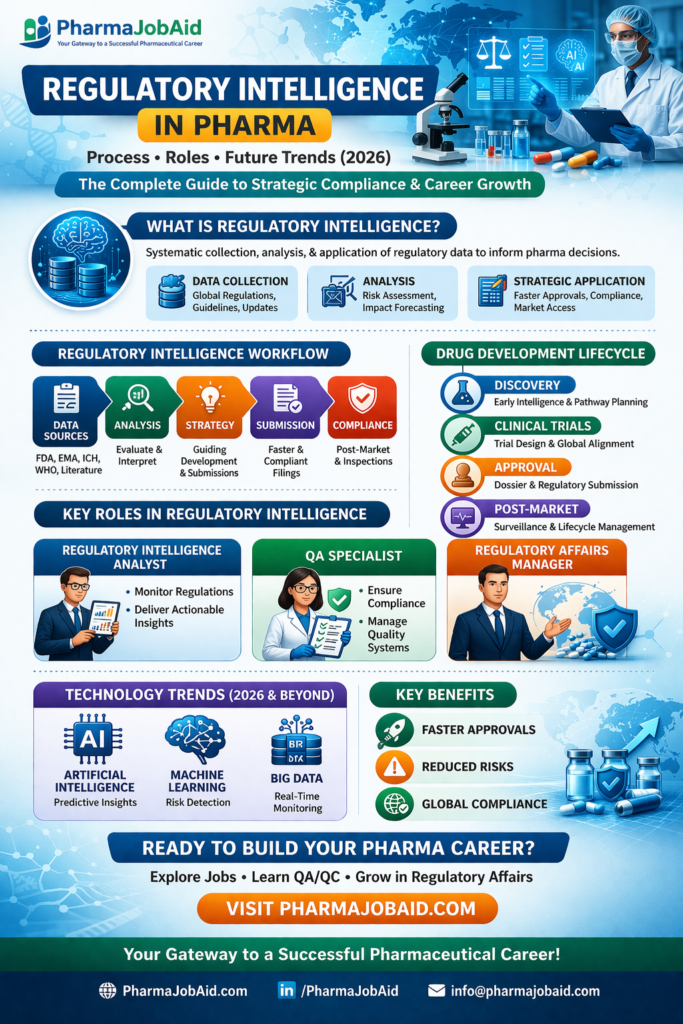
Chapter 4: Regulatory Intelligence in Drug Development
4.1 Discovery Phase
RI helps identify:
- Regulatory pathways
- Innovation opportunities
4.2 Preclinical Phase
Ensures compliance with:
- Toxicology requirements
- Safety guidelines
4.3 Clinical Trials
Supports:
- Trial design
- Regulatory approvals
- Global alignment
4.4 Submission and Approval
Improves:
- Dossier quality
- Approval timelines
4.5 Post-Marketing Surveillance
Monitors:
- Adverse events
- Compliance updates
Chapter 5: Technology in Regulatory Intelligence
5.1 Artificial Intelligence
AI enables:
- Automated monitoring
- Predictive analytics
5.2 Machine Learning
ML identifies patterns in regulatory data.
5.3 Big Data
Supports large-scale regulatory analysis.
5.4 Digital Platforms
Centralized systems improve efficiency.
Chapter 6: Regulatory Intelligence Strategy
6.1 Building an RI Framework
Key steps:
- Define objectives
- Identify data sources
- Implement tools
- Train teams
6.2 Organizational Integration
RI must collaborate with:
- QA
- QC
- Clinical teams
6.3 KPIs for RI
- Approval timelines
- Compliance rates
- Risk reduction
Chapter 7: Challenges in Regulatory Intelligence
- Rapid regulatory changes
- Data overload
- Lack of skilled professionals
- Integration difficulties
Chapter 8: Regulatory Intelligence in Bangladesh
Bangladesh’s pharmaceutical industry is growing rapidly, with increasing regulatory requirements.
RI helps companies:
- Meet export standards
- Comply with global regulations
- Expand into international markets
Chapter 9: Career Opportunities in Regulatory Intelligence
9.1 Job Roles
- Regulatory Intelligence Analyst
- Regulatory Affairs Manager
- Compliance Specialist
9.2 Skills Required
- Analytical thinking
- Regulatory knowledge
- Communication
👉 Start your pharma career: https://pharmajobaid.com/pharmaceutical-jobs/
Chapter 10: Future Trends (2026–2035)
- AI-driven regulatory prediction
- Global regulatory harmonization
- Digital transformation
- Real-time compliance systems
Chapter 11: Case Studies
Case Study 1: Faster Drug Approval Through RI
A company reduced approval time by 30% using regulatory intelligence.
Case Study 2: Avoiding Compliance Failure
RI helped identify regulatory risks early.
Chapter 12: Best Practices
- Continuous monitoring
- Cross-functional collaboration
- Technology adoption
- Training and development
Chapter 13: Internal Linking Strategy (SEO Boost)
Link to:
- QA in Pharma
- QC in Pharma
- Pharma Jobs
Chapter 14: External Linking Strategy
Link to:
- FDA
- EMA
- ICH
Chapter 15: Conclusion
Regulatory intelligence is the backbone of modern pharmaceutical success. It enables companies to navigate complexity, reduce risk, and accelerate innovation.
Final Call to Action
🚀 Build your pharma career with expert guidance: