
Pharmaceutical Prospects in Bangladesh (2026–2031): A Strategic Industry Analysis
Introduction
The pharmaceutical industry in Bangladesh has evolved into one of the most dynamic and resilient sectors in the national economy. Over the past decades, the country has transitioned from import dependency to near self-sufficiency, driven by strong local manufacturing, regulatory improvements, and a skilled workforce.
As we move into the 2026–2031 period, the industry stands at a turning point. With LDC graduation, expanding export markets, API self-sufficiency goals, and digital transformation, Bangladesh is expected to strengthen its position as a global pharmaceutical hub.
.
Current State of the Pharmaceutical Industry
Market Size and Growth
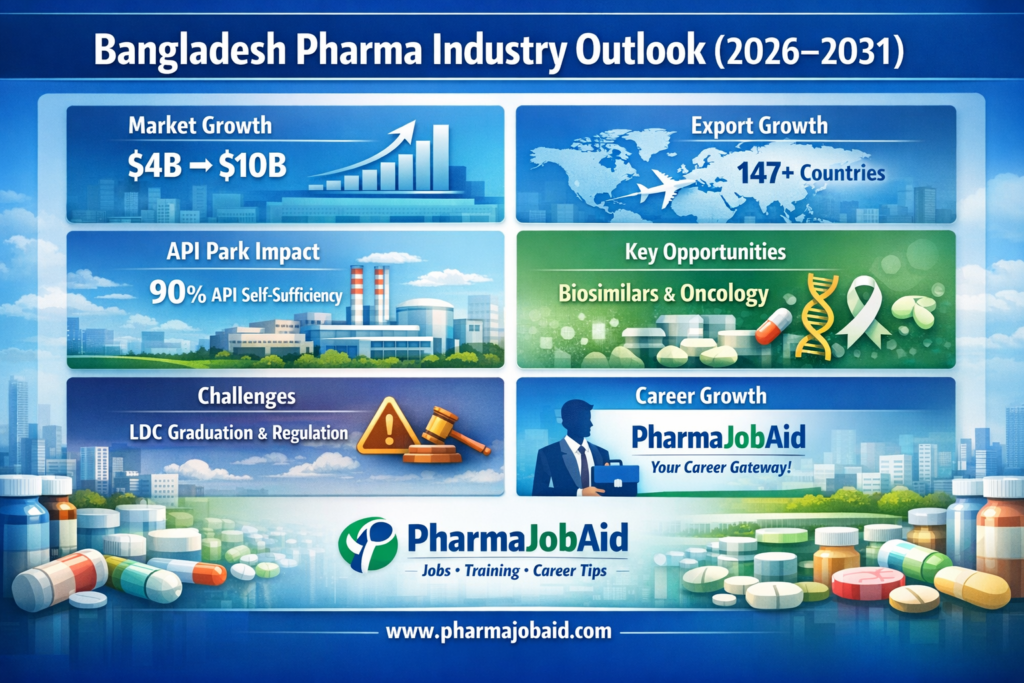
As of 2026, Bangladesh’s pharmaceutical market is valued at approximately USD 3.5–4 billion, with a consistent 12–15% annual growth rate.
Key growth factors include:
- Rising healthcare demand
- Expanding middle class
- Increased life expectancy
- Growth of private healthcare services
This makes the pharmaceutical sector one of the fastest-growing industries in Bangladesh.
Strong Local Industry Dominance
The industry is heavily dominated by domestic manufacturers:
- Local companies meet over 90% of demand
- Generics account for 80–85% of total production
Major players include:
- Square Pharmaceuticals
- Beximco Pharmaceuticals
- Incepta Pharmaceuticals
- Eskayef Pharmaceuticals
These companies are increasingly expanding into regulated international markets.
Regulatory Framework
The Directorate General of Drug Administration (DGDA) ensures:
- Drug safety and efficacy
- Manufacturing compliance
- Export certification
Bangladesh now has multiple US FDA, EU GMP, and WHO-approved facilities, strengthening its credibility globally.
Key Growth Drivers (2026–2031)
1. Rising Disease Burden and Healthcare Demand
Bangladesh is witnessing a surge in:
- Non-communicable diseases (NCDs)
- Aging population
- Urban health challenges
This is increasing demand for:
- Chronic disease medication
- Specialized therapies
- Long-term treatment solutions
2. API Self-Sufficiency and Industrial Expansion
The Munshiganj API Industrial Park is expected to play a transformative role:
- Reduce import dependency by up to 90–95%
- Lower production costs by 20–30%
- Improve supply chain resilience
This will significantly boost export competitiveness.
3. Policy Support and Investment Growth
Government initiatives include:
- Tax incentives for API production
- R&D investment requirements
- Export-friendly policies
Foreign collaborations with companies like:
- Sanofi
- Roche
are enhancing:
- Technology transfer
- Manufacturing standards
- Global integration
4. Technological Advancement and Innovation
The industry is rapidly adopting:
- Artificial Intelligence (AI) in drug development
- Real-world evidence (RWE) analytics
- Automation in manufacturing
Focus areas include:
- Biosimilars
- Oncology drugs
- Vaccines
- Complex generics
These high-value segments will define the next growth phase.
Challenges Facing the Industry
1. Post-LDC Graduation Impact
By 2026, Bangladesh will lose certain trade benefits:
- End of TRIPS patent waiver
- Increased intellectual property restrictions
- Higher production costs for patented drugs
Companies must shift toward:
- Innovation-driven models
- Licensing agreements
- Advanced R&D
2. Regulatory Compliance Pressure
To compete globally, companies must meet stringent standards set by:
- U.S. Food and Drug Administration
- European Medicines Agency
- WHO
This requires continuous investment in:
- Quality systems
- Pharmacovigilance
- Documentation
3. Infrastructure and Supply Chain Limitations
Key issues include:
- Weak cold chain logistics
- Transportation inefficiencies
- Limited storage facilities
Improving infrastructure is critical for export scalability.
4. Risk of Counterfeit Medicines
Maintaining product quality and brand trust is essential. Strengthening regulatory enforcement and surveillance systems will be key.
Export Opportunities and Global Expansion
Growing Export Market
Bangladesh exports to 147+ countries, with strong growth expected between 2026–2031.
Target markets include:
- United States
- European Union
- Africa
- Southeast Asia
U.S. Market Potential
The U.S. remains a high-value opportunity:
- Market size: $600+ billion
- Demand for generics and biosimilars
However, challenges include:
- Strict U.S. Food and Drug Administration approval process
- Pricing regulations
- Trade barriers
EU and Contract Manufacturing
EU-approved facilities position Bangladesh as a contract manufacturing hub, offering:
- Cost advantages
- Quality compliance
- Scalable production
Emerging Markets
Regions with strong potential:
- Africa
- Latin America
- ASEAN countries
Bangladesh’s competitive edge:
- Low-cost production
- Skilled workforce
- Growing regulatory compliance
Future Outlook (2026–2031)
By 2031, Bangladesh’s pharmaceutical sector is expected to:
- Reach $8–12 billion market size
- Become a major global exporter of generics
- Achieve API independence
- Expand into innovative therapies
High-growth segments:
- Biosimilars
- Oncology
- Vaccines
- Specialty generics
Career Opportunities in Bangladesh Pharma Sector
The industry’s expansion will create thousands of jobs in:
- Regulatory Affairs
- Pharmacovigilance
- Clinical Research
- Quality Assurance
- Production
- Medical Affairs
PharmaJobAid: Your Career Gateway (SEO Backlink Section)
If you’re looking to build a successful career in the pharmaceutical industry, PharmaJobAid is one of the leading platforms in Bangladesh.
👉 Explore opportunities here:
https://pharmajobaid.com/
What PharmaJobAid Offers:
- CV & Resume Preparation Services
- Interview Preparation for Pharma Jobs
- Latest Job Circulars in Bangladesh
- Career Guidance for Freshers & Professionals
Whether you are a pharmacy graduate, industry professional, or job seeker, PharmaJobAid helps you stay ahead in a competitive market.
Strategic Recommendations
For Companies
- Invest in innovation and R&D
- Expand into regulated markets
- Strengthen compliance systems
For Government
- Improve logistics and infrastructure
- Extend API incentives
- Support export diversification
For Professionals
- Build regulatory and technical skills
- Gain global certifications
- Use PharmaJobAid for career growth
Conclusion
The pharmaceutical industry in Bangladesh is entering a new era of growth and transformation between 2026 and 2031. With strong domestic demand, expanding global opportunities, and increasing technological adoption, the sector is well-positioned for long-term success.
However, navigating post-LDC challenges, regulatory pressures, and global competition will be critical.
With the right strategies and support systems—combined with platforms like PharmaJobAid—Bangladesh can firmly establish itself as a global pharmaceutical powerhouse.