
The U.S. Food and Drug Administration’s approval of Awiqli (insulin icodec-abae) marks one of the most significant innovations in diabetes management in recent years. Developed by Novo Nordisk, Awiqli is the first once-weekly basal insulin approved in the United States for adults with type 2 diabetes.
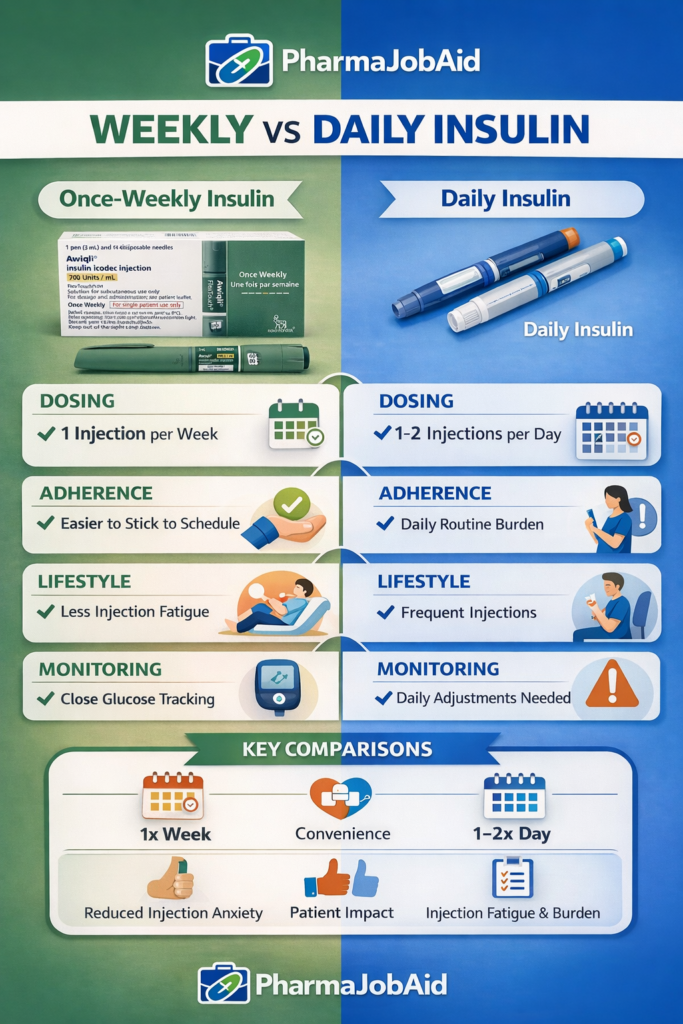
For decades, insulin therapy has relied on daily injections, which, while effective, often present challenges in adherence, patient convenience, and psychological acceptance. Awiqli introduces a paradigm shift—reducing injection frequency from 365 times per year to just 52—while maintaining comparable efficacy and safety.
This article explores the science, clinical evidence, regulatory perspective, and future implications of Awiqli, supported by peer-reviewed journal data and authoritative sources, tailored for PharmaJobAid readers and pharmaceutical professionals.
🧬 Understanding Basal Insulin and the Need for Innovation
Basal insulin plays a critical role in maintaining steady blood glucose levels throughout the day and night. Traditional basal insulins such as:
- insulin glargine
- insulin degludec
require once-daily administration, sometimes even twice daily depending on patient needs.
Key Challenges with Daily Insulin:
- ❌ Missed doses due to lifestyle or forgetfulness
- ❌ Injection fatigue and needle anxiety
- ❌ Delayed initiation of insulin therapy
- ❌ Reduced adherence leading to poor glycemic control
These barriers have been well documented in diabetes care literature. According to studies published in journals like Diabetes Care and The Lancet Diabetes & Endocrinology, non-adherence to insulin therapy is a major contributor to suboptimal outcomes.
Awiqli was developed to address these issues directly.
💉 What is Awiqli (Insulin Icodec)?
Awiqli contains insulin icodec, a novel ultra-long-acting insulin analogue engineered for once-weekly dosing.
Mechanism of Action:
- Strong reversible binding to albumin
- Slow and sustained insulin release
- Half-life exceeding 8 days
- Stable glucose-lowering effect across one week
📚 Journal Reference:
- Lau J. et al., The Lancet Diabetes & Endocrinology (2023) – Insulin icodec pharmacology
Administration:
- Injected subcutaneously via prefilled pen
- Given on the same day each week
- Dose titrated based on fasting glucose levels
⚠️ Safety Profile and FDA Label Considerations
Despite its convenience, Awiqli introduces new safety considerations due to its prolonged duration.
Key FDA Warnings:
- 🔍 Close monitoring required when switching from daily insulin
- ⚠️ Hypoglycemia remains the most common adverse event
- 🔄 Risk of dose mix-ups (weekly vs daily confusion)
- 📅 Strict adherence to weekly schedule is critical
Because of its long half-life, any dosing error may persist for several days, making patient education essential.
📚 Official Source:
- FDA prescribing information
- U.S. Food and Drug Administration approval summary
📊 Clinical Evidence: ONWARDS Phase 3 Trial Program
The FDA approval of Awiqli is based on the ONWARDS clinical trial program, one of the largest studies in insulin development, involving over 2,600 participants with type 2 diabetes.
📚 Primary Journal Publications:
- Rosenstock J. et al., New England Journal of Medicine (NEJM, 2023)
- Philis-Tsimikas A. et al., JAMA (2023)
- Bajaj HS. et al., The Lancet Diabetes & Endocrinology (2023)
📈 Glycemic Control and A1C Reduction
Across multiple trials, Awiqli demonstrated non-inferiority and sometimes superiority compared to daily basal insulin.
Key Findings:
- HbA1c reduction:
- Awiqli: up to –1.6%
- Insulin glargine: –1.4%
- Comparable performance vs insulin degludec
📚 Reference:
- Rosenstock J. et al., NEJM, 2023
👉 https://www.nejm.org/doi/full/10.1056/NEJMoa2303208
These results confirm that weekly insulin provides effective long-term glycemic control.
⏱️ Time in Range (TIR): A New Regulatory Milestone
Awiqli is among the first insulin therapies where Time in Range (70–180 mg/dL) is included in FDA labeling.
Trial Results:
- Basal insulin users:
- Awiqli: 62.3%
- Degludec: 59.9%
- Basal-bolus therapy:
- Awiqli: 66.8%
- Glargine: 66.5%
- Insulin-naïve patients:
- Awiqli: 71.9%
- Glargine: 66.9%
📚 Reference:
👉 https://diatribe.org/diabetes-medications/fda-approves-once-weekly-basal-insulin-awiqli-type-2
Why TIR Matters:
- Reflects real-world glucose control
- Reduces risk of complications
- Preferred metric in modern diabetes care
⚖️ Hypoglycemia Risk
Hypoglycemia remains a central concern in insulin therapy.
Findings:
- Low overall risk across all trials
- Slight increase in mild hypoglycemia with Awiqli
- Severe hypoglycemia: similar to daily insulin
📚 Reference:
- Bajaj HS. et al., Lancet Diabetes & Endocrinology (2023)
Interestingly, the use of digital dosing tools significantly reduced hypoglycemia risk.
🧪 Type 1 Diabetes: Why FDA Limited Approval
The FDA has not approved insulin icodec for type 1 diabetes, despite its study in this population.
Reason:
- Increased rates of hypoglycemia
- Safety concerns outweigh benefits
📚 Reference:
- Philis-Tsimikas A. et al., JAMA (2023)
However, other regulatory agencies globally have taken different approaches, approving it for broader use.
🌍 Global Regulatory Landscape
Awiqli has already been approved in:
- European Union
- Canada
- Japan
- China
- India
- Australia
This reflects growing global confidence in once-weekly insulin therapy.
👨⚕️ Patient-Centric Benefits
1. Improved Adherence
Weekly dosing significantly reduces the burden of treatment.
2. Reduced Injection Fatigue
Fewer injections improve patient comfort and acceptance.
3. Simplified Treatment Regimen
Ideal for patients struggling with daily routines.
4. Potential Reduction in Diabetes Stigma
Less frequent injections may improve quality of life.
📚 Reference:
- Polonsky WH et al., Diabetes Care – adherence challenges
🏥 Implications for the Pharmaceutical Industry
Awiqli represents more than a product—it signals a shift in drug development strategy.
Industry Impact:
🔬 R&D Innovation
- Focus on ultra-long-acting biologics
- Advanced protein engineering
📊 Regulatory Evolution
- Inclusion of TIR as an endpoint
- Patient-centered outcomes
💼 Market Dynamics
- New competition in insulin market
- Lifecycle management opportunities
📈 Digital Integration
- Dose titration apps
- Real-world data tracking
🇧🇩 Relevance for Bangladesh Pharma Industry
For Bangladesh, where diabetes prevalence is rapidly increasing, Awiqli offers important insights:
Opportunities:
- Local production of biosimilar long-acting insulin
- Expansion of diabetes care market
- Training of healthcare professionals
Challenges:
- Cost and accessibility
- Patient education
- Regulatory adaptation
Bangladesh’s pharmaceutical sector can leverage this innovation to strengthen its global competitiveness.
🔗 Key Journal References & Links
🧾 Peer-Reviewed Journals:
- Rosenstock J. et al. (2023) – NEJM
👉 https://www.nejm.org/doi/full/10.1056/NEJMoa2303208 - Bajaj HS. et al. (2023) – Lancet Diabetes & Endocrinology
👉 https://www.thelancet.com/journals/landia/article/PIIS2213-8587(23)00115-9 - Philis-Tsimikas A. et al. (2023) – JAMA
👉 https://jamanetwork.com/journals/jama/fullarticle/2807007
🏛️ Official & Clinical Sources:
- FDA Approval Summary
👉 https://www.fda.gov - Novo Nordisk Press Release
👉 https://www.prnewswire.com/news-releases/fda-approves-novo-nordisks-awiqli - Clinical Insights (diaTribe)
👉 https://diatribe.org
🔚 Conclusion
The approval of Awiqli marks a new era in insulin therapy, transforming how diabetes is managed globally. By combining clinical efficacy, improved adherence, and patient convenience, once-weekly insulin has the potential to redefine standard care.
However, its success will depend on:
- Proper patient selection
- Strong education programs
- Careful monitoring
As innovation continues, Awiqli sets the stage for a future where chronic disease treatment is simpler, smarter, and more patient-friendly.
🚀 PharmaJobAid Takeaway
Awiqli is not just a new drug—it is a strategic innovation model for the pharmaceutical industry. It highlights the importance of:
- Patient-centric design
- Long-acting drug delivery systems
- Integration of digital health
- Evidence-based regulatory evolution