
China’s AI Hospitals: Revolutionising Healthcare with Artificial Intelligence
The healthcare landscape is transforming faster than ever, and at the forefront of this revolution is China. The country is not only experimenting with AI in hospitals but has now launched the world’s first AI Agent Hospital. At this facility, artificial intelligence does much of the diagnostic and treatment work autonomously.
While science fiction often portrays fully robotic hospitals, the reality in China is more sophisticated and impactful. These hospitals integrate AI deeply into every aspect of care: from imaging and diagnostics to clinical decision-making, virtual patient consultations, and research.
This article explores what AI hospitals are, China’s leadership in the field, real-world examples (including the groundbreaking Tsinghua AI Agent Hospital), and the implications for global healthcare.
📌 What Is an AI Hospital?
An AI Hospital is not a facility devoid of human doctors. Instead, it is a hospital where artificial intelligence enhances clinical workflows, improves diagnostics, supports treatment decisions, and optimizes hospital operations.
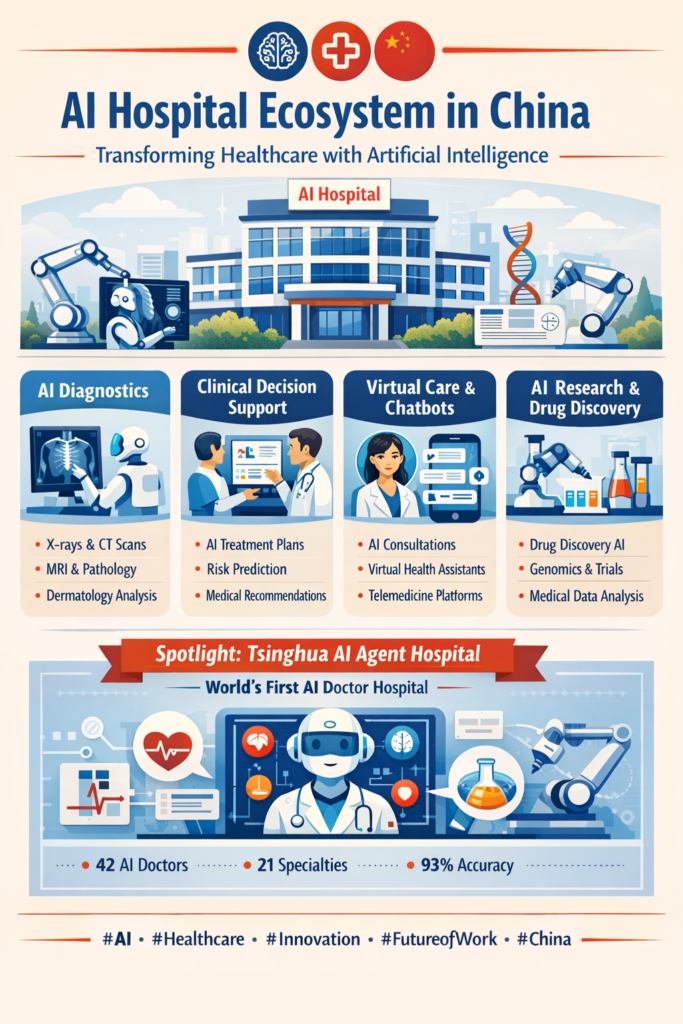
In China, AI hospitals encompass:
- AI-Powered Diagnostics: Deep learning algorithms analyze X-rays, CT scans, MRIs, pathology slides, and dermatology photos, often achieving high accuracy and speed.
- AI Clinical Decision Support: Tools provide recommendations and treatment plans to doctors.
- Virtual AI Doctors and Chatbots: AI agents perform initial patient triage and guide care pathways.
- AI in Hospital Logistics: Automated scheduling, resource allocation, and workflow optimization.
- AI in Research and Drug Discovery: AI accelerates clinical research, helps design therapies, and identifies patterns in patient populations.
The key takeaway: AI augments human clinicians, making healthcare faster, safer, and more accessible, rather than replacing doctors entirely.
🚀 Why China Leads in AI Hospital Development
Several factors have made China a global leader in AI hospitals:
🧠 Large Population & Data Availability
China’s massive population generates enormous amounts of clinical data—a critical resource for training AI models. More data equals better predictions, improved diagnostics, and scalable healthcare solutions.
💡 National AI Strategy
The government’s “Healthy China 2030” initiative explicitly supports AI integration in healthcare. Public funding, regulatory support, and innovation hubs drive research and adoption.
🤝 Collaboration Between Tech, Academia, and Government
China’s BATPs (Baidu, Alibaba, Tencent, Ping An) have heavily invested in healthcare AI.
Leading universities such as Tsinghua University and Zhejiang University conduct research, develop AI algorithms, and train talent.
Together, these institutions work with hospitals to create end-to-end AI healthcare systems.
🏥 Real Examples of AI Hospitals in China
China’s AI hospital ecosystem includes both physical facilities and digital health platforms.
1. AI-Powered Diagnostics in Hospitals
Deep learning algorithms are increasingly deployed to analyze medical imaging:
- X-rays, CT scans, MRI scans, and ultrasounds
- Detect abnormalities such as tumors, fractures, or lesions
- Aid radiologists in improving accuracy and reducing turnaround time
Hospitals across China have reported significant improvements in both speed and diagnostic precision.
2. Clinical Decision Support Tools
AI helps clinicians develop treatment plans, predict patient risk, and even monitor recovery.
- Predicting complications after surgery
- Recommending personalized therapies
- Offering real-time guidance during procedures
Rather than replacing clinicians, AI acts as a highly skilled second opinion.
3. Virtual AI Triage and Consultation Platforms
China’s leading online healthcare platforms, including Ping An Good Doctor and WeDoctor, have built virtual front doors for healthcare:
- Patients interact with AI-powered chatbots for initial evaluation
- AI triages cases and refers patients to partner hospitals if needed
- Reduces strain on physical hospitals and improves access to care
4. Digital Human Hospital Concepts
China is also exploring “digital human” hospital models, where AI systems train on simulated patients before deployment. These environments accelerate research and optimize AI agents’ learning in controlled scenarios.
🌟 5. World’s First AI Agent Hospital: Tsinghua University Leads the Way
In April 2025, China achieved a historic milestone: the launch of the world’s first AI Agent Hospital by Tsinghua University’s Institute for AI.
Unlike previous AI applications, this hospital operates autonomous AI doctors across multiple specialties, handling cases with minimal human intervention.
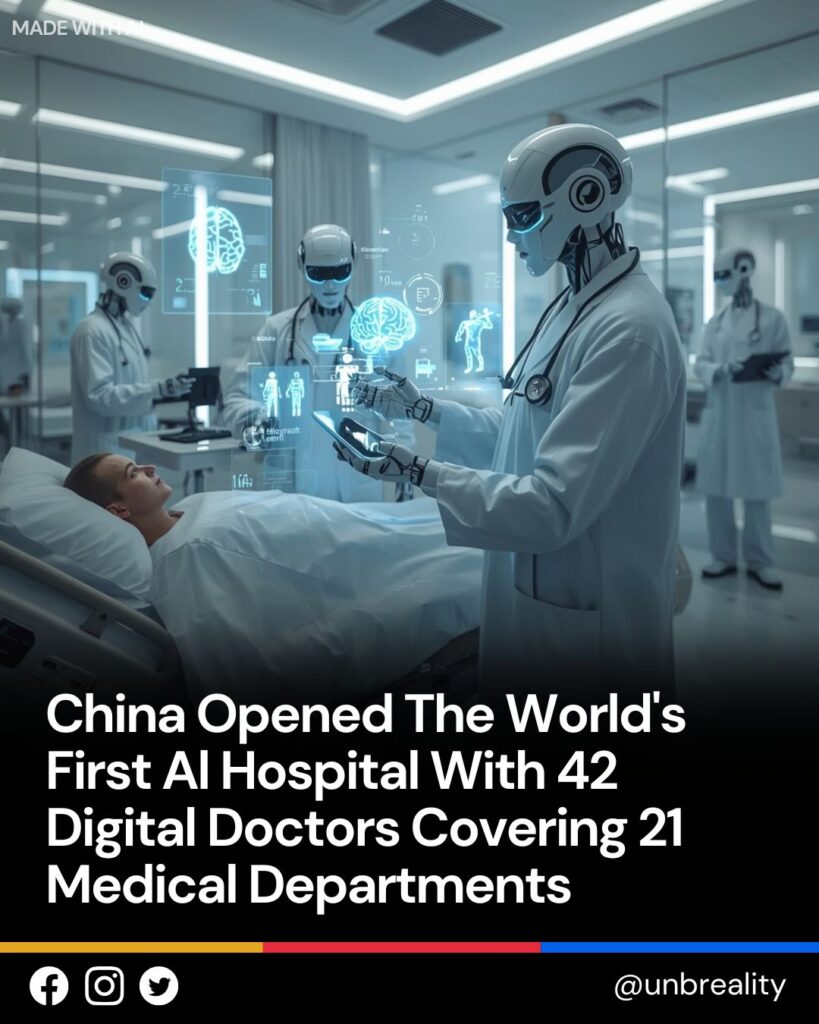
Key Highlights:
- 42 AI doctors covering 21 specialties, from cardiology to neurology
- Autonomous diagnosis, treatment planning, and follow-up
- Over 10,000 cases diagnosed in days during pilot testing
- 93.06% accuracy on the U.S. MedQA licensing benchmark
- Used to train medical students in real-world clinical scenarios
💡 Why this is groundbreaking: Every interaction feeds back into the AI system, creating data gravity. Unlike human clinicians who accumulate experience slowly, AI agents compound knowledge across millions of interactions instantly, continually improving quality and outcomes.
China has set a global benchmark, but the real race isn’t about building the first AI hospital—it’s about creating the healthcare brain the world will rely on.
Discussion Prompt:
👉 Would you trust an AI doctor with your diagnosis?
Hashtags for Social & SEO Engagement:
#AI #Healthcare #Innovation #FutureOfWork #China
🤝 Who Is Driving AI Hospital Innovation?
China’s AI hospital ecosystem is a triad of government, tech, and academia:
🏛 Government Leadership
- Policies under Healthy China 2030 encourage AI adoption
- Funding research labs and innovation hubs
- Developing regulatory frameworks for AI safety and ethics
💼 Tech Giants
- Baidu: Imaging and natural language processing AI
- Alibaba Cloud: Healthcare infrastructure and analytics
- Tencent AI Lab: Diagnostics, telemedicine, and virtual care
- Ping An Good Doctor: AI-driven triage and online consultations
🎓 Academic Institutions
Universities such as Tsinghua and Zhejiang conduct cutting-edge research, train talent, and collaborate with hospitals for pilot AI programs.
⚙️ How AI Hospitals Work: Infrastructure & Workflow
AI hospitals rely on three critical pillars:
1. Data Infrastructure
- Electronic Health Records (EHRs), imaging, lab results, and genomics
- Standardization and anonymization ensure high-quality training datasets
2. AI Model Training & Validation
- AI models are trained on massive clinical datasets
- Validated against expert clinician reviews
- Updated continuously for real-world performance
3. Clinical Integration
- AI outputs are integrated into doctor workflows
- Virtual triage systems connect with patient portals
- Alerts and suggestions support clinicians without replacing them
📈 Real-World Impact
✅ Faster Diagnostics
- AI-assisted imaging reduces turnaround from hours to minutes
- Critical in emergency care
✅ Improved Accuracy
- Reduces diagnostic errors
- Enhances detection of subtle diseases like early-stage cancers
✅ Increased Access
- Virtual AI consultations expand care in rural or underserved areas
✅ Operational Efficiency
- AI scheduling and logistics reduce wait times
- Optimizes hospital resource allocation
⚠️ Challenges and Considerations
🧑⚖️ Regulation and Ethics
- Ensuring AI safety and transparency is essential
- Patient data privacy must be maintained
📉 Bias and Data Limitations
- AI models may reflect biases in training datasets
- Requires diverse and representative data
🤖 Human-AI Collaboration
- Doctors must adapt to AI integration
- Training and change management are critical
🌍 Global Implications
China’s AI hospital experience has worldwide relevance:
- Shared research and standards can guide global AI healthcare policies
- Exportable AI platforms may assist hospitals internationally
- Virtual triage and AI diagnostics could reshape care delivery everywhere
China’s AI hospitals demonstrate that the future of healthcare is data-driven, scalable, and accessible, transcending geography and resources.
👉 Explore AI healthcare resources at PharmaJobAid: https://pharmajobaid.com/
📌 Conclusion
China is at the vanguard of AI hospitals, combining technology, data, and clinical expertise to deliver faster, more accurate, and more equitable healthcare.
Key takeaways:
- AI hospitals augment clinicians rather than replace them
- Real-world deployments span imaging, diagnostics, virtual care, and AI-driven research
- The Tsinghua AI Agent Hospital marks a historic milestone in autonomous healthcare
- Challenges remain, including ethics, regulation, and training
- The global future of AI hospitals depends on governance and data integration
China’s leadership sets a benchmark for the next era of healthcare, where AI systems continuously learn, improve, and extend the reach of human expertise.
Discussion Prompt for Readers:
👉 Would you trust an AI doctor with your diagnosis?
Hashtags:
#AI #Healthcare #Innovation #FutureOfWork #China